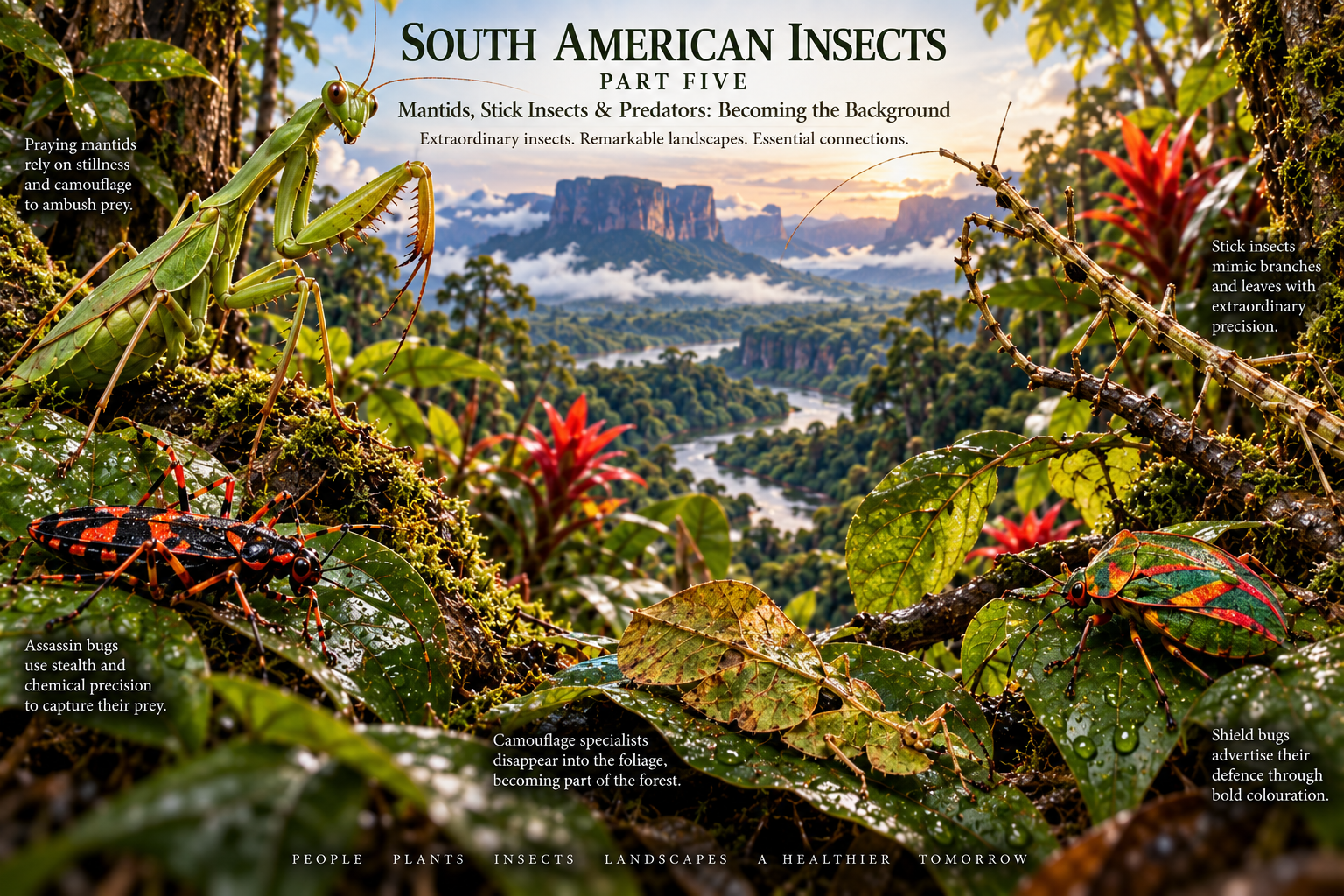
| A 5-Part Series |
| A curated exploration of South America’s most iconic, curious, and ecologically important insects |
| Part Five — Mantids, Stick Insects & Predators: Becoming the Background |
| There is something rather extraordinary about an insect that can remain directly in front of us without being noticed. We tend to associate survival with speed, strength, or the ability to escape danger, yet throughout South America’s forests, grasslands, and tropical vegetation, countless insects have developed an altogether quieter strategy. They survive by resembling their surroundings so convincingly that predators struggle to recognise them as living creatures. A twig may possess legs, a leaf may suddenly move, and what appears to be a harmless patch of vegetation can conceal a remarkably efficient hunter. South America provides an extraordinary setting for these adaptations. Its tropical forests contain dense layers of foliage, tangled branches, shifting light and an almost bewildering variety of potential hiding places. Yet concealment matters just as much beyond the rainforest, where dry vegetation, grasslands, and scrub offer very different backgrounds against which insects must avoid detection. Camouflage is not simply a matter of possessing the correct colour. Shape, texture, posture and behaviour all contribute, and an insect that blends perfectly into one setting may become conspicuous in another. For a gardener, the principle is familiar. We have probably all examined a plant closely, convinced nothing unusual was present, only to discover an insect that had been there all along. Sometimes it moves and gives itself away; occasionally we notice the outline of a leg or antenna that does not quite belong to the vegetation. These moments remind us that the insects we see represent only a fraction of those actually sharing our gardens. In South America, where the variety of potential disguises is remarkable, the distinction between looking and noticing becomes especially important. Praying mantids and the advantage of patience Praying mantids are among the most accomplished ambush predators in the insect world. Their triangular heads, prominent eyes and specialised front legs are immediately recognisable, although their appearance varies considerably between species. Some resemble leaves, others blend into bark or grasses, and certain South American mantids possess flattened bodies or irregular outlines that make them difficult to distinguish from surrounding vegetation. Their hunting strategy often depends upon remaining motionless until suitable prey approaches. Rather than continuously searching for food, a mantis may wait among foliage, relying upon camouflage to avoid detection before striking with extraordinary speed. Its powerful front legs have spines that help secure captured insects, while its flexible head and well-developed vision let it assess nearby movement. This approach is economical. Pursuing prey consumes energy and exposes a hunter to its own dangers, whereas remaining concealed allows opportunities to develop without constant movement. Yet mantids are not entirely passive. Some stalk prey carefully, adjusting their position and posture before making a final attack. Others sway gently, a behaviour that may help them resemble vegetation in the breeze or aid visual assessment. It is tempting to describe mantids as beneficial insects because they consume other insects, but that is only part of the picture. A mantis does not distinguish between a caterpillar damaging a valued plant and a pollinator visiting its flowers. Both may become prey if they are suitable and within reach. Their ecological importance lies in their role as predators within a wider food web, rather than in any particular service they provide to gardeners. That distinction matters because nature rarely divides its inhabitants into the convenient categories we prefer. A predator is not necessarily a gardener’s ally in every encounter, just as a plant-feeding insect is not automatically an enemy. Stick insects and the extraordinary art of resemblance. Stick insects take concealment in a different direction. Rather than disguising themselves primarily as leaves or patches of foliage, many resemble the branches and twigs upon which they rest. Their elongated bodies, slender legs and carefully controlled posture can make them remarkably difficult to identify, particularly when surrounded by vegetation of similar shape and colour. South America supports a diverse range of stick insects, including species that achieve impressive lengths. Some are green and resemble fresh stems, while others possess brown, irregular bodies that imitate dry twigs or rough bark. Their success depends upon more than appearance alone. Many remain motionless for extended periods, particularly during daylight, and some move with a gentle rocking motion that resembles vegetation disturbed by air currents. The effect can be astonishing. An insect several inches long might seem impossible to overlook, yet its shape can become so completely integrated into the surrounding branches that our eyes pass over it. We are accustomed to recognising animals through familiar outlines, and stick insects exploit that expectation by presenting a form our brains interpret as vegetation. Many feed upon leaves and are themselves prey for birds, reptiles, spiders and other predators. Their camouflage therefore protects them rather than helping them hunt. Some species possess additional defensive adaptations, including spines, startling displays or the ability to release defensive substances when threatened. This offers a useful lesson in how we observe wildlife. We often look for movement because it draws our attention. Stick insects show that staying still can be as important as escaping quickly, especially in habitats where a predator’s first challenge is recognising that prey is present at all. Leaf mimicry without being a leaf insect Among the most remarkable disguises found in South American insects are those that resemble living or damaged foliage. Certain mantids, katydids and other insects possess body shapes and markings that imitate leaves with extraordinary accuracy. Some display irregular edges, vein-like patterns or patches resembling discolouration, helping them merge into vegetation that is itself rarely perfect. However, it is important to distinguish these South American specialists from the true leaf insects of the family Phylliidae, which are principally associated with Asia, Australasia, and surrounding Old World regions. South America has developed its own extraordinary examples of leaf mimicry through other insect groups, demonstrating how similar solutions can evolve independently. This is particularly apparent among some tropical katydids. Their broad wings can resemble leaves so convincingly that even the fine details appear consistent with surrounding vegetation. In certain species, the imitation extends to markings resembling fungal damage or areas where a leaf has begun to deteriorate. Such imperfections may actually improve the disguise. A perfectly uniform green shape can stand out among real foliage, where leaves are continually affected by feeding insects, weather, age and disease. Mimicking nature’s irregularities can therefore be more effective than resembling an idealised leaf. The relationship between camouflage and background is also important. An insect that closely matches fresh foliage may be less effectively concealed when resting among dry vegetation. Behaviour, habitat selection and the ability to remain motionless all contribute to whether the disguise succeeds. For gardeners, this offers a rather different way of looking at plants. We are accustomed to noticing leaf damage as something requiring attention, yet in natural habitats those irregularities also form part of the visual environment. Insects have evolved not only to resemble plants, but sometimes to resemble the imperfections upon them. Assassin bugs and concealed precision Assassin bugs introduce a more active form of deception. These predatory true bugs are found throughout South America, occupying vegetation, bark, leaf litter and numerous other habitats. Many rely upon stealth, approaching prey slowly or waiting until another insect comes within reach. Their principal hunting equipment is a specialised piercing mouthpart, or rostrum, used to penetrate prey and introduce saliva containing substances that immobilise the victim and begin breaking down its tissues. They can then consume the resulting liquid material. This is a highly effective feeding method, although it is more accurate to describe the process as extra-oral digestion than to imagine prey being instantly dissolved. Some assassin bugs possess additional adaptations that make them especially difficult to detect. Certain species camouflage themselves with dust, debris or material collected from their surroundings, while others use body shape and colour to blend into vegetation. The result is a predator that can remain concealed not simply by resembling a plant, but by disguising its identity beneath material from the environment itself. Assassin bugs also demonstrate why broad insect names require a little care. The family Reduviidae includes many predatory species, but also the blood-feeding kissing bugs associated with the transmission of Chagas disease in parts of the Americas. These insects occupy a very different ecological role from the familiar predators hunting other invertebrates among foliage. Understanding such distinctions is important. A group may contain insects with very different feeding habits, relationships and consequences for people, even when they share aspects of their anatomy. Shield bugs and the decision to be noticed. Not every insect survives by disappearing. Shield bugs take the opposite approach, with many species relying on chemical defences that make them unpleasant or difficult for predators to consume. Their distinctive bodies are familiar to gardeners, although South America supports a particularly varied community of shield bugs and related true bugs. Some are green or brown and blend into vegetation, while others display bold combinations of red, orange, yellow and black. In certain species, conspicuous colouration can act as a warning signal. Predators that have experienced an unpleasant encounter may learn to avoid similarly marked insects, reducing the likelihood of repeated attacks. Chemical substances released from defensive glands provide another layer of protection, sometimes producing the characteristic odour associated with stink bugs. This approach contrasts with mantids and stick insects. Concealment reduces the chance of being discovered, whereas warning colouration can reduce the chance of being attacked after discovery. Both strategies have advantages, depending upon the insect’s biology, habitat and the predators it encounters. Not all shield bugs possess equally effective chemical defences, and not every bright colour should automatically be interpreted as a warning. Some species are primarily plant feeders, while others are predators. Their diversity once again challenges the assumption that appearance alone can tell us everything about an insect’s ecological role. What makes them particularly interesting is that survival does not always require escape. Sometimes the most effective defence is persuading a predator that an attack would not be worthwhile. The importance of remaining unnoticed Camouflage is often described as though it were a permanent characteristic, something an insect possesses simply because its body resembles a leaf, twig or patch of bark. In reality, concealment is a relationship between the insect, its surroundings and the visual abilities of whatever might be searching for it. Light changes throughout the day. Leaves grow, age and fall. Vegetation moves in the wind, and the background against which an insect rests may alter dramatically between seasons. A disguise that works well in one position may fail a short distance away. This is why behaviour matters as much as appearance. Remaining motionless, choosing suitable resting places and moving at appropriate times can all influence survival. No camouflage is perfect, and even highly specialised insects remain vulnerable to predators that can detect movement, scent, or other clues. For gardeners, these relationships offer another reason to value structural diversity. Dense planting, shrubs, grasses, leaf litter and undisturbed stems provide places where insects can shelter, feed and reproduce. A garden need not be completely overgrown to offer such opportunities, but one in which every surface is exposed and every fallen leaf removed may provide surprisingly little protection. Practical limits exist, of course. Gardens must remain usable, plants sometimes require pruning, and certain insects can cause genuine damage. Supporting wildlife does not mean abandoning management. It means recognising that shelter and complexity have ecological value alongside neatness and appearance. A small area left comparatively undisturbed can support relationships that would otherwise be lost. Becoming part of the landscape South America’s mantids, stick insects, assassin bugs and shield bugs demonstrate an extraordinary range of responses to the same fundamental challenge: surviving long enough to reproduce in environments filled with predators, competitors and changing conditions. Some become almost indistinguishable from vegetation. Others conceal themselves beneath debris, remain motionless until prey approaches or advertise chemical defences through conspicuous markings. None of these strategies guarantees survival, but each represents an adaptation refined through countless generations of interaction with the surrounding environment. What interests me most is how easily these insects challenge our assumptions about the natural world. We tend to admire creatures that are conspicuous, fast or physically impressive, yet some of the most successful adaptations depend upon doing almost nothing that attracts attention. A stick insect may go unnoticed all afternoon. A mantis can wait among foliage while other insects pass nearby. An assassin bug may move so carefully that its prey fails to recognise the approaching danger. Their lives are not uneventful simply because much of their activity escapes our attention. This brings us rather neatly to the conclusion of our South American Insects series. Across these five episodes, we have encountered ants cultivating fungus, bees connecting flowers, butterflies communicating through colour, beetles recycling organic matter and grasshoppers responding to the changing availability of vegetation. We have listened to the rhythms of crickets and considered the uncelebrated work of forest cockroaches. Now we finish with insects whose greatest achievement may be their ability to remain unseen. Together, they reveal a continent where extraordinary biodiversity is sustained not simply by the number of species present, but by the relationships between them. Pollination, decomposition, herbivory, predation and concealment are all part of the same continuing process. For a gardener, the lesson is both familiar and worth repeating. We do not need to understand or manage every relationship in a living landscape. Much of nature’s work happens quietly, beyond our immediate attention, and sometimes our most useful contribution is to provide enough habitat for those relationships to continue. The more closely we examine the natural world, the more we discover that being visible is not necessarily the same as being important. And in South America’s forests, some of the most remarkable insects are those we might walk straight past without ever knowing they were there. |
| Wander through the Article Directory and see where curiosity takes you next. |
| About our writing & imagery Most articles reflect our real gardening experience and reflection. Some use AI in drafting or research, but never for voice or authority. Featured images may show our photos, original AI-generated visuals or, where stated, credited images shared by others. All content is shaped and edited by Earthly Comforts, expressing our own views. |

