| Episode 001 |
| Them! (1954) The Giant Ants That Terrorised Atomic-Age America |
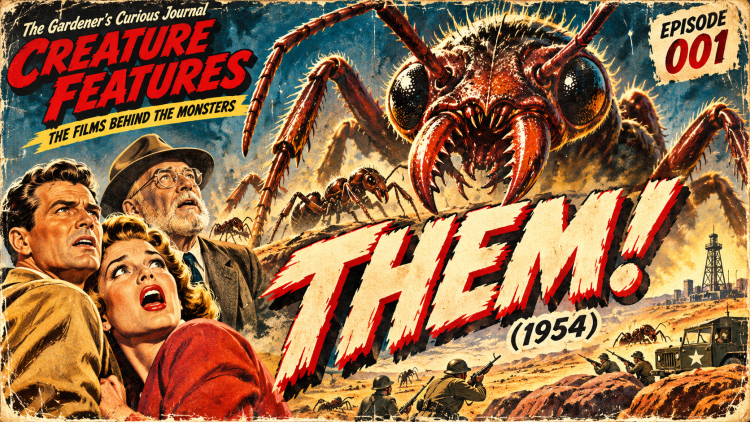
| Sometimes in cinema, humanity finds itself threatened by something so extraordinarily improbable that one wonders how the filmmakers ever persuaded anyone to take the idea seriously. Giant ants marching across the American desert might sound like one of those occasions, yet Them!, released in 1954, remains one of the most effective creature-feature films ever produced. It is atmospheric, surprisingly intelligent and considerably more frightening than its enormous mechanical insects might suggest. Directed by Gordon Douglas for Warner Bros., the film emerged during an era when atomic radiation had become Hollywood’s favourite explanation for practically every unnatural occurrence imaginable. Nuclear testing, scientific uncertainty and the possibility of humanity accidentally engineering its own destruction provided fertile ground for filmmakers. In Them!, those anxieties take the form of a particularly unwelcome development in the insect world. Something Is Moving in the Desert The story begins in the New Mexico desert, where police discover a young girl wandering alone, apparently traumatised and unable to explain what has happened. Nearby, a family trailer has been destroyed, and subsequent investigations reveal a series of increasingly disturbing incidents. State policeman Ben Peterson, played by James Whitmore, soon finds himself involved in a mystery that ordinary police procedures are spectacularly ill-equipped to solve. Enter Dr Harold Medford, an eccentric but knowledgeable entomologist played by Edmund Gwenn, accompanied by his daughter, Dr Pat Medford, portrayed by Joan Weldon. Their investigation reveals that atomic testing has produced an extraordinary mutation: ants of gigantic proportions, equipped with formidable mandibles and an unfortunate willingness to regard human beings as potential victims. What follows is a race to prevent the creatures from establishing new colonies, potentially transforming a local emergency into a worldwide catastrophe. The film wisely avoids revealing too much too soon. Its early scenes rely on unsettling sounds, mysterious destruction and the reactions of frightened witnesses. By the time the enormous ants finally appear, the audience has plenty of reasons to fear them. Building a Monster Without a Computer One of the most interesting aspects of Them! is the practical ingenuity behind its creatures. The giant ants were constructed as large mechanical props, operated through a combination of internal mechanisms and external controls. Their movements can occasionally seem deliberate, but the production makes effective use of lighting, camera angles, and sound to give them an intimidating presence. The creatures’ distinctive high-pitched calls are especially memorable. Rather than relying entirely on visual spectacle, the filmmakers use sound to suggest danger before the monsters appear. Gordon Douglas also deserves credit for treating the material seriously. The actors rarely behave as though they are participating in a ridiculous monster picture, and that commitment helps make the extraordinary premise believable within the film’s world. The climax, involving an underground search through Los Angeles storm drains, demonstrates how effectively a relatively straightforward monster story can generate suspense through confined spaces and the threat of an unseen enemy. The Creature Behind the Monster Although Them! presents its enormous insects as mutated ants, the film does not establish a reliable modern species identification for its fictional monsters. Their appearance is broadly recognisable as that of ants, with exaggerated mandibles, segmented bodies and prominent antennae, but identifying a particular species as the filmmakers’ definitive model would require supporting production evidence. Real ants belong to the family Formicidae and are among the most successful social insects on Earth. Their colonies can contain thousands or even millions of individuals, depending on the species, with workers performing specialised tasks including foraging, nest construction, brood care and defence. Communication is particularly important. Ants use chemical signals called pheromones to organise activities, mark trails and warn colony members of danger. Some species also communicate through vibrations and physical contact. In this respect, the coordinated behaviour of the fictional ants is not entirely fanciful. The extraordinary efficiency of real ant colonies provides a convincing biological foundation for imagining what might happen if their members suddenly became enormous. However, their gigantic size presents considerable scientific difficulties. Insects breathe primarily through a system of air-filled tubes called tracheae, while their external skeletons impose structural limitations. Simply enlarging an ordinary ant to the dimensions depicted in Them! would create serious problems involving respiration, body support and movement. Radiation would not conveniently overcome those difficulties, regardless of Hollywood’s enthusiasm for the idea. The film also draws an intriguing distinction between its aggressive monsters and ordinary ant behaviour. Real ants generally defend their colonies, compete for resources and respond to threats rather than deliberately plotting the destruction of humanity. Nevertheless, some species possess powerful mandibles, painful stings and remarkably effective collective defensive strategies. Fortunately, none requires the intervention of the United States Army. A Monster Movie That Still Matters What makes Them! particularly successful is its understanding that suspense depends upon more than the size of the monster. Its opening mystery, convincing performances and gradual escalation create an atmosphere that many later creature features struggled to reproduce. The film also helped establish a formula that would become familiar throughout the 1950s: scientific experimentation produces an unnatural threat, authorities initially struggle to understand the danger, and humanity must combine scientific knowledge with military force to survive. Yet Them! remains considerably better than many of its imitators. The ants may be mechanical, the science is decidedly questionable, and certain moments reflect the conventions of their time, but the film still entertains. It respects its audience sufficiently to build a genuine mystery before unleashing its monsters. For our opening episode, it provides an almost perfect introduction to the strange and wonderful world of creature-feature cinema. After all, if an ordinary ant can threaten civilisation, imagine what Hollywood might do with a grasshopper. Creature Features verdict: A genuine atomic-age classic, combining intelligent suspense, memorable monsters and wonderfully imaginative filmmaking. One film. One creature. One monstrous adventure. |
| Now Showing — The Original Theatrical Trailer Step back into the cinema of 1954 and experience how Them! was originally promoted to audiences. Long before internet advertising and digital effects, theatrical trailers relied upon dramatic narration, sensational imagery and the promise of something audiences had never witnessed before. Watch the original theatrical trailer for Them! (1954) below. |
| A Future Hollywood Legend Among the Ants One particularly entertaining detail is the appearance of a young Clint Eastwood, then at the very beginning of his screen career. Playing an uncredited laboratory technician, Eastwood makes a brief appearance during the scientific investigation, long before audiences would associate him with western gunfighters, Inspector Harry Callahan or his distinguished directing career. It is one of those delightful moments in cinema history when a future superstar turns up in the most unexpected surroundings. Before becoming the Man with No Name, Eastwood had already encountered something considerably more troublesome than an outlaw: giant radioactive ants. |
| Editorial research note The film’s history has been checked against the American Film Institute, the British Film Institute and Turner Classic Movies. One particularly interesting discovery is that Them! was originally planned in colour and 3D, before being released in black and white. Its giant ant models were operated using elaborate mechanical arrangements. |
| More Monsters Await! Creature Features — The First Twenty Films Our opening collection contains twenty extraordinary encounters with cinema’s most memorable monsters. Discover the other nineteen adventures awaiting exploration. |
| 001 — Them (1954) 002 — The Lost World (1925) 003 — Tarantula (1955) 004 — The Birds (1963) 005 — King Kong (1933) 006 — The Deadly Mantis (1957) 007 — Jaws (1975) 008 — The Black Scorpion (1957) 009 — Razorback (1984) 010 — Beginning of the End (1957) |
| 011 — Phase IV (1974) 012 — Alligator (1980) 013 — Kingdom of the Spiders (1977) 014 — Tremors (1990) 015 — The Food of the Gods (1976) 016 — Mimic (1997) 017 — Piranha (1978) 018 — Black Sheep (2006) 019 — The Host (2006) 020 — Crawl (2019) |
| Wander through the Article Directory and see where curiosity takes you next. |
| About our writing & imagery Most articles reflect our real gardening experience and reflection. Some use AI in drafting or research, but never for voice or authority. Featured images may show our photos, original AI-generated visuals, or, where stated, credited images shared by others. All content is shaped and edited by Earthly Comforts, expressing our own views. |


Excellent write up, Rory, and how interesting that Clint Eastwood made an appearance in this movie.
LikeLiked by 1 person
Hey Eugenia, thank you – yes a lot of the old actors showed up in the strangest of films 🙂
LikeLiked by 1 person
Most welcome, Rory.
LikeLiked by 1 person