| Part Five 1978: Comedy, Horror and the Films That Stayed With Me |
| By 1978, I was fifteen years old, back in Britain after spending much of my childhood in Australia, and becoming increasingly interested in the world of cinema. Books, comics and magazines were still a major part of my life, as was my enthusiasm for collecting and cataloguing things. Still, films were beginning to occupy an increasingly important place alongside them. Music was another developing interest, and looking back at the productions released in 1978, it is remarkable how many reflected the period’s changing tastes and popular culture. What makes this particular year so interesting is its variety. It included enormously successful musicals, groundbreaking horror films, powerful war dramas, irreverent comedies, and ambitious literary adaptations. Some remain favourites today, while others were enjoyable at the time but have perhaps lost something over the intervening decades. I have seen all thirty films in our original selection, along with several others worth mentioning, although I watched many years after their initial release. As with this series, AI helped assemble the film selections and provide a starting point for discussion, but the memories, opinions, preferences, and personal choices are entirely my own. |
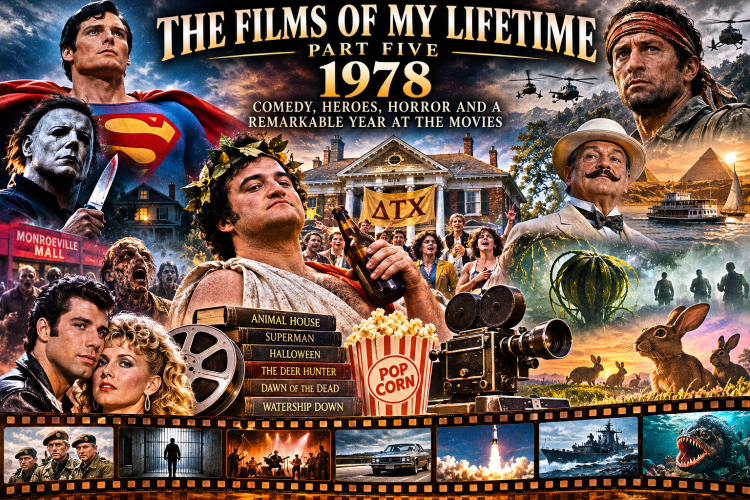
| A House Full of Laughter Of all the comedies associated with 1978, National Lampoon’s Animal House occupies a particularly special place in my memories. I first watched it at the cinema in 1980, when I was seventeen, accompanied by a group of friends. It was outrageous, irreverent and thoroughly entertaining, and I enjoyed it enormously. John Belushi was terrific, but the appeal extended well beyond one performer. The entire production had a wonderfully anarchic quality, and it introduced a sort of humour that could be gloriously ridiculous without taking itself particularly seriously. I went on to watch Animal House several more times, although it must now be around fifteen years since I last saw it. I greatly admired the earlier National Lampoon films and enjoyed the particular brand of comedy associated with that period. Belushi was one of those performers whose energy could dominate a scene, while Dan Aykroyd became another favourite through films such as The Blues Brothers, 1941 and Dragnet. There was something enormously appealing about these actors and the comedies they helped create, and their work became an important part of my film watching. Another comedy I remember with considerable affection is Who Is Killing the Great Chefs of Europe?, also known as Too Many Chefs. Featuring Jacqueline Bisset, George Segal and Robert Morley, it combined a wonderfully eccentric mystery with some excellent comic performances. I thought it was an absolute cracker of a film, and it remains one of my favourites from the year. Bisset had already made quite an impression on me in The Deep, while Morley was one of those marvellous character actors who could bring something memorable to almost any production. Comedy was well represented elsewhere, too. Foul Play, starring Goldie Hawn and Chevy Chase, was a terrific comedy thriller, and both performers became firm favourites whose later careers I followed with enthusiasm. I enjoyed Hawn in films such as Private Benjamin, Bird on a Wire, Death Becomes Her, and The First Wives Club, and I also became a great admirer of Kurt Russell, particularly in Overboard, where he appeared alongside her. Chevy Chase was another actor whose films I enjoyed following, and his particular style of comedy suited me enormously. The Cheap Detective was another enjoyable spoof, with Peter Falk demonstrating the sort of comic timing that made him such a wonderful performer. I was also a tremendous admirer of Falk as Lieutenant Columbo, a character whose apparently absent-minded manner concealed a remarkably sharp intelligence. California Suite, meanwhile, offered an excellent collection of interconnected stories supported by a cast of major stars. I have only watched it once, but the way the stories fitted together was particularly appealing. Not every comedy has remained quite so memorable. Heaven Can Wait was enjoyable enough at the time, although it was never a genuine favourite, and I suspect it might feel rather dated if I watched it again today. Every Which Way but Loose, with Clint Eastwood and Clyde the orangutan, was another film I enjoyed for what it was, along with its sequel, Any Which Way You Can. They were entertaining productions of their time, even if they don’t necessarily occupy the same place in my affections today. Horror Finds New Ways to Frighten Us If comedy was one of the great pleasures of 1978, horror was another, and two of my five favourite films from the year belong firmly within the genre. John Carpenter’s Halloween genuinely terrified me when I first saw it. The masked figure of Michael Myers was frightening enough, but what made the film particularly effective was the extraordinary use of music. Carpenter’s score created a constant unease, turning ordinary scenes into moments of almost unbearable suspense. The film was filled with the sort of tension that could make an audience jump even when very little was actually happening on screen. Donald Pleasence was excellent as Dr Sam Loomis, bringing urgency and credibility to the increasingly frightening events. I have always enjoyed horror films that understand the importance of atmosphere, and Halloween demonstrated how much could be achieved through careful direction, music and anticipation. I felt similarly about the first two Friday the 13th films, which would arrive a little later. Those early productions captured something that became increasingly difficult to reproduce as the slasher genre expanded into long-running franchises. George A. Romero’s Dawn of the Dead was another favourite, although my feelings about the original and its later remake are rather different. I enjoyed both, but I actually prefer the 2004 version. That may surprise those who consider Romero’s original untouchable, but I’ve never believed that the first version of a film must automatically be the best. Sometimes a remake captures the essential idea while presenting it in a way that appeals more strongly to me, and Dawn of the Dead is a good example. Zombies have long been one of my favourite subjects in horror, alongside cannibal stories and the genre’s more psychologically disturbing side. Romero’s film helped establish the modern zombie film as something much more ambitious than a simple monster story, using an apparently ordinary shopping centre as the setting for an increasingly desperate struggle for survival. The later remake took a different approach, with faster-moving creatures and a more relentless sense of danger, and I found that version particularly effective. Another remake that worked exceptionally well for me was Invasion of the Body Snatchers. I enjoyed the 1956 original, but I preferred the 1978 adaptation starring Donald Sutherland. Its unsettling atmosphere and growing paranoia were brilliantly handled, and the film demonstrated how science fiction and horror could work together without relying entirely on elaborate special effects. I have always enjoyed stories in which apparently familiar surroundings gradually become threatening, and this was one of the finest examples. Magic, starring Anthony Hopkins, was frightening in a rather different way. Its story of a ventriloquist and his increasingly disturbing relationship with a dummy was unsettling, but what interested me most was the imagination behind its creation. Having enjoyed writing horror stories myself, I could appreciate the mind behind such an unusual psychological premise. The horror lay not simply in the dummy’s appearance but in the ideas and behaviour surrounding it. The Fury, Brian De Palma’s supernatural thriller, was enjoyable enough, although I preferred his earlier adaptation of Stephen King’s Carrie. Then there was Piranha, which arrived in the wake of Jaws’ enormous success. Of the many films attempting to capitalise on that success, I thought Piranha was one of the better efforts. It wasn’t a brilliant film, but it had a certain novelty, combining creature horror with enough humour and invention to make it entertaining. The War Films That Left Their Mark The war films of 1978 were another particularly strong group, and none made a greater impression on me than The Deer Hunter. It was a fabulously sad film, and one I haven’t watched for many years, but certain scenes have remained firmly lodged in my memory. What made it so powerful was not simply its depiction of the Vietnam War, but the way it established the lives and relationships of its characters before showing how profoundly those lives changed. The close-knit community at the beginning of the film was especially important. The friendships, celebrations and ordinary routines gave the characters a sense of belonging, making the consequences of war all the more devastating. Robert De Niro, Christopher Walken, John Savage, Meryl Streep and the rest of the cast delivered extraordinary performances, and the infamous Russian roulette sequences were almost unbearably tense. Those scenes stayed with me for years, much as certain moments from The Killing Fields and Gorillas in the Mist would later do. I have always appreciated films that leave such a lasting impression, even when watching them is uncomfortable. The Deer Hunter was not something I would put on for an easy evening’s entertainment, but it was an extraordinary achievement. The ending, the characters, and the sense of loss stayed with me long after the film ended, and it deserves its place among my five favourites from 1978. Coming Home, another film dealing with the consequences of the Vietnam War, was also a worthwhile production, featuring Jane Fonda, Jon Voight and Bruce Dern. However, for me, nothing compared with The Deer Hunter. Both explored difficult subjects, but the latter made a much stronger impression. The Boys in Company C was another excellent Vietnam War film, and it reminded me of the later Hamburger Hill, which would become another particular favourite. I enjoyed the performances and the depiction of soldiers dealing with the realities of war, and it belonged to a group of films that approached military conflict from a much grittier perspective than the traditional wartime adventures. That didn’t mean I had lost my enthusiasm for those older-style adventure films. The Wild Geese, with Richard Burton, Richard Harris, Roger Moore and Hardy Krüger, was thoroughly enjoyable, and I appreciated it as much as A Bridge Too Far and Force 10 from Navarone. The performances made the stories believable, and I became increasingly aware of the different acting styles of the performers I admired. By this stage, I was already developing something like a mental catalogue of actors, remembering their faces, voices, performances and the other productions in which they had appeared. A strong cast could draw me to a film almost regardless of its subject, and I often found that the actors made the biggest difference in whether a story succeeded. Force 10 from Navarone was another excellent adventure, with an impressive cast, and I enjoyed both it and the earlier The Guns of Navarone. What made these large-scale productions so entertaining was how they brought together performers whose work I already knew. They offered a different experience from the realism and emotional weight of The Deer Hunter, but I could appreciate both approaches. Actors First, Stories Second One of the clearest takeaways from revisiting these films is how much actors shape my enjoyment of cinema. If I had to describe my priorities, I’d say performances come first, followed by the plot, then the action. A brilliant action sequence can be spectacular, but without convincing characters and good acting, it rarely leaves the same impression. Capricorn One was an excellent example. Its conspiracy storyline was fascinating, but it was the performers, including Elliott Gould and James Brolin, who made the film particularly enjoyable for me. The plot and action were important, certainly, but the cast brought the story to life. The Boys from Brazil was another remarkable production, with Gregory Peck, Laurence Olivier, James Mason, and a young Steve Guttenberg in the cast. Its disturbing premise stayed with me, and pairing such established performers with an unsettling thriller made it particularly memorable. Guttenberg would later become familiar through Police Academy and Cocoon, providing another of those connections between films that I have always enjoyed discovering. I also liked Robert Mitchum’s interpretation of Philip Marlowe in The Big Sleep, preferring it to Humphrey Bogart’s earlier portrayal, although I had seen and enjoyed both versions. The Driver, starring Ryan O’Neal and Bruce Dern, was another worthwhile thriller. I have always appreciated Dern’s ability to bring a slightly rougher, character-driven quality to his roles, although the film didn’t quite reach the heights of car-chase classics such as Bullitt or Gone in 60 Seconds. Convoy, starring Kris Kristofferson, Ali MacGraw and Ernest Borgnine, was entertaining enough but never became a particular favourite. Midnight Express, on the other hand, was a powerful and disturbing prison drama that I enjoyed but have only watched once. Some productions are so intense that a single viewing is sufficient, even when the performances and storytelling are excellent. Books, Music and the Wider World My love of reading continued to influence the films I watched, and 1978 offered several excellent adaptations. Watership Down was one of them. I had read Richard Adams’s novel and watched the animated film, but I preferred the book. The story was far darker and more complex than its animated-adventure appearance suggested, and the novel had a depth I felt the film couldn’t fully capture. The Lord of the Rings was another important literary connection. I had read Tolkien’s books long before watching their adaptations and remained a great admirer of his fictional world. I enjoyed the later film franchise, including The Hobbit, and the stories have continued to interest me over the years. Once again, the books came first, with cinema offering another way to experience characters and places I already knew. Agatha Christie was another author whose work had become familiar, and Death on the Nile offered another opportunity to enjoy Hercule Poirot. I have always admired the character and enjoyed the various screen adaptations, although Peter Ustinov remains my preferred interpretation. The film’s remarkable ensemble cast was another attraction, and the combination of a good mystery with familiar performers made it thoroughly entertaining. I also enjoyed the different adaptations of The 39 Steps, including the versions associated with Alfred Hitchcock, Kenneth More and Robert Powell. It is fascinating to see how different directors and performers approach the same underlying story, sometimes remaining faithful to the source and sometimes taking considerable liberties. As someone who enjoyed reading the books behind films, I always found those comparisons part of the pleasure. Music was also becoming increasingly important in my life. Grease, starring John Travolta and Olivia Newton-John, was one of the great coming-of-age musicals of the period, and I enjoyed it enormously. The Buddy Holly Story was another enjoyable production, with Gary Busey giving an excellent performance. I have always thought Busey was rather underrated as an actor, and he was particularly convincing in that role. Looking back, the films of this period were introducing me to performers and musical styles that would remain familiar for decades. Sometimes a film led me toward an actor, sometimes toward an author, and sometimes toward music I might not otherwise have discovered. The connections between these interests were becoming increasingly numerous, and I enjoyed following them wherever they led. A Few More Worth Remembering Several films outside our original thirty deserve a place in this year’s memories. Jaws 2 was a very good sequel to my all-time favourite film, and although I watched the remaining instalments in the franchise, I didn’t enjoy them nearly as much. The original Jaws remains in a class of its own, but the second film was a worthwhile continuation of the story. Hooper, starring Burt Reynolds and Sally Field, was another fabulous film, combining action, humour and an affectionate look at the world of stunt performers. Reynolds was one of those actors whose work I followed enthusiastically, and his natural comic ability made him particularly enjoyable in lighter productions. Revenge of the Pink Panther was another excellent comedy, with Peter Sellers once again demonstrating why I enjoyed his performances so much. These additions remind us that any selection of thirty films is only a starting point. This series isn’t meant to create a definitive catalogue of every release, but to explore the films that have stayed with me, including those that might not appear on conventional lists of the year’s greatest productions. |
| Five Films That Define My 1978 Choosing five favourites from 1978 was particularly difficult. I enjoyed so many films, and several others could easily have made the list. In the end, however, five stood out for different reasons, and together they give a fairly accurate picture of my tastes then and in the years that followed. My five favourite films of 1978, in no particular order, are: National Lampoon’s Animal House — An outrageous comedy, John Belushi, and the memory of watching it at the cinema with friends in 1980. Who Is Killing the Great Chefs of Europe? (Too Many Chefs) — A wonderfully entertaining comedy mystery with Jacqueline Bisset, George Segal and Robert Morley. The Deer Hunter — An extraordinarily powerful and deeply affecting film about friendship, community and the devastating consequences of war. Dawn of the Dead — A landmark zombie horror film that helped establish one of my favourite branches of the genre, even though I prefer the later remake. Halloween — A terrifying, brilliantly atmospheric horror film whose music, suspense, and central villain made an unforgettable impression. There is no particular ranking here. I wouldn’t necessarily choose to watch The Deer Hunter on the same evening as Animal House, nor would I expect the two films to provide anything remotely similar. That is precisely what makes the selection interesting. One offers laughter, another profound sadness, and two explore very different kinds of horror. They are favourites for different reasons, and I see no reason they should compete. |
| Looking Back at 1978 If 1977 was the year my interest in cinema began developing more deliberately, 1978 showed just how broad that interest could become. I was equally happy watching a comedy, a war film, a thriller or a horror production, provided the story and performances held my attention. I was beginning to recognise actors not simply as familiar faces but as individual performers with distinctive styles, and I increasingly enjoyed following their work from one production to another. I was also learning that films didn’t necessarily retain the same appeal throughout life. Some productions were wonderful when first encountered but seemed less impressive years later, while others became increasingly enjoyable with repeated viewings. A few were unforgettable, but I didn’t particularly want to revisit them. There was no simple formula, and I don’t think there ever has been. What remained constant was my appetite for stories and the people who brought them to life. The books, comics, and magazines I had collected as a youngster were still important, but cinema offered another enormous world to explore. I didn’t need every film to be a masterpiece, and I certainly didn’t need to agree with the critics. I wanted to be entertained, surprised, frightened, amused or occasionally moved by something extraordinary. By the end of 1978, I had another remarkable collection of films to discover and remember, although many would not reach me until much later. The habit of mentally cataloguing actors, stories and performances was becoming increasingly established, and the years ahead would provide more than enough material to keep it growing. And so we move towards 1979, with another extraordinary assortment of films waiting to be explored. By then, cinema was changing rapidly, and so were the stories it was prepared to tell. |
| About our writing & imagery The Films of My Lifetime reflects Rory’s personal memories, experiences, and opinions of cinema. AI may assist with research, drafting, editing, and creating film-inspired illustrations, but all recollections and editorial decisions are Rory’s own. AI-generated images are artistic interpretations, not original film photography or posters. All content is reviewed by Earthly Comforts before publication. |

