
| Episode 8 The Great Departure! |
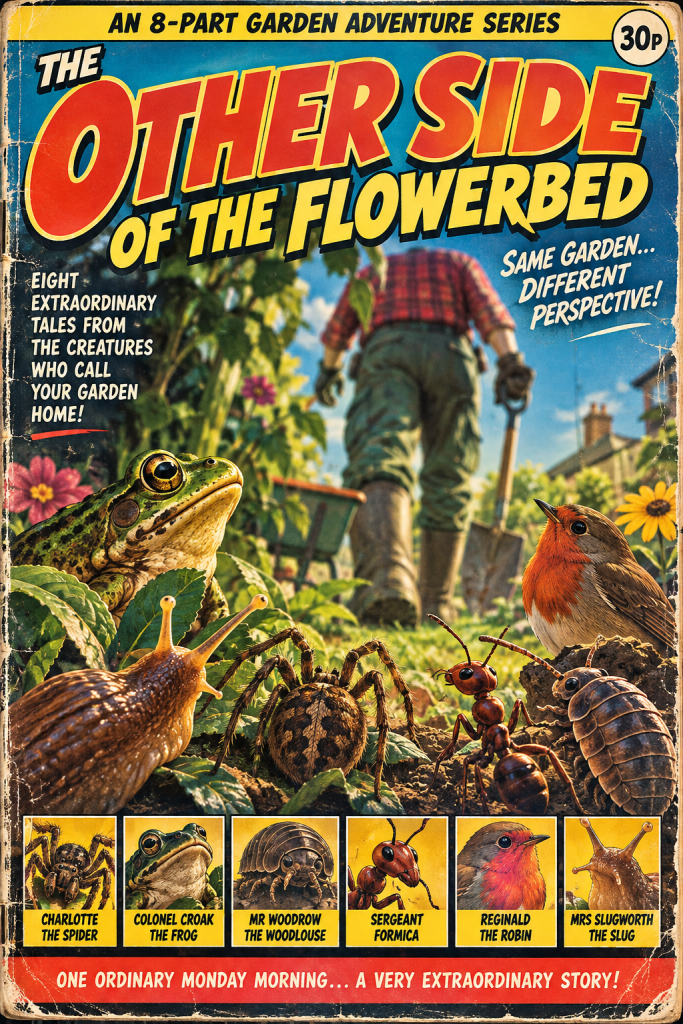
| Even during the most extraordinary disturbance, a moment comes when the world begins to settle, the immediate dangers seem to have passed, and those who spent the preceding hours worrying about survival can finally consider what happened. In the garden, that moment arrived with the unmistakable sound of the Giant gathering its equipment. The enormous creature had spent much of the morning moving through the borders, disturbing the soil, trimming vegetation and rearranging objects that had occupied their previous positions for longer than many of the garden’s inhabitants could remember. Now, apparently satisfied with its activities, it was collecting its tools, consolidating the contents of its green waste container and preparing to depart. To the Giant, the morning had been entirely ordinary. He had arrived at eight o’clock, completed the maintenance work scheduled for the visit and was preparing to leave at eleven, having spent three productive hours improving a garden that would inevitably require further attention the following week. The borders were tidier, the hostas had been relieved of their damaged foliage, the shrubs had received some necessary pruning, and the collection of flowerpots beside the shed had been rearranged into a more satisfactory position. He had also added compost to an area of tired soil and removed a quantity of unwanted vegetation that might otherwise have continued competing with the established plants. It was, he considered, a reasonable morning’s work. For the inhabitants of the garden, however, the same three hours had constituted a succession of disasters, emergencies, territorial disputes and near-catastrophic encounters with a creature whose motivations remained entirely incomprehensible. Homes had been disturbed, familiar landmarks altered and established routines interrupted with an apparent disregard for the welfare of those who depended upon them. The fact that most of these disturbances had been temporary, and that the garden remained perfectly habitable afterwards, did little to diminish the sense of outrage felt by certain residents. Colonel Croak was the first to recognise that the Giant’s activities were drawing to a close. From his headquarters beneath the hostas, he had been keeping a cautious watch on the enormous creature, noting its movements and trying to determine whether the latest changes in behaviour represented a genuine withdrawal or merely a tactical deception. The gathering of tools suggested the former, although the Colonel was not prepared to declare victory until the creature had passed beyond the garden boundary. “Movement towards the western exit,” he announced, addressing a nearby beetle who had stopped to investigate a patch of damp soil. “Enemy forces appear to be disengaging. Maintain observation until withdrawal is confirmed.” The beetle looked towards the Giant, then back at the Colonel. “Isn’t he just going home?” The Colonel regarded the suggestion with the weary patience of an experienced commander explaining military affairs to someone with limited strategic imagination. He pointed out that the Giant had entered the garden carrying formidable equipment, interfered with several established positions and subsequently withdrawn after encountering what he described as determined local resistance. The beetle listened politely, although it could not recall witnessing any resistance beyond the Colonel making a particularly impressive leap from beneath a hosta leaf. Nevertheless, the frog’s confidence was infectious, and word began spreading that the Giant was finally leaving. Near the lavender, Charlotte was completing the outer framework of her replacement web. The morning’s events had left her exhausted and deeply dissatisfied, although she had to admit that the new structure was developing rather well. The altered arrangement of branches provided several useful attachment points, and the slightly more sheltered position protected her from the stronger air movements that had occasionally troubled her previous construction. She had already secured a small insect in the outer strands and was beginning to feel that her architectural reputation might survive the incident after all. When she heard that the Giant was preparing to depart, Charlotte paused to examine the surrounding shrubs. Several branches had been shortened, the dead material had been removed, and the overall arrangement was noticeably more open than before. She remained offended by how they had made these changes, especially the complete lack of consultation. Still, she could not entirely deny that the new conditions offered certain practical advantages. This was an uncomfortable admission for a spider who had spent much of the morning denouncing the destruction of her property. “I suppose,” she murmured, carefully adjusting a supporting strand, “that one could describe the outcome as a partial improvement, provided one ignores the appalling methods employed to achieve it.” A small beetle passing beneath her web suggested that the Giant might have been trying to improve the garden all along. Charlotte regarded this observation with suspicion, explaining that good intentions were no substitute for proper planning and that any creature capable of removing structural supports without warning should be regarded as fundamentally unsuitable for architectural work. She returned to her web, determined not to forget the matter. Beneath the relocated flowerpot, Mr Woodrow was experiencing a similarly complicated mixture of satisfaction and indignation. The Under-Pot Residents’ Association had survived its unexpected relocation, and the new accommodation was proving considerably more satisfactory than several members had anticipated. The soil beneath the container was pleasantly damp, the entrances were convenient, and the surrounding vegetation offered additional shelter. Several residents had already begun exploring the new surroundings, while others were settling into comfortable positions among the fragments of decaying organic material. Mrs Crumble, who had maintained throughout the emergency that the simplest solution was to find somewhere suitable and get on with living, was particularly pleased with the arrangement. She had discovered a sheltered corner containing an excellent accumulation of damp leaf litter. She had no intention of allowing the chairman’s administrative concerns to interfere with her enjoyment of it. Mr Woodrow, however, remained troubled by the precedent established. The Giant had relocated an entire residential community without notice, approval or any apparent understanding that the property was occupied. The fact that the resulting accommodation was perfectly satisfactory did not, in his opinion, excuse the complete absence of procedure. He had therefore decided to establish a permanent relocation review committee. “We must ensure,” he announced to the assembled residents, “that the events of this morning are properly documented, thoroughly investigated and subjected to a comprehensive review of existing residential safeguards. We cannot simply accept that an enormous outside authority may move our homes whenever it considers such action convenient.” Mrs Crumble listened from her comfortable corner before observing that the Giant had already gone to considerable trouble to put the pot somewhere rather nice. She suggested that the association might usefully spend the remainder of the day enjoying its new accommodation rather than discussing the circumstances under which it had arrived there. Mr Woodrow regarded this as a dangerously casual attitude towards residential governance. “The issue is not whether the new premises are satisfactory, Mrs Crumble. The issue is whether the relocation was conducted according to an acceptable administrative framework.” Mrs Crumble considered this for a moment, then quietly withdrew farther beneath the leaf litter, where the chairman’s voice became pleasantly muffled. Elsewhere, Sergeant Formica was conducting a final inspection of the colony’s restored transport network. The enormous compost sack that had obstructed the principal supply route was gone, the original chemical trail had been re-established, and workers were once again moving supplies between the underground chambers and the surrounding feeding areas. The temporary diversion remained faintly detectable, but its importance was diminishing as workers increasingly returned to the shorter, more efficient route. The Sergeant considered the morning a useful demonstration of the colony’s resilience. Despite a major obstruction, unexpected soil disturbances, and several interruptions caused by the Giant’s activities, the workforce had adapted, maintained operations, and restored normal service without significant loss of resources. He was particularly pleased that the colony had continued functioning despite the considerable difficulties Private Derek presented. Unfortunately, Derek was still presenting difficulties. The private had been instructed to return a small fragment of leaf to the colony, a task that should have required only a straightforward journey along an established route. Instead, he had become distracted by the fading diversion trail, followed it around the former obstruction and eventually returned to the same point from which he had departed. Sergeant Formica found him standing beside a small stone, apparently trying to determine whether he had reached his destination. “Derek,” the Sergeant said with an air of profound resignation, “why are you still here?” The private turned towards him, visibly relieved to encounter somebody familiar. He explained that he had followed the route as instructed, but the route had apparently changed, and he was now uncertain whether he was approaching headquarters or leaving it. Formica examined the surrounding soil, identified the familiar colony entrance only a short distance away, and briefly considered whether an ant could become permanently lost within sight of its own home. “Headquarters is over there,” he replied, pointing towards the entrance. “Walk directly towards it, report to the entrance supervisor and do not stop to investigate anything. I shall be following behind you, and if you turn in the wrong direction, I shall personally escort you the remainder of the way.” Derek nodded enthusiastically and set off, carrying his leaf fragment with renewed determination. The Sergeant watched him negotiate the final stretch of pathway and disappear into the entrance without further incident. This achievement produced a satisfaction entirely disproportionate to the task’s difficulty. For a brief moment, everything seemed to be under control. Then Derek’s voice emerged faintly from the tunnel, enquiring whether the fragment of leaf should be delivered to the food stores or the construction stores. Sergeant Formica closed his eyes and decided that the question could wait until after he had enjoyed several moments of silence. Beneath the shrubs, Mrs Slugworth was preparing for an altogether different undertaking. Her forced relocation from the hosta district had left her deeply dissatisfied. Although the shaded soil beneath her new shelter was comfortable enough, she remained determined to return to the plants that had provided her with such excellent accommodation and dining opportunities. The Giant’s departure was therefore welcome news. Mrs Slugworth extended her eye stalks from beneath a fallen leaf and examined the surrounding garden. The enormous creature moved toward the gate, carrying the last of its equipment, and the vibrations that had disturbed her morning gradually diminished. The hostas remained visible through the vegetation, their surviving leaves presenting an enticing prospect for the evening ahead. She had already considered the journey in considerable detail. The route would take her beneath a low-growing shrub, across a narrow patch of exposed soil and eventually into the shelter of the remaining hosta foliage. She intended to wait until the light faded and the air cooled, so she could travel under conditions better suited to a creature dependent on moisture. It would not be a particularly rapid expedition, but Mrs Slugworth had never believed that speed was an essential component of a successful life. She was far more interested in comfort, food and the satisfaction of returning to a place from which she had been removed without permission. “Let him think he’s won,” she murmured, settling back beneath her leaf. “By the time he returns, I’ll have eaten half the neighbourhood.” The remark was not intended as a threat so much as a statement of personal ambition, although had the Giant been capable of hearing it, he might have considered taking a closer look at the hostas during his next visit. Above the garden, Reginald was enjoying an entirely different emotional experience. The robin had spent the morning following the Giant’s activities with the enthusiasm of a creature attending a particularly successful banquet. Freshly disturbed soil had provided a succession of feeding opportunities, and the gardener’s movements through the borders had exposed worms, small insects and other invertebrates that would otherwise have remained hidden. Reginald had enjoyed himself enormously, and the prospect of the Giant’s departure filled him with a mild but genuine sense of disappointment. He watched from the fence as the enormous creature gathered its remaining equipment, occasionally tilting his head to inspect the ground for any final opportunities. Several promising patches of soil remained to investigate, but the main event was clearly drawing to a close. The Giant noticed him and paused. “Well, you’ve done all right today, haven’t you?” he remarked. Reginald responded with an enthusiastic burst of song, which he considered an entirely appropriate expression of appreciation. The Giant smiled, adjusted the equipment he was carrying and continued towards the gate. From beneath the hostas, Colonel Croak observed the exchange with mounting irritation. “Disgraceful,” he muttered. “Absolutely disgraceful. The enemy is withdrawing, and that feathered idiot is giving him a farewell performance.” The Colonel had been preparing to announce the successful conclusion of the morning’s defensive operations. Still, he now found himself distracted by the extraordinary spectacle of a garden resident apparently celebrating the very creature responsible for so much disruption. Reginald, meanwhile, remained entirely untroubled by the Colonel’s opinion. He had long ago accepted that the frog possessed a fundamentally pessimistic outlook, and there seemed little point in attempting to persuade him that the Giant’s visits could be beneficial. The gardener reached the gate, set down the last of his equipment, and turned for one final look at the garden. The lawn stretched neatly between the borders, the shrubs were tidier, the hostas had been relieved of their damaged foliage, and the flowerpots beside the shed stood in their new arrangement. The compost had been spread, the weeds removed and the green waste collected. It was a pleasant enough garden, and with regular attention it would continue developing into an attractive, healthy space. He was satisfied with the morning’s work. “Right,” he said quietly. “That’ll do.” Then he stepped through the gate and closed it behind him. For several moments, the garden remained unusually still. The distant sounds of the Giant’s departure faded beyond the boundary, and the vibrations that had accompanied his movements finally ceased. A light breeze stirred the leaves, a blackbird called from somewhere beyond the fence, and the familiar activity of the smaller inhabitants gradually resumed. To a human observer, nothing particularly remarkable had occurred. A gardener had completed a routine maintenance visit and gone on to his next appointment. To the garden’s residents, however, the silence represented something approaching liberation. Colonel Croak emerged from beneath his hosta and surveyed the surroundings with the solemn satisfaction of a commander inspecting a battlefield after a successful engagement. He noted that the Giant had withdrawn, the principal defensive positions remained occupied, and the community had survived despite the considerable disruption inflicted upon its familiar surroundings. The Colonel decided that the moment warranted a formal declaration. “Residents of the garden,” he announced, addressing anyone within hearing distance, “I am pleased to report that the enemy has been successfully repelled. Despite overwhelming superiority in size and equipment, the Giant has been forced to abandon its operations and withdraw beyond our borders.” Charlotte, finishing the final adjustments to her web, paused to listen. Mr Woodrow emerged briefly from beneath his flowerpot, while Sergeant Formica halted long enough to hear the announcement before returning to his duties. Mrs Slugworth extended her eye stalks from beneath the shrub, and Reginald settled upon a nearby branch with an expression of cheerful curiosity. The Colonel continued, explaining that the garden’s survival was a testament to vigilance, determination and the effectiveness of carefully considered defensive arrangements. He made particular reference to his own successful manoeuvre beneath the hostas, describing it as a decisive action that had prevented further incursions into the eastern sector. Charlotte regarded him thoughtfully. “Colonel, didn’t the Giant simply move away after you jumped out from beneath the leaf?” The frog stiffened. “A tactical withdrawal, Charlotte. There is a considerable difference.” Mr Woodrow cleared his throat and observed that the morning had demonstrated the urgent need for formal agreements governing the treatment of established residential properties. He suggested establishing a garden-wide committee to consider the matter, with representatives from each major residential district. Sergeant Formica immediately objected, pointing out that the ant colony already possessed an efficient system of organisation and had no intention of diverting workers from essential duties to attend meetings about matters over which they possessed no practical control. Mrs Slugworth, meanwhile, declared that the entire discussion overlooked the morning’s most serious issue: the unacceptable interference with her hosta accommodation and the removal of several perfectly edible leaves. Charlotte reminded her that her own home had been destroyed outright. At the same time, Mr Woodrow insisted that relocating an entire residential community was far more significant than losing a few leaves. The discussion quickly became an argument. Colonel Croak tried to restore order, but his efforts faltered because nobody had appointed him to command anything, and several residents began to question whether his repeated declarations of victory served any useful purpose. Reginald watched the exchange with growing amusement. From his perspective, the garden had endured a busy but entirely successful morning. The Giant had improved the borders, exposed an abundance of food and departed without causing serious harm to any of the principal residents. The complaints were understandable, perhaps, but he could not help feeling that everyone was overlooking the most important point. They were all still there. Charlotte had a new web, Mr Woodrow’s association had a comfortable new home, Sergeant Formica’s transport routes were functioning, and Colonel Croak remained securely established beneath his hostas. Mrs Slugworth had found another sheltered position and was already planning her return to the remaining foliage. The garden had changed, certainly, but gardens were always changing. Plants grew, leaves fell, soil shifted and creatures adapted to whatever circumstances arose around them. The Giant was simply another part of that process, albeit a particularly large and occasionally disruptive one. Reginald considered explaining this to the assembled residents, but experience suggested that such observations would be received with limited enthusiasm. Instead, he waited until the argument subsided. “Well,” he said cheerfully, “I thought it was a lovely morning.” The Colonel turned towards him with an expression of profound disbelief. “Lovely? We’ve survived three hours of relentless interference, and you describe it as lovely?” Reginald tilted his head. “Certainly. Plenty of worms, a nice bit of sunshine and the borders look much better. Can’t ask for much more than that.” Charlotte made an irritated movement along her web, while Mr Woodrow muttered something about the complete absence of proper residential safeguards. Sergeant Formica returned to his transport network, apparently deciding that the discussion had ceased to serve any practical purpose, and Mrs Slugworth withdrew beneath her leaf with a final complaint about the appalling standards of modern garden management. Colonel Croak remained where he was, regarding the robin with an expression that combined disappointment, suspicion and a certain reluctant affection. “You really have no understanding of the dangers we’ve faced, do you?” Reginald considered the question. “Oh, I understand perfectly well that things have been a little inconvenient for some of you. But everything seems to have worked out rather nicely in the end.” The Colonel sighed. He had spent much of his life trying to prepare the garden’s inhabitants for danger, and yet here was Reginald treating the whole experience as if it had been arranged for his personal entertainment. “At least,” the frog declared, drawing himself up with renewed dignity, “the Giant has finally gone. We may now enjoy a period of peace without further interference.” Reginald looked towards the closed garden gate. “Oh, he’ll be back.” The Colonel turned slowly. “What?” “The Giant. He’ll be back.” A faint silence settled over the nearby residents. Charlotte stopped adjusting her web. Mr Woodrow emerged from beneath the flowerpot once more, and even Mrs Slugworth extended her eye stalks from the shelter of her leaf. Colonel Croak regarded the robin with growing concern. “And what, precisely, makes you so certain of that?” Reginald appeared genuinely surprised by the question. He had watched the Giant return to the garden on countless occasions, always after a familiar interval, and he had never considered the possibility that the visits might one day cease. “Well, he always comes back, doesn’t he?” the robin replied. “Every Monday.” The Colonel stared at him. The elderly frog paused, considering the implications. He had spent three hours overseeing what he regarded as a major defensive operation, celebrated the enemy’s withdrawal and declared victory before the assembled community. Yet the robin now suggested the entire performance would be repeated after only a brief interval. Charlotte looked towards her newly completed web and began calculating how much construction work she might accomplish before the next disturbance. Mr Woodrow considered introducing a standing agenda item on future relocations. At the same time, Sergeant Formica, who had overheard the exchange, made a mental note to review the colony’s emergency diversion procedures. Mrs Slugworth merely sighed. “Honestly,” she murmured. “One hardly has time to eat anything.” Colonel Croak remained silent for several moments before slowly retreating towards the shelter of his hosta. “Every Monday,” he repeated in a voice of profound disbelief. Reginald puffed out his chest. “Yes. Isn’t it wonderful?” The Colonel disappeared beneath his leaf. From somewhere in the darkness came a faint, despairing mutter. “We’re going to need a bigger army.” Above the garden, perched comfortably on his familiar fence post, Reginald began to sing. For him, the future looked exceptionally promising. After all, there were only six more sleeps until another hearty breakfast. |
| The End [Well …. maybe] |
| Wander through the Article Directory and see where curiosity takes you next. |
| Author’s Note The Other Side of the Flowerbed is an original work of humorous fiction. All characters, personalities, dialogue and events are fictional. Any similarity in character names to those appearing in existing literary works or other fictional creations is coincidental and does not imply any connection with, or endorsement by, their respective creators or rights holders. © 2026 Rory Matier. All rights reserved. |
| Story inspired by Sonel of The Creative Soul |


Rory! 😂😂 Oh dear, I don’t know where to begin! These little garden characters are something else!
Poor Colonel Croak! Three hours of military planning, celebrating victory and then Reginald casually announces that the Giant will be back EVERY Monday! I can just imagine the look on his little face! 🤣
And poor Sergeant Formica having to deal with Private Derek! The line about the colony continuing to function despite the considerable difficulties Derek presented, followed by “Unfortunately, Derek was still presenting difficulties” had me in stitches! 😂
But Mrs Slugworth is another one! Half the neighbourhood, she says! Good grief, that little lady has some serious eating plans! 🤣
And Reginald? Bless his little heart! Everyone else is worrying about the Giant returning, while he’s simply looking forward to another hearty breakfast. I think I’ll just sit beside him on that fence post and enjoy the show. Much safer! 😂🐦
And thank you as always for the lovely mention, Rory. I’m still so pleased that I could give you a spark of inspiration. Look what you’ve created! A whole garden community with more drama than a soap opera! 😂❤️
I’m thoroughly enjoying these stories, my friend. Please keep them coming! 🤗❤️
LikeLiked by 1 person
Well, they are coming 🙂
LikeLiked by 1 person
🙌🤗🙏🏻❤️
LikeLiked by 1 person