
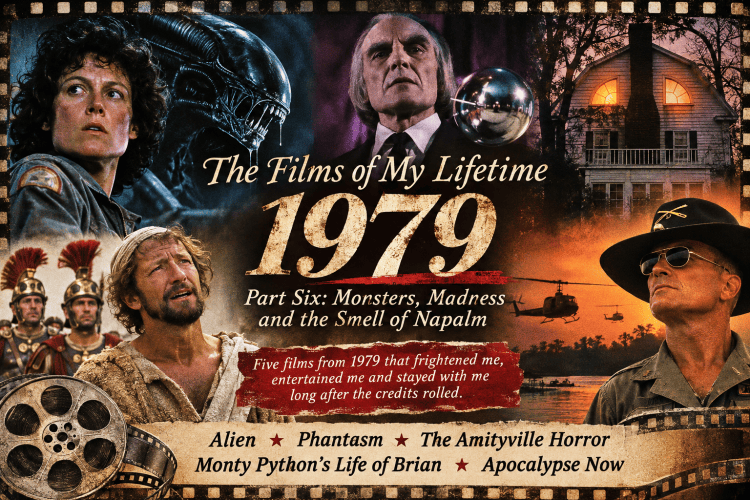
| Part Six 1979: Monsters, Madness and the Smell of Napalm |
| By 1979, I was sixteen, and my enthusiasm for films was developing into something that would stay with me for the rest of my life. Horror had already established a firm foothold in my imagination. Still, I was equally drawn to unusual stories, memorable actors, clever comedy and films that refused to behave quite as expected. Looking back, 1979 was an extraordinary year. Films explored creatures lurking in the darkness, supernatural forces occupying suburban houses, surreal nightmares, religious satire, and the madness of war. Some I discovered years after their original release, particularly during the video years of the 1980s, when films became far more accessible to me. That distinction matters. This series isn’t simply about what I watched in a particular year, but about the films released that year and the memories I accumulated as I encountered them throughout my life. For 1979, my five favourites are Alien, Phantasm, The Amityville Horror, Monty Python’s Life of Brian, and Apocalypse Now. |
| 1. Alien (1979) Directed by Ridley Scott I didn’t see Alien when it was originally released in 1979. I first saw it in 1982 on video, and by then I was already developing a strong appetite for films that combined science fiction with horror. What made Alien so effective was that it wasn’t simply a film about a monster. It was a film about isolation, vulnerability and the terrible realisation that something utterly unknown had entered an environment from which there was almost no possibility of escape. The spaceship Nostromo was hardly the gleaming, comfortable future imagined by some earlier science-fiction productions. It was industrial, claustrophobic and inhabited by ordinary working people who found themselves confronting something far beyond their understanding. The creature itself was extraordinary, and the design helped establish an atmosphere that was both fascinating and deeply disturbing. Sigourney Weaver was not an actress I had particularly followed before this film. Alien introduced me to her, and I subsequently watched her in other productions, including Gorillas in the Mist in 1988. That was a remarkable performance in a film that affected me so deeply that, despite admiring it enormously, I could never bring myself to watch it a second time. The sadness stayed with me. My interest in Alien went beyond the screen. I read the books associated with the films as they became available, and I have continued watching the franchise through its various sequels and later additions. Not every instalment has approached the original in quite the same way, but I have enjoyed the entire series. Some horror films rely on what they show, while others understand the importance of what remains unseen. Alien combined both approaches magnificently, and it deserves its place among my favourites. 2. Phantasm (1979) Directed by Don Coscarelli Some horror films frighten you because they present something recognisable and then turn it into a nightmare. Others frighten you because they seem to operate by rules nobody has bothered to explain. Phantasm belongs firmly in the second category. I thoroughly enjoyed this film and went on to watch the entire franchise, though I freely admit the series spooked me more than once. What made it deeply unsettling was its surreal atmosphere, its strange storyline, and, above all, the presence of the Tall Man. Angus Scrimm created one of horror cinema’s most memorable figures. His character didn’t need elaborate explanations or constant displays of violence to be frightening. His appearance, manner and mysterious purpose were enough to make the whole experience uncomfortable. Then, of course, there were those flying silver spheres. Bloody balls! They became one of the defining images of the series, but the overall surrealism and the plot’s impact fascinated me most. Phantasm never felt quite like an ordinary horror film. It existed somewhere between a nightmare, a mystery and a particularly disturbing dream from which the characters couldn’t entirely escape. I enjoyed the subsequent films as well, and although the mythology became increasingly elaborate, the unusual atmosphere remained a large part of their appeal. There is something to be said for horror that leaves you slightly bewildered. Not every mystery needs to be explained immediately, and not every frightening image needs a rational explanation. Phantasm understood that remarkably well. 3. The Amityville Horror (1979) Directed by Stuart Rosenberg My relationship with The Amityville Horror began with the book, and I found that frightening enough before I ever watched the film. Jay Anson’s account of the experiences the Lutz family supposedly endured captured my imagination. By the time I saw the screen adaptation, I was already thoroughly absorbed in the story. What distinguished The Amityville Horror from many other supernatural films was its claimed connection to real events. The house existed, the murders committed by Ronald DeFeo Jr. had happened, and the subsequent haunting claims had become the subject of enormous public interest. I became so captivated that I read extensively about the background, including the DeFeo crimes and the history preceding the alleged haunting. I also followed the subsequent films and continued exploring the subject long after my first encounter with the original story. The film frightened me, certainly, but the fascination extended far beyond the immediate scares. I wanted to understand the people, the events and the different accounts of what had supposedly occurred. That doesn’t mean accepting every supernatural claim as fact. The murders were real; the haunting story remains disputed. For me, part of the fascination lay in the mixture of documented crime, human tragedy, competing explanations and the extraordinary mythology that grew around the house. I have always been interested in true crime, and The Amityville Horror brought that interest together with my enthusiasm for supernatural horror. It was a powerful combination, and one that kept the film firmly lodged in my memory. 4. Monty Python’s Life of Brian (1979) Directed by Terry Jones After three films involving monsters, nightmares and supernatural terror, it seems only reasonable to turn to something completely different. Monty Python. I was a huge admirer of the Python troupe, and my enthusiasm extended well beyond their films. I subsequently watched their original television sketch series, which began in 1969, and developed an enormous affection for the group’s distinctive approach to comedy. Their humour was clever, absurd, irreverent and frequently gloriously ridiculous. They could take a familiar situation, twist it beyond recognition and somehow make the result seem perfectly logical within their own peculiar universe. Life of Brian remains one of my favourite Python films, alongside Monty Python and the Holy Grail and The Meaning of Life. Of those three, I would place Life of Brian first. What I particularly enjoy is how the film uses misunderstanding, bureaucracy, political squabbling, and crowd behaviour to create comedy. Brian himself is an ordinary man who finds himself trapped in circumstances that become increasingly impossible to control. The film was controversial on its original release, but beneath the irreverence lay sharp observations about human behaviour, conformity, and the extraordinary things people are prepared to believe. It is also wonderfully quotable, although I suspect anyone who has spent much time around Monty Python enthusiasts already knows that. What makes Life of Brian so successful for me is that it doesn’t simply depend on a succession of unrelated jokes. A story holds the madness together, and the performances make even the most absurd moments entertaining. I have watched the Python films repeatedly over the years, and they remain among my favourite examples of British comedy. Sometimes a film doesn’t need a monster to create chaos. A few determinedly foolish human beings will do perfectly well. 5. Apocalypse Now (1979) Directed by Francis Ford Coppola Some films entertain you, some frighten you, and some leave you wondering what you have just experienced. Apocalypse Now manages all three, though not necessarily in the conventional sense. I first encountered it well after its original cinema release, watching it on video, and I have returned to it several times since. It is a strange, disturbing and extraordinary film, made even more remarkable by its cast. Martin Sheen, Marlon Brando, Robert Duvall and Dennis Hopper were among the actors who brought this unsettling journey to life, and their performances helped create a film unlike almost anything else I had seen. I had already been affected by The Deer Hunter, another film dealing with the Vietnam War, but Apocalypse Now approached its subject differently. Rather than presenting a straightforward war story, it became an increasingly surreal journey into obsession, violence and the darker aspects of human nature. As the journey progresses, the ordinary rules of the world seem to fall away. A growing sense suggests the characters are travelling not merely through a war zone but into something far more disturbing. And then there is Robert Duvall. His performance as Lieutenant Colonel Kilgore is unforgettable, not least because of one particular line that has stayed with me for decades. ‘I love the smell of napalm in the morning.’ Over the years, I have borrowed that line and adapted it to suit different circumstances. Given my profession and my rather considerable enthusiasm for gardening, one version has become particularly appropriate: ‘I love the smell of compost in the morning.’ I suspect Francis Ford Coppola never imagined that one of his film’s most famous lines would eventually find its way into the world of compost heaps and gardening, but there we are. Apocalypse Now is a terrific film. Strange, certainly, and frequently uncomfortable, but filled with remarkable performances and unforgettable moments. It is one of those productions that demands attention, even when you are not entirely certain where it is taking you. Beyond My Five Favourites Choosing only five films from 1979 inevitably meant leaving out several productions that I thoroughly enjoyed. The China Syndrome was an excellent thriller with superb casting, while Being There was a film I revisited relatively recently and found absolutely charming. Peter Sellers was wonderful, and the supporting performances, particularly those of Shirley MacLaine and Jack Warden, added enormously to its appeal. My enthusiasm for horror also extended to David Cronenberg’s The Brood, which I watched in the 1990s and found excellently frightening, and Werner Herzog’s Nosferatu the Vampyre, which appealed strongly to my longstanding fascination with vampires. I enjoyed Mad Max and kept following the franchise, especially the original three films. I also appreciated Escape from Alcatraz, with Clint Eastwood giving another memorable performance, and The Onion Field, which combined my love of reading with my interest in true crime. The Muppet Movie was another thoroughly enjoyable experience, while Bette Midler’s performance in The Rose made that film particularly memorable when I eventually saw it during the 1990s. There were disappointments too. I admired Dustin Hoffman and Meryl Streep enormously, but couldn’t stand Kramer vs Kramer. I was a huge Steve Martin fan, yet The Jerk did very little for me. And although I enjoyed several disaster films over the years, Airport ’79 struck me as a particularly poor ending to an increasingly over-the-top franchise. Then there was Up from the Depths, a decidedly disappointing monster film. Nevertheless, even bad creature films can be fascinating, and I may yet examine that one in my separate Creature Features series. One further production deserves a special mention: the 1979 television adaptation of Stephen King’s Salem’s Lot. I had read the novel before watching it, and the infamous vampire at the bedroom window certainly frightened me. Stephen King has long been one of my favourite authors, and this adaptation made a lasting impression. Looking Back at 1979 When I consider these five films together, I can see just how varied my interests had become. Alien offered intelligent science-fiction horror, Phantasm introduced a surreal nightmare, and The Amityville Horror combined supernatural storytelling with a real-life criminal tragedy. Life of Brian offered a completely different form of entertainment, while Apocalypse Now showed how cinema could transform a war story into something strange, haunting, and unforgettable. None of these films needed to be discovered on their original release to become important to me. Some arrived years later on videotape, others through books, and several became part of longer journeys through sequels, adaptations and the careers of actors I admired. That is one of the pleasures of looking back across a lifetime of cinema. A film’s release date is only the beginning of its story. The more important date, at least from a personal perspective, is often the moment it enters your own life. And 1979 gave me five films that have never entirely left mine. |
| The Films of My Lifetime is a personal journey through cinema, beginning in 1963 and exploring the films that entertained, frightened, fascinated and occasionally disappointed me along the way. These are not necessarily the films critics considered the greatest. They are the films that became part of my life. |
| Wander through the Article Directory and see where curiosity takes you next. |
| About our writing & imagery Most articles are grounded in our real gardening experience, observations and reflections. AI may assist with research, drafting and editing, but the experiences, opinions and editorial direction are our own. Featured images may include our photography, original AI-generated visuals or, where stated, images credited to others. All published content is reviewed and shaped by Earthly Comforts before publication. |

