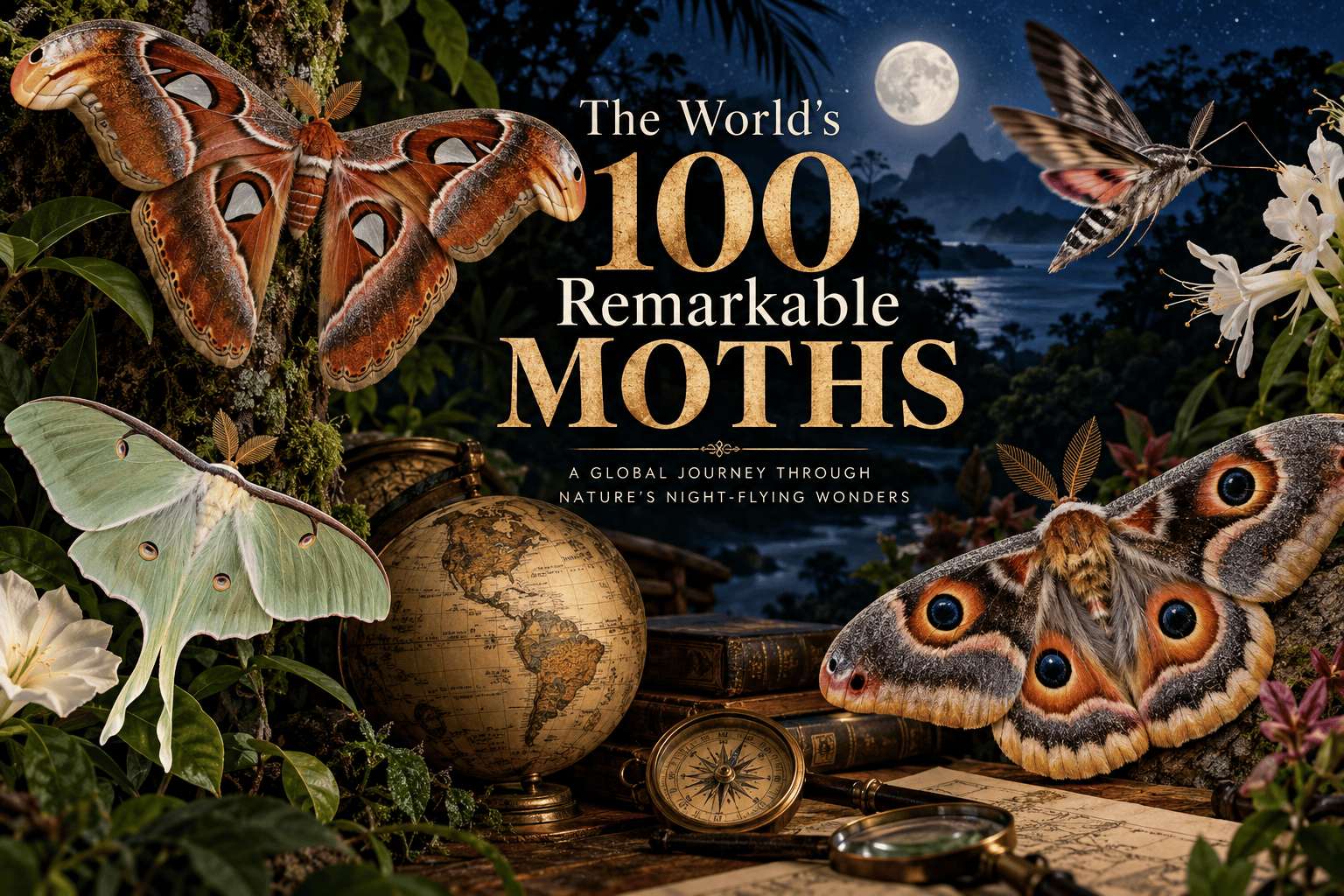
| 100 Remarkable Species from Around the Globe EPISODE 1 |
| Giants and Jewels The Atlas Moth and Madagascan Sunset Moth |
| Two extraordinary moths reveal just how spectacular the insect world can become, from the enormous wings of an Asian forest giant to the shimmering colours of a Madagascan jewel. |
| There is a wonderful irony in the way we tend to think about moths. Butterflies are celebrated for their beauty, while moths are frequently dismissed as their rather drab, nocturnal cousins. Yet our first two species demonstrate just how misleading that distinction can be. One is among the largest moths in the world, with wings so enormous that they resemble an elaborate piece of embroidered fabric. The other has colours so brilliant it could easily be mistaken for an exotic butterfly. Our journey begins in the forests of Asia, then crosses the Indian Ocean to Madagascar, where two very different members of the moth family reveal the extraordinary creativity of evolution. |
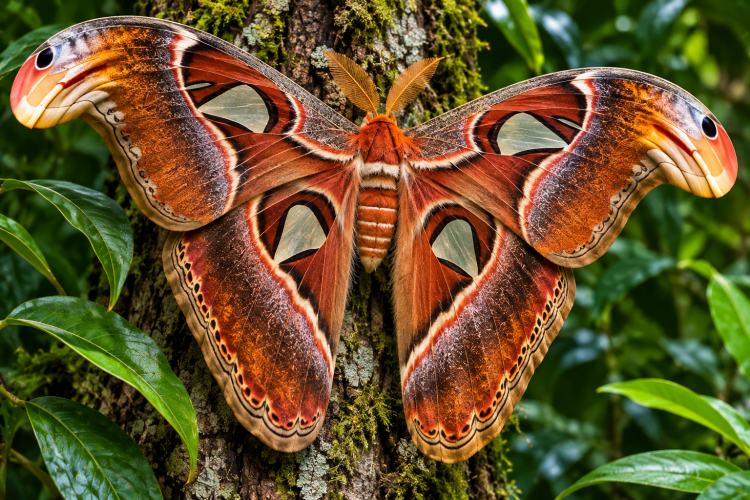
| 1. The Atlas Moth — Attacus atlas Family: Saturniidae | Distribution: South and Southeast Asia |
| Imagine encountering a moth whose wings stretch almost the width of a dinner plate. The Atlas moth, Attacus atlas, is one of the world’s largest moths, with a wingspan that can approach 25 centimetres and an exceptionally large wing surface area. Its enormous wings are patterned in rich shades of reddish brown, cream, black and orange, creating an appearance reminiscent of an intricately woven tapestry. Perhaps its most remarkable feature lies at the tips of its forewings. These elongated, curved structures bear markings that resemble snake heads, complete with what appear to be eyes and open mouths. This extraordinary resemblance is thought to provide a defensive advantage, potentially startling predators or discouraging attacks. Although the precise effectiveness of this mimicry remains a subject of scientific interest, it is undoubtedly one of the insect world’s most striking visual adaptations. The Atlas moth inhabits tropical and subtropical forests across parts of South and Southeast Asia. Its caterpillars are substantial, greenish creatures that feed on the foliage of various trees and shrubs, accumulating the energy reserves that will sustain their adult lives. And here we encounter something particularly fascinating. Adult Atlas moths possess greatly reduced, non-functional mouthparts and do not feed. Their entire adult existence depends upon the reserves accumulated during their caterpillar stage. With only a relatively short time available, their principal purpose is reproduction. Females release chemical signals known as pheromones, which males detect using their elaborate, feather-like antennae. These specialised sensory structures allow males to locate potential mates, sometimes from considerable distances. The Atlas moth is therefore a remarkable example of an insect whose spectacular adult form represents the culmination of months of development, yet whose final stage of life may last only a week or two. |
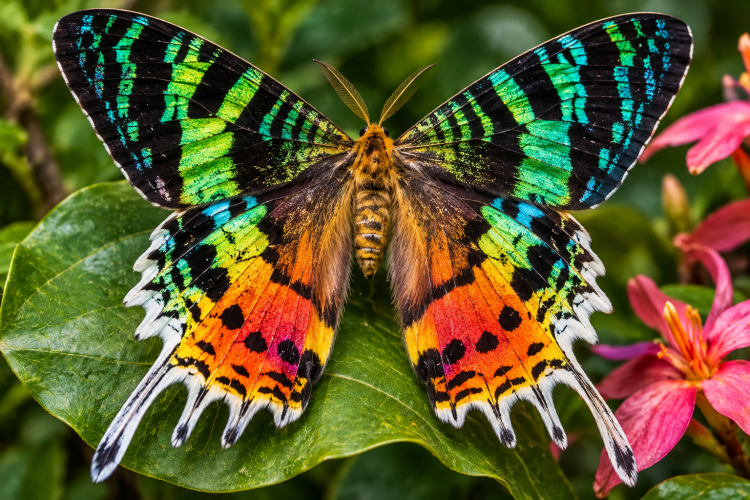
| 2. The Madagascan Sunset Moth — Chrysiridia rhipheus Family: Uraniidae | Distribution: Madagascar |
| If the Atlas moth impresses through sheer size, the Madagascan sunset moth achieves something equally remarkable through colour. Known scientifically as Chrysiridia rhipheus, this extraordinary species is endemic to Madagascar and is widely regarded as one of the most spectacularly coloured moths on Earth. Its wings display an astonishing combination of metallic green, electric blue, golden yellow, orange and deep black, arranged in patterns that appear almost impossibly vivid. Unlike many moths, the Madagascan sunset moth is active during daylight hours. Its brilliant appearance and daytime behaviour frequently lead observers to mistake it for a butterfly, although its scientific classification places it firmly among the moths. What makes its colours especially fascinating is the way they are produced. Much of the moth’s brilliance results from microscopic structures within its wing scales rather than conventional pigments alone. These structures manipulate reflected light, producing iridescent colours that can change depending upon the viewing angle. The result is a living display of optical physics, created through biological structures of extraordinary precision. The moth’s caterpillars feed primarily on plants belonging to the genus Omphalea, which contain defensive chemical compounds. The larvae are adapted to feeding on these plants, and their association with them plays an important role in the species’ ecology. Changes in the availability and condition of these host plants can influence the moth’s distribution and movements across Madagascar. Adults, meanwhile, visit flowers to obtain nectar, contributing to pollination as they move between blossoms. Their relatively long proboscis allows them to reach nectar within suitable flowers, demonstrating another important difference from the non-feeding adult Atlas moth. There is also something particularly intriguing about the Madagascan sunset moth’s colouration. Although its brilliance might seem likely to attract predators, conspicuous patterns can function as warning signals in insects, particularly when associated with chemical defences. The precise protective role of its adult colouration is more complex than appearance alone might suggest. Still, it offers a fascinating reminder that nature’s brightest displays are not always intended to attract attention. |
| Two Moths, Two Extraordinary Strategies Our first two species could hardly be more different. The Atlas moth relies upon enormous size, elaborate wing patterns and a brief adult life sustained entirely by stored energy. The Madagascan sunset moth is a comparatively smaller, active daytime flyer whose shimmering colours and specialised relationship with its food plants reveal another side of moth evolution. Yet both demonstrate the same fundamental principle: moths are not merely creatures that flutter around lights after dark. They are extraordinarily specialised insects, shaped by millions of years of adaptation to their environments. And if these first two species are any indication, our journey through the world’s remarkable moths promises to be anything but ordinary. |
| Episode Information Series: The World’s 100 Remarkable Moths Episode: 1 of 50 Species featured: 1–2 of 100 Geographical focus: South and Southeast Asia; Madagascar Next Episode — 2: Moonlight and Emerald Wings: The Luna Moth and Spanish Moon Moth Two magnificent green moths, separated by the Atlantic Ocean, reveal the remarkable beauty of the Saturniidae family and the evolutionary advantages of their delicate, trailing wings. |
| Series Inspired by My Teddy Bear Moth: A Little Mystery Solved |
| Wander through the Article Directory and see where curiosity takes you next. |
| About our writing & imagery Most articles reflect our real gardening experience and reflection. Some use AI in drafting or research, but never for voice or authority. Featured images may show our photos, original AI-generated visuals, or, where stated, credited images shared by others. All content is shaped and edited by Earthly Comforts, expressing our own views. |

