| Episode 003 |
| Tarantula (1955) Eight Legs of Atomic-Age Terror |
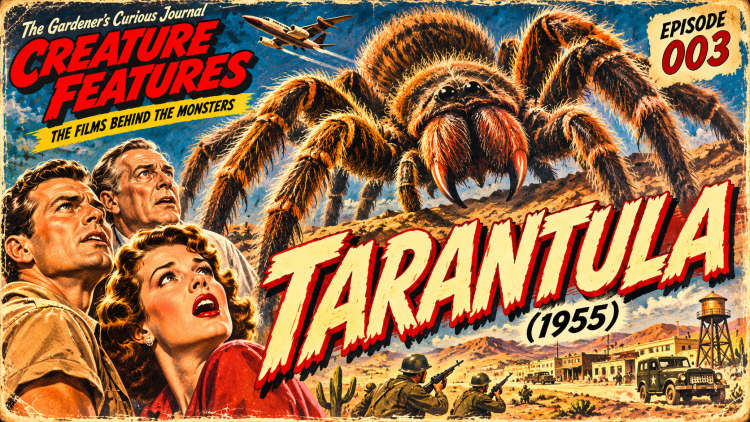
| If there is one creature that hardly needs Hollywood’s help to frighten people, it is the spider. Give it eight hairy legs, formidable fangs and the ability to appear unexpectedly in somebody’s bathroom, and you already have the ingredients for a minor domestic horror film. However, in 1955, Universal Pictures decided ordinary spiders were not frightening enough and introduced cinema audiences to a tarantula capable of looking through upstairs windows without climbing the walls. Directed by Jack Arnold, Tarantula remains one of the most recognisable creature features of the atomic age. Unlike many of its contemporaries, however, its monster was not created directly by nuclear weapons testing but by scientific research intended to benefit humanity. Naturally, things did not quite go according to plan. When Scientific Ambition Goes Horribly Wrong Set in the Arizona desert, the film follows Dr Matt Hastings, played by John Agar, as he investigates a mysterious death involving severe physical abnormalities. His enquiries lead him towards Professor Gerald Deemer, portrayed by Leo G. Carroll, a scientist developing an experimental nutrient intended to address the world’s growing demand for food. Working alongside the professor is Stephanie Clayton, played by Mara Corday, a young research assistant who gradually realises something is seriously wrong with the experiments. Among the laboratory’s unfortunate inhabitants is a tarantula exposed to the experimental formula. Following a disturbance at the laboratory, the spider escapes into the surrounding desert, where it continues growing at an alarming rate. Livestock begin disappearing, mysterious remains are discovered, and the local population soon finds itself dealing with a rather substantial pest-control problem. What makes Tarantula particularly entertaining is that its scientific premise begins with an admirable intention. Professor Deemer is attempting to solve a genuine humanitarian problem, but his enthusiasm for scientific progress ultimately creates something considerably more dangerous than the problem he intended to address. Behind the Monster Jack Arnold was already establishing himself as one of the most capable directors working in science-fiction cinema, having directed It Came from Outer Space (1953) and Creature from the Black Lagoon (1954). He understood how to create suspense through atmosphere, isolation and the gradual revelation of a threat. Rather than relying entirely on mechanical models, the production used footage of a real tarantula, photographed, enlarged, and combined with miniature landscapes and live-action scenes. Special-effects artist Clifford Stine contributed to the visual effects that made the spider appear to wander through the Arizona desert. Using a living spider gave the monster a convincing quality that many mechanical creatures struggled to achieve. Its movements were naturally unsettling, and there was no need to teach a tarantula how to behave like a tarantula. The filmmakers needed to make it appear considerably larger than nature had intended. The stark desert landscape also contributes enormously to the atmosphere. There is something particularly disturbing about watching an enormous spider moving across an otherwise empty horizon, where its size becomes increasingly apparent as it approaches familiar buildings and vehicles. The Creature Behind the Monster True tarantulas belong to the family Theraphosidae, which contains more than a thousand recognised species distributed throughout tropical, subtropical and some temperate regions of the world. They are particularly well represented across Central and South America, although native species also inhabit the southwestern United States, including Arizona. Some accounts identify the spider used in the film as a Mexican red-rumped tarantula, now classified as Tliltocatl vagans, formerly Brachypelma vagans. This attractive species possesses a predominantly dark body with reddish abdominal hairs. However, reliable production records confirming this identification appear elusive, so it should be regarded as a possible rather than definitive identification. Despite their intimidating appearance, most tarantulas lead relatively secretive lives. Many are terrestrial, occupying burrows and emerging primarily at night to hunt insects and other small animals. Rather than constructing elaborate webs to capture prey, they rely on sensitive hairs to detect vibrations, seize their victims with powerful fangs, and immobilise them with venom. Many American tarantulas also possess irritating abdominal hairs that can be dislodged as a defensive mechanism. These protect predators without requiring the spider to engage in confrontation. The enormous specimen portrayed in Tarantula would encounter considerable biological difficulties. Spiders rely partly on hydraulic pressure to extend their legs, and their respiratory systems and exoskeletons would struggle to accommodate such extraordinary growth. Increasing a tarantula’s size without fundamentally redesigning its anatomy would create far more problems than Professor Deemer’s nutrient could solve. Real tarantulas are also considerably less interested in pursuing humans than Hollywood would have us believe. Most would much rather retreat from a threatening situation than participate in the wholesale destruction of an Arizona township. Familiar Faces and Fascinating Film Facts Look carefully towards the end of the film, and you will discover a young Clint Eastwood appearing in an uncredited role as a military jet pilot. Twenty-five when the film was released, Eastwood was still several years away from widespread recognition through the television western Rawhide. His early film career also included an appearance in another Jack Arnold production, Revenge of the Creature (1955). Another rather delightful connection comes from The Rocky Horror Picture Show (1975), whose opening song, Science Fiction/Double Feature, specifically references Leo G. Carroll and the tarantula from this film. Twenty years after its release, the enormous spider had become part of a musical tribute to classic science-fiction cinema. A Spider That Has Aged Rather Well Tarantula benefits enormously from its restrained approach to storytelling. Jack Arnold allows the scientific mystery to develop before placing his monster centre stage, and the decision to use a real spider helps the effects remain surprisingly convincing. There is something wonderfully entertaining about the simplicity of these early creature features. They didn’t require complicated mythologies, endless sequels, or enormous digital effects budgets. Sometimes all that was necessary was an enthusiastic scientist, an unfortunate experimental subject and a small American town that happened to be in the wrong place. Creature Features verdict: An atmospheric atomic-age classic with inventive special effects, an engaging scientific premise and one of cinema’s most memorable eight-legged monsters. One film. One creature. One monstrous adventure. |
| Now Showing — Tarantula (1955) |
| Editorial research note The film’s principal credits, original production history and restoration details have been checked against the American Film Institute, George Eastman Museum and Turner Classic Movies. One particularly worthwhile historical detail for our archive is that the film was selected for the United States National Film Registry in 1998, recognising its lasting significance. |
| About our writing & imagery Creature Features explores the history of monster cinema alongside the natural history of the creatures that inspired it. AI may assist with research, drafting, editing and the creation of original pulp-style illustrations. All editorial content is shaped and reviewed by The Gardener’s Curious Journal. Featured artwork is an artistic interpretation rather than original film photography or theatrical advertising. |

