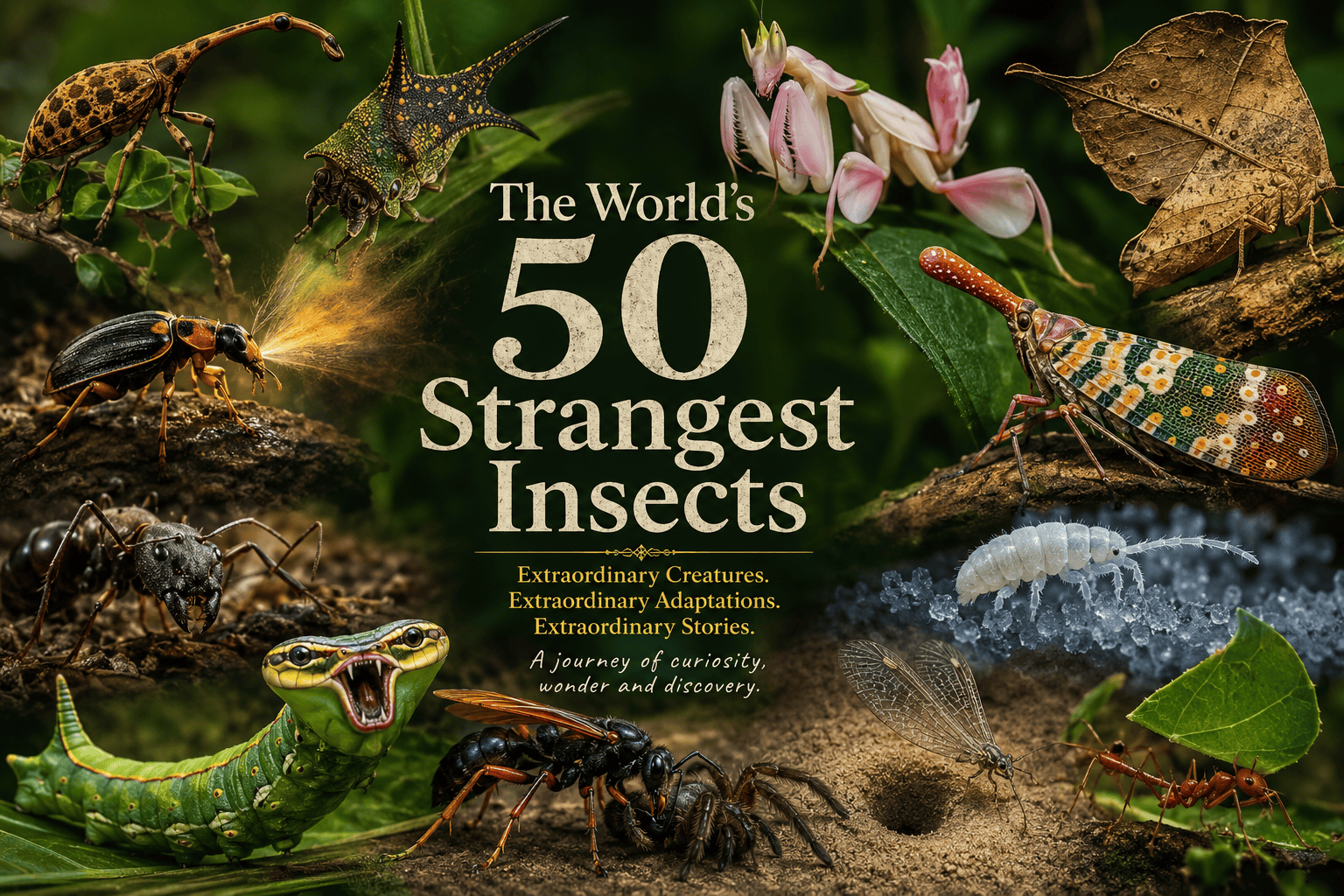
| Episode 4 — Between Leaf and Water |
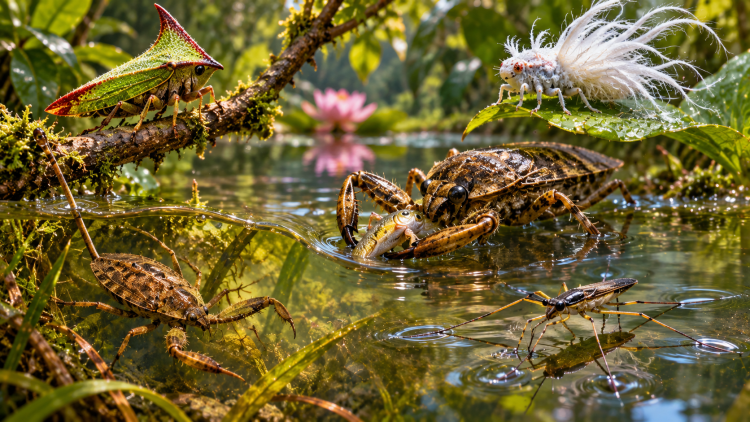
| One thing I particularly enjoy about gardening is that you are never terribly far from an interesting insect, although finding it sometimes requires a little patience. A branch that appears to be covered in thorns may be supporting a gathering of small sap-feeding insects, whilst something resembling a piece of white fluff might suddenly develop legs and disappear. Even the surface of a garden pond, which at first glance seems relatively uneventful, provides hunting grounds for insects whose lives depend on the peculiar physical properties of water. I remember the monsoon drains in Malaysia being particularly interesting places to investigate as a child. There was always something living in or around the water, although my knowledge of what I was looking at was considerably less developed than my enthusiasm for finding it. In Britain, I have encountered both water scorpions and pond skaters, two insects that occupy very different parts of the same freshwater environment. The more I have learnt about them, the more I appreciate that a pond is not simply a body of water but a collection of overlapping habitats, each presenting its inhabitants with different opportunities and difficulties. In this episode, we shall investigate five insects whose appearances and behaviour reveal some extraordinary relationships with their surroundings. There is also a surprising amount of parental care involved, something we perhaps don’t associate with insects enough. 16. The Thorn Bug — Umbonia crassicornis Some insects are so well camouflaged that you could easily overlook them whilst examining a plant. The thorn bug, Umbonia crassicornis, is one such creature, an American treehopper whose prominent upward-pointing structure makes it resemble a thorn growing from a branch. Encounter several individuals gathered along a stem, and the illusion becomes particularly convincing, although the apparent thorns may occasionally rearrange themselves, which would understandably make a gardener look twice. Thorn bugs belong to the family Membracidae, the same family as the extraordinary Brazilian treehopper we encountered in our opening episode. The conspicuous structure extends from the pronotum, a plate covering the upper surface of the first thoracic segment. Across the treehopper family, this structure has evolved into an astonishing variety of shapes, including projections resembling thorns, helmets and elaborate ornaments. In Umbonia crassicornis, the resemblance to a plant’s natural defences is particularly striking, although its appearance is only the beginning of an interesting story. Thorn bugs feed upon plant sap, inserting their specialised mouthparts into plant tissues and drawing out the fluids they require. Like many sap-feeding insects, they produce honeydew, which may attract ants and other insects interested in its sugar content. Large gatherings can sometimes damage their host plants, particularly younger growth, but concentrating solely upon their feeding habits would mean overlooking one of their most remarkable characteristics: the relationship between a mother and her offspring. Female thorn bugs remain with their developing young, protecting them against potential predators. The nymphs gather together on the host plant, and their mother can respond aggressively to disturbances around the group. What makes this arrangement especially fascinating is how the youngsters communicate their need for assistance. Research by entomologist Reginald Cocroft demonstrated that disturbed nymphs produce vibrations that travel through the plant. Nearby siblings respond, creating a coordinated disturbance signal that elicits protective behaviour from their mother. When researchers interrupted the transmission of these vibrations, the mother’s response was prevented. The branch on which the insects were feeding also functioned as their communication network. I find that particularly interesting from a gardener’s perspective because we tend to regard plants as passive participants in the lives of the insects that occupy them. Yet a stem can provide food, protection, a suitable surface for laying eggs and a means of transmitting information between individuals. An entire conversation may be taking place among the occupants of a branch without us hearing a thing. The thorn bug’s remarkable appearance might initially attract our attention, but its family life is arguably the more extraordinary discovery. 17. Waxy Planthoppers — Fulgoroidea If you spend sufficient time examining plants, you will eventually encounter insects that appear to have covered themselves in something resembling cotton wool. Woolly aphids, mealybugs and various scale insects produce waxy secretions. Still, some of the most elaborate examples are found among planthoppers, whose young can have extraordinary arrangements of white filaments projecting from their bodies. Planthoppers belong to the superfamily Fulgoroidea, which also includes the lanternflies from our previous episode. They are sap-feeding insects with considerable diversity in body shapes, colours, and behaviours. Many are accomplished jumpers, capable of disappearing from a leaf fast enough to leave someone examining them wondering where on earth they went. The wax-producing nymphs are especially interesting because their secretions can develop into structures considerably larger than the insects producing them. Depending upon the species, these may resemble feathers, delicate strands of wool, miniature brushes or elaborate fans. Some have such conspicuous trailing filaments that the insect itself is easily overlooked amongst the material surrounding it. Wax production is not unusual amongst insects. A waxy outer covering can help protect the body from moisture loss and other environmental pressures, whilst specialised wax deposits may protect eggs or reduce contact with sticky honeydew. The more extravagant structures produced by planthoppers, however, raise additional questions, particularly when the material extends well beyond the insect’s surface. An especially interesting study published in 2024 investigated the wax tails of nymphs in the genus Ricania. Using high-speed photography, researchers compared the jumping behaviour of individuals with their wax structures intact against those from which the structures had been removed. The difference was considerable. Nymphs retaining their wax tails were much better at controlling their orientation in the air and landing successfully, whilst those without them were more likely to tumble. The wax produces aerodynamic resistance, helping to stabilise the insect during a jump. It is rather like the arrangement of feathers on a badminton shuttlecock, although the comparison is only a convenient way of understanding the physical principle. For a wingless youngster living amongst branches and leaves, the ability to land on its feet could make a considerable difference to its chances of escaping danger. That does not mean every wax-producing planthopper has developed its elaborate appearance for the same purpose. Some structures may provide environmental protection, others may influence predator behaviour, and several functions could operate together. Research on Ricania is particularly valuable because it demonstrates a specific benefit rather than simply suggesting one based on appearance. As gardeners, we are accustomed to investigating white deposits on plants because they can indicate sap-feeding insects. It is tempting to concentrate entirely upon whether the plant is being damaged, but there is another story worth considering. What appears to be an untidy collection of white fluff may be part of an insect’s highly effective means of travelling safely between leaves. I suspect I shall be looking rather differently at some of those little waxy gatherings from now on. 18. The Water Scorpion — Nepidae The water scorpion is an insect I find particularly appealing, partly because its appearance is so wonderfully misleading. Despite its name and rather formidable front legs, it is neither a scorpion nor a close relative. It belongs to the true bugs, order Hemiptera, and its long, apparently threatening tail serves a function far less aggressive than its appearance suggests. Our familiar British water scorpion, Nepa cinerea, has a flattened brown body that blends remarkably well amongst submerged leaves and plant debris. The family Nepidae also contains the more elongated water stick insects, including members of the genus Ranatra. Although their overall shapes differ considerably, both possess specialised grasping forelegs and a breathing arrangement adapted to life beneath the water. Unlike many aquatic insects, the water scorpion is not an enthusiastic swimmer. It spends much of its time moving amongst submerged vegetation or waiting patiently for potential prey to come within reach. Small aquatic invertebrates, tadpoles, and occasionally small fish can become meals for the larger individuals. Its front legs close around the victim, and its piercing mouthparts allow it to feed on the tissues of its prey. The most distinctive feature is the long respiratory siphon extending from the rear of the abdomen. Formed from two associated structures, it provides a passage through which the insect can obtain atmospheric air whilst remaining largely submerged. What looks like a dangerous tail is effectively a snorkel, allowing the animal to remain concealed beneath the surface without regularly exposing its entire body to the outside world. I have encountered water scorpions in Britain, and they are amongst those pond inhabitants that reward a closer examination. Their brown colouring and flattened shape make them relatively easy to overlook, particularly amongst decomposing leaves. An animal that remains motionless and resembles the surrounding debris has little reason to advertise its presence, especially when its hunting success depends upon other creatures failing to notice it. There is something worth considering here when we maintain garden ponds. We often prefer water features to appear clear and tidy, removing accumulated vegetation and fallen leaves because they look unattractive. Excessive organic matter can certainly cause problems, but removing every piece of submerged debris also removes shelter and hunting opportunities for animals such as water scorpions. A little natural untidiness, managed sensibly, is often valuable. The insect’s reproductive arrangements are interesting too. Female water scorpions place their eggs amongst suitable plant material, and the eggs possess respiratory projections that help the developing embryos obtain oxygen. From the beginning of its development, the water scorpion must navigate the challenges of living in an environment where atmospheric air is not always immediately accessible. For an insect that lacks the speed of many other aquatic predators, it has developed a remarkably effective combination of concealment, patience and respiratory adaptation. It does not need to pursue everything that passes through its territory when so much can be achieved by remaining quietly amongst the leaves. 19. The Giant Water Bug — Belostomatidae If the water scorpion gives us an interesting example of an aquatic ambush predator, the giant water bugs take freshwater hunting to another level. Members of the family Belostomatidae occur across many parts of the world, particularly warmer regions, and the largest species can reach approximately ten centimetres or more in length. That is a substantial insect by anybody’s standards, especially one equipped with powerful grasping forelegs and piercing mouthparts. Giant water bugs are formidable predators, feeding on other aquatic insects, crustaceans, and, depending on the species and its size, small vertebrates such as tadpoles and fish. They capture prey with their front legs and inject saliva that helps break down its tissues. Their flattened bodies and swimming adaptations let them move through freshwater environments, although many also have functional wings and can travel between suitable habitats. In some regions, they are known as electric light bugs because flying adults are attracted to artificial lighting. Elsewhere, the rather memorable name of toe-biter reflects their ability to deliver a painful defensive bite if disturbed or handled. These are insects best appreciated through observation rather than enthusiastic attempts to pick them up. However, what particularly interests me about giant water bugs is something considerably removed from their formidable reputation as predators. They are amongst the most remarkable examples of paternal care in the insect world, with males undertaking responsibility for protecting and maintaining developing eggs. In several genera, including Appasus, Abedus and Belostoma, females deposit eggs upon the backs of males. The eggs remain attached during development, and the male must maintain conditions suitable for their survival. Depending upon the species, his behaviour can include movements that improve oxygen delivery and positioning himself where the eggs receive an appropriate balance of moisture and air. Other giant water bugs, notably those belonging to the group Lethocerinae, use a different arrangement. Females deposit eggs on vegetation emerging above the water, and males attend them, helping prevent dehydration and protecting them against threats. Both approaches involve considerable expenditure of time and energy, with consequences for the male’s feeding opportunities and exposure to danger. Research published in 2016 found that females of two Japanese species, Appasus major and Appasus japonicus, preferred egg-bearing males over those without eggs. More recent research, published in 2025, revealed something even more interesting in Appasus japonicus: males frequently tended eggs fertilised by other males, and the broods could contain offspring from several parents. The relationship between paternal care and reproductive success is evidently more complicated than scientists previously supposed. I rather like the contrast between these different aspects of the insect’s life. Here is a powerful aquatic predator capable of overpowering animals considerably larger than many insects will ever encounter, yet a substantial part of its breeding life may be devoted to maintaining a collection of delicate eggs. The giant water bug is a useful reminder that an animal’s reputation as a predator tells us remarkably little about the rest of its behaviour. Sophisticated parental arrangements can exist among creatures we might otherwise dismiss as particularly large and intimidating bugs. 20. The Water Strider — Gerridae Our final insect will probably be the most familiar to many British readers, although familiarity can sometimes keep us from appreciating how extraordinary an animal it really is. Water striders, more commonly called pond skaters in Britain, belong to the family Gerridae and spend much of their lives travelling across a surface that most terrestrial insects would struggle to negotiate. I have always enjoyed watching pond skaters. They can remain almost motionless before suddenly travelling across the water, leaving little disturbances in their wake and appearing to move with remarkably little effort. It is easy to become accustomed to the sight of them, particularly around garden ponds, but the physics involved in supporting and moving their bodies is fascinating. Water molecules attract one another, producing a phenomenon known as surface tension. That surface can support a sufficiently small animal with suitably adapted legs without breaking through it. The pond skater’s legs possess microscopic water-repellent hairs that help prevent wetting and allow the insect to distribute its weight. Look closely at a stationary individual, and you may notice small depressions in the water beneath its feet. Its three pairs of legs perform different tasks. The front pair is comparatively short and useful for capturing prey, the middle pair provides much of the propulsion, and the hind pair helps support the insect and control its direction. This combination allows the pond skater to move rapidly across the surface whilst remaining sufficiently sensitive to disturbances that may indicate the presence of food or danger. For some time, scientists debated how water striders generated the forces necessary to propel themselves. Research published in Nature in 2003 demonstrated that they transfer momentum through swirling movements of the water beneath the surface, produced by strokes of their middle legs. These small vortices help explain how even young pond skaters can move effectively, contributing to our understanding of locomotion at the air-water boundary. Pond skaters are predators, and the surface of a pond provides opportunities to catch insects that have fallen into the water. Vibrations travelling across the surface help them locate struggling prey, which they can seize and feed upon using their piercing mouthparts. As with the thorn bugs earlier in the episode, disturbances transmitted through the surroundings carry biologically important information. The difference is that the medium here is water rather than a plant. Perhaps even more extraordinary are the ocean skaters belonging to the genus Halobates. Certain species spend their lives upon the surface of the open ocean, far removed from the sheltered freshwater habitats we normally associate with insects of this kind. Very few insects have successfully occupied such an environment, which makes these marine relatives particularly interesting additions to an already remarkable family. There is much to appreciate in the ordinary British pond skater, however. We don’t necessarily need to travel to tropical forests or distant oceans to observe extraordinary insect adaptations. Sometimes a few minutes beside a garden pond, watching something we have seen a hundred times before, can provide an entirely new appreciation of the familiar. The Worlds Within Our Gardens What I have particularly enjoyed about investigating these five insects is discovering how differently they make use of their surroundings. A thorn bug’s host plant carries vibrations between a mother and her offspring, a planthopper’s wax helps steady its movements through the air, and a water scorpion remains submerged whilst maintaining access to the atmosphere. Giant water bugs negotiate the difficulties of caring for developing eggs, whilst pond skaters have become wonderfully adapted to the narrow physical boundary between water and air. We often describe wildlife habitats in terms of gardens, woodlands, wetlands or grasslands, but those categories can conceal an enormous amount of smaller-scale complexity. To an insect, the difference between a smooth leaf and a rough branch, between submerged vegetation and open water, or between a sheltered corner and an exposed surface can be enormously significant. It reinforces something I have increasingly come to appreciate through gardening. Providing for wildlife involves more than choosing suitable plants. The structure of a garden, its variety of surfaces, its moisture levels, and the small areas we leave undisturbed can all influence what can live there. We may never discover everything occupying those little environments, but that shouldn’t diminish their importance. In our next episode, we shall explore insects that survive under some seemingly improbable conditions, including the cold of Antarctica, the heat of deserts and the unusual aquatic lives of certain Hawaiian caterpillars. Having reached twenty of our fifty insects, I think it is becoming increasingly apparent that being an insect is a considerably more versatile occupation than we might first imagine. |
| Companion Resources — Explore Further For readers wishing to investigate the science behind this episode, the following research papers and specialist natural-history resources have been selected for their credibility and direct relevance. Thorn Bug — Umbonia crassicornis Offspring-Parent Communication in a Subsocial Treehopper Behaviour, 1999 — Reginald B. Cocroft’s original research investigating vibrational communication between thorn bug nymphs and their mother. Waxy Planthoppers — Fulgoroidea Wax “Tails” Enable Planthopper Nymphs to Self-Right Midair and Land on Their Feet Integrative and Comparative Biology, 2024 — Experimental research demonstrating the aerodynamic benefits of wax structures in Ricania nymphs. Water Scorpion — Nepidae Water Scorpion — Nepa cinerea Kent Wildlife Trust — An authoritative, accessible British natural-history resource covering identification, habitat, feeding behaviour, and respiratory adaptations. Giant Water Bugs — Belostomatidae Ecology of Giant Water Bugs Entomological Science, 2019 — A scientific review covering predation, morphology, reproductive behaviour, paternal care and conservation. Reproductive Strategies in Paternal Care and Remarkably Low Paternity Level in a Giant Water Bug Ecology and Evolution, 2025 — Open-access original research providing new insights into paternal care and reproductive relationships in Appasus japonicus. Water Striders — Gerridae The Hydrodynamics of Water Strider Locomotion Nature, 2003 — Landmark experimental research explaining how water striders propel themselves across the water’s surface. Walking on Water: Biolocomotion at the Interface Annual Review of Fluid Mechanics, 2006 — A scientific review exploring the physical principles that allow animals to move across water. These resources have been selected for their scientific authority and relevance. Findings concerning individual species should not automatically be assumed to apply to every member of their wider insect group. |
| About our writing & imagery The World’s 50 Strangest Insects explores the extraordinary diversity of insect life through scientific research, personal recollections, natural-history observations and a lifelong fascination with the natural world. AI may assist with research, drafting, editing and the creation of original illustrations, but the editorial direction, personal reflections and final content are shaped and reviewed by Earthly Comforts. Featured images are original AI-generated artistic interpretations of the insects discussed, intended to reflect their appearance and behaviour as accurately as possible. They are not photographs of living specimens. Companion resources are selected for their scientific credibility and relevance, allowing readers to investigate the subject further. |

