| Part Eight 1981: Werewolves, Warriors and a Cinema on My Doorstep |
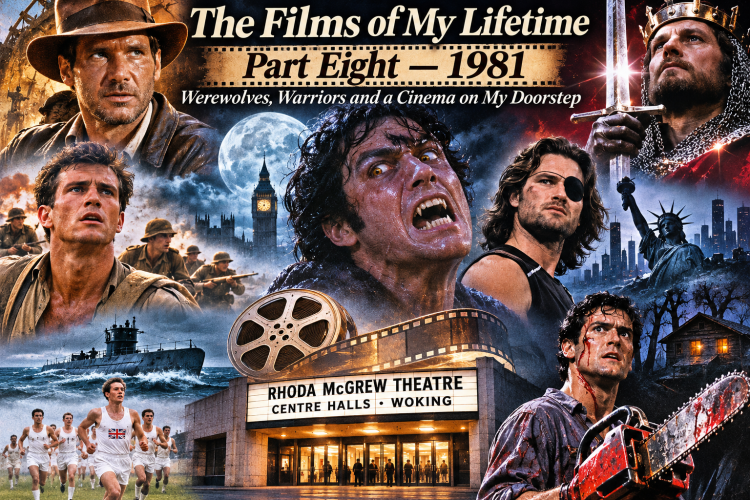
| By 1981, I was eighteen years old, and my enthusiasm for films was showing absolutely no signs of slowing down. If anything, it was gathering momentum, helped enormously by a rather fortunate arrangement that any young film enthusiast would have considered a gift. During 1981–82, I was working as an assistant banqueting manager at Centre Halls in Woking. One advantage of the job was that I could watch films for free in the Rhoda McGrew Theatre. Imagine that for a moment. Here I was, already fascinated by cinema, with the chance to indulge that interest without paying for every visit. It was brilliant, and it fed my addiction. In those two years, as well as in 1983 [when l could come back and still watch the cinema] l watched probably around 40 films a year at the Centre Halls alone. Throughout the 1980s and 1990s, I became an increasingly regular cinema-goer, although video also played an enormous part in my film-watching life. Looking back at 1981, I can honestly say I saw every one of the thirty films we originally selected for this instalment, along with quite a few others. And what a year it was. There were adventures, historical dramas, science-fiction thrillers, werewolves, dragons, demons, slashers, comedies and war films. Some became lifelong favourites. Others were enjoyable at the time but have aged rather badly, while a handful were films I watched once and had little desire to revisit. Choosing just five favourites from 1981 has been particularly difficult. |
| Indiana Jones, Snake Plissken and the appeal of adventure Steven Spielberg’s Raiders of the Lost Ark was one of the year’s great adventures, and I thoroughly enjoyed it. Harrison Ford was brilliant as Indiana Jones, bringing together humour, determination, occasional exasperation and the ability to get himself into almost impossible situations. I was already a tremendous admirer of Spielberg’s productions, and Raiders was another example of his ability to create cinema that could appeal to a remarkably broad audience. I enjoyed the entire Indiana Jones franchise and have watched all the films a few times, although they aren’t productions I return to repeatedly. Another adventure, albeit of a very different kind, was John Carpenter’s Escape from New York. Kurt Russell was excellent as Snake Plissken, and Adrienne Barbeau was another welcome presence in a film with atmosphere, action, and a wonderfully grim vision of the future. The original was brilliant. Its eventual sequel, Escape from L.A., wasn’t terrible, but I felt it tried far too hard to recreate what had made the first film successful. Instead, the storyline became tired, and watching it once was sufficient. The original, however, remains one of my five favourites from 1981. Then there was Mad Max 2: The Road Warrior, another production that took audiences into a violent and rather unpleasant future. I enjoyed all the original Mel Gibson films, with their rough edges, gritty atmosphere and sense that everything was being held together by ingenuity and a considerable amount of desperation. I’ve also watched the more recent entries in the franchise. They’re good films in their own right, but they don’t particularly float my boat. Perhaps it’s because the originals felt more naturally gritty, whereas modern productions, however spectacular, can sometimes appear rather too polished. Werewolves were having a very good year. If there was one film from 1981 that captured something in me and never really let go, it was An American Werewolf in London. This is one of my all-time favourite films. I’ve probably watched it thirty times, perhaps more, and I still try to watch it whenever the opportunity presents itself. Some films seem to connect with us in ways we can’t properly explain. We might admire the acting, the story, the direction or the effects, but none of those things entirely accounts for why we keep returning. Something about the whole production works for us. An American Werewolf in London is one of those films for me. I also think Jenny Agutter’s presence helped a lot, as l had a huge crush on her, but the film itself was brilliant! John Landis managed to combine genuinely frightening horror with dark comedy, without either element completely overwhelming the other. And then, of course, there were Rick Baker’s extraordinary special effects. The transformation sequence was incredible, particularly when you remember the practical techniques available at the time. Baker was an enormously talented effects artist, and his work would become familiar to an even wider audience through Michael Jackson’s Thriller in 1983. But 1981 gave us another notable werewolf film: Joe Dante’s The Howling. The first film was brilliant, and as a werewolf enthusiast, I naturally followed the franchise. In retrospect, I rather wish I hadn’t bothered with some of the later instalments! The first two had a connection, but much of what followed became a collection of increasingly disappointing productions that seemed to share little beyond the franchise name. For me, the original The Howling remains an excellent horror film, but An American Werewolf in London is the one that has stayed with me. Knights, dragons and a world of fantasy Another of my all-time favourites arrived in 1981, and this one couldn’t have been more different from a modern werewolf story. John Boorman’s Excalibur was magnificent. I’ve always enjoyed stories involving King Arthur, Merlin, the Knights of the Round Table and the strange mixture of history, mythology and magic surrounding them. Excalibur brought that world to the screen with a darkness and seriousness that made it particularly memorable. The atmosphere, performances, armour, landscapes and sense of legend all appealed to me, but I especially loved the soundtrack. Music can become inseparable from our memories of a film, and that is certainly true here. Curiously, despite considering Excalibur one of my all-time favourites, I’ve only watched it a handful of times. It isn’t always easy to find, and I’ve been thinking that I may have to buy a DVD to enjoy it again. That illustrates something I’ve come to recognise about my film preferences. Watching a film thirty times doesn’t necessarily mean I love it more than one I’ve watched only three or four times. Some productions leave an impression that lasts for decades, regardless of how often we revisit them. Fantasy was particularly well represented that year. Clash of the Titans was brilliant, showcasing Ray Harryhausen’s wonderful stop-motion creatures and a collection of familiar actors. I also enjoyed the 2010 remake, which offered a different approach to the same mythological material. Dragonslayer was another excellent production, with a grittier atmosphere and impressive special effects. I enjoyed the darker treatment of fantasy, where the creatures were dangerous, and the world felt rather less comfortable than the fairy tales of childhood. Terry Gilliam’s Time Bandits was another film I absolutely loved at the time. Its imagination, eccentric characters and unusual humour made it a thoroughly enjoyable experience. But some films age better than others. Watching Time Bandits today doesn’t produce quite the same reaction in me. I feel much the same about Gilliam’s earlier Jabberwocky, which I loved when I first saw it but now find rather too silly. That doesn’t take away the enjoyment those films gave me originally. It simply demonstrates how our tastes can change as we grow older. Horror, gore and films that genuinely frightened me The early 1980s were an extraordinary period for horror, particularly for anyone who enjoyed practical effects, supernatural stories and the increasingly inventive slasher genre. Sam Raimi’s The Evil Dead was another outstanding production from 1981, and I won’t pretend that I watched it without being frightened. Parts of it scared the crap out of me. Bruce Campbell was excellent as Ash Williams, and the film’s frantic energy, disturbing imagery and sheer determination to frighten its audience made it memorable. I went on to watch Evil Dead II in 1987 and Army of Darkness in 1992, although I haven’t followed the subsequent films. I also enjoyed Lucio Fulci’s The Beyond, a bleak and gritty journey into supernatural terror that certainly didn’t hold back on the gore. The House by the Cemetery was another Fulci production I enjoyed, although I haven’t revisited either since watching them on video during the 1990s. That was one of the advantages of the video era. It allowed horror enthusiasts to discover films from different countries, including productions that weren’t always readily available through ordinary cinema screenings. The Burning was another remarkable discovery and remains, in my opinion, one of the best slasher films I’ve seen. I remember encountering a second-hand copy and being aware of its reputation for graphic violence. It was among the films caught up in Britain’s notorious video-nasties controversy, which only drew more attention to it. My Bloody Valentine was another enjoyable example of eighties slasher horror, with a murderous figure wielding a pickaxe in a mining-community setting. It was campy, violent and thoroughly typical of the period, which was precisely part of its appeal. Not every horror film impressed me, though. Wes Craven’s Deadly Blessing, which I watched on video during the 1990s, was acceptable but not especially original. Tobe Hooper’s The Funhouse was another slasher that I found merely okay rather than particularly memorable. Possession, on the other hand, was brilliant. Its mixture of psychological and supernatural horror made it a far more interesting experience. I also enjoyed David Cronenberg’s Scanners, an unusual film with a good cast, including Michael Ironside, an actor I would later enjoy in productions such as Total Recall, Top Gun and Starship Troopers. It wasn’t perfect, but it was certainly worth watching. As for sequels, Friday the 13th Part 2 was every bit as enjoyable to me as the original. Halloween II, however, was terrible. With slasher franchises, I think audiences often get what they’re looking for. Some people follow every instalment regardless of quality, while others are satisfied with the original films. I’ve done both over the years, although my patience with repetitive sequels has certainly diminished. War films, real lives and the tragedy of Gallipoli War films have always interested me, particularly when they explore the experiences of the people caught up in events rather than treating conflict simply as a backdrop for action. Wolfgang Petersen’s Das Boot was incredible. Although it wasn’t a straightforward retelling of a particular true event, it drew on wartime experience and presented submarine warfare with an extraordinary sense of confinement, danger, and uncertainty. I admired the way the film placed its audience alongside the crew, making the submarine itself feel almost like another character. Chariots of Fire was another exceptional film, based on the lives of Eric Liddell and Harold Abrahams. The casting was excellent, and the story demonstrated how a historical production could be both absorbing and emotionally rewarding. But the film that made the deepest impression on me was Peter Weir’s Gallipoli. Mel Gibson and Mark Lee were wonderfully cast in a story that begins with youthful energy, friendship and ambition before moving towards the terrible realities of war. There is nothing romantic about the ending. The final ten minutes are heartbreaking, and the film concludes with a sense of utter catastrophe. It remains one of the most haunting war films I’ve watched, precisely because it refuses to disguise the human cost of the conflict. Gallipoli is another of my five favourites from 1981. I also particularly enjoyed Southern Comfort, which reminded me in certain respects of Deliverance and The Deer Hunter. Its survival storyline, hostile Louisiana setting and strong cast made it an excellent thriller. It belongs among the year’s films that deserve recognition, even if it didn’t quite make my final five. Comedies, Bond and familiar faces Not everything I watched in 1981 involved monsters, warfare or impending catastrophe. I thoroughly enjoyed The Cannonball Run, and with a cast including Burt Reynolds, Dom DeLuise and Roger Moore, what wasn’t there to enjoy? It was packed with familiar performers, and the entertainment came as much from the actors as from the increasingly ridiculous road-racing antics. Stripes was another fabulous comedy. Bill Murray, Harold Ramis, John Candy and P. J. Soles were among its memorable performers, alongside actors such as Bill Paxton and Judge Reinhold, whose careers I would continue to follow. Comparing Stripes with Private Benjamin, which we’d discussed in our 1980 instalment, is interesting because the two films approach military comedy quite differently. Private Benjamin says more about independence and personal growth, while Stripes is much more interested in slapstick and the absurdity of its situations. I enjoyed both for different reasons. Roger Moore returned as James Bond in For Your Eyes Only, another film I thoroughly enjoyed. I particularly liked Moore’s comedic approach to Bond, which distinguished his interpretation from those of other actors who played the character. Arthur, however, wasn’t really for me. I watched it once and wasn’t a fan, despite its popularity. And while I enjoyed Gregory’s Girl, which I saw at the Rhoda McGrew Theatre, I wouldn’t describe it as a favourite. Romantic comedies have never been my strongest preference, although I’ve enjoyed plenty of romantic films and so-called chick flicks over the years. It’s another reminder that a film doesn’t have to belong to our favourite genre for us to enjoy it. Great performances don’t always make a personal favourite. One thing I’ve noticed while revisiting these years is that I can admire a film’s cast, direction, and production without necessarily wanting to watch it again. The French Lieutenant’s Woman was enjoyable. I was a fan of Meryl Streep, although Jeremy Irons wasn’t among my favourite actors. On Golden Pond was another film I enjoyed seeing on the big screen, largely because I admired Henry Fonda, Katharine Hepburn and Jane Fonda. The Postman Always Rings Twice had excellent leading performances from Jack Nicholson and Jessica Lange, and I enjoyed watching it, but the film wasn’t particularly my thing. I felt much the same about Ragtime. It was a terrific production with a wonderful cast, and I particularly liked Mary Steenburgen, but the story didn’t hold my interest as strongly as some of the year’s other releases. The Four Seasons also had a very good cast, including Alan Alda and Carol Burnett, but again, it wasn’t really for me. Body Heat, however, was absolutely superb. William Hurt and Kathleen Turner worked wonderfully together, supported by a strong cast that included Mickey Rourke, Ted Danson, and Richard Crenna. It was an atmospheric neo-noir thriller that demonstrated how effective a well-constructed crime story could be without relying on spectacle. I also enjoyed Blow Out, with John Travolta, another thriller worth remembering from 1981. And although The Fox and the Hound was a very good animated film, I’ve only ever watched it once. |
| The books that accompanied the films Cinema was only one part of my entertainment during these years. I was still reading extensively, particularly horror, thrillers, and darker fiction. Stephen King, James Herbert, and Guy N. Smith remained important names on my reading list, but they were far from alone. I was also reading Edgar Allan Poe, Thomas Harris, Peter Straub, Graham Masterton, Whitley Strieber, and Clive Barker. Together, they offered an extraordinary range of stories, from psychological suspense and supernatural terror to disturbing creatures and some decidedly unpleasant situations. I enjoyed that variety, just as I enjoyed moving between different film genres. Books and films weren’t competing interests for me. They complemented one another, and an interesting actor, storyline or adaptation could easily lead me towards another book or another film. |
| My five favourite films of 1981 This has been one of the hardest selections so far. There were several productions I could easily have included, particularly Raiders of the Lost Ark, Das Boot, The Howling, The Burning, Chariots of Fire and Southern Comfort. But after considering the films that made the strongest impression on me, these are my five personal favourites, in no particular order. An American Werewolf in London — A film I’ve watched perhaps thirty times and still enjoy. Its mixture of horror, comedy and remarkable practical effects has never lost its appeal. Excalibur — A magnificent interpretation of Arthurian legend, with a wonderful atmosphere and soundtrack. One of those films that has remained important to me despite relatively few repeat viewings. Gallipoli — A deeply moving war film whose devastating ending has stayed with me for decades. The Evil Dead — A frightening, energetic and memorable horror production, with Bruce Campbell delivering a performance that helped make the film unforgettable. Escape from New York — John Carpenter’s atmospheric science-fiction thriller, with Kurt Russell creating one of the most memorable characters of the period. Five very different productions, yet each represents something I particularly enjoyed about cinema in 1981. |
| Looking back at eighteen When I think about 1981 now, I remember a young man whose interest in films was growing almost as quickly as the number of productions available to watch. Working at Centre Halls and having access to the Rhoda McGrew Theatre was a wonderful opportunity. I was also discovering more films through video, exploring different genres and building an appreciation of performers whose names would become increasingly familiar to me over the following decades. Some of the films I loved then no longer appeal in quite the same way. Others have survived repeated viewings and remain just as enjoyable as they were when I first encountered them. And then there are productions such as Excalibur and Gallipoli, which I don’t need to watch every year to remember how strongly they affected me. Perhaps that’s one of the most interesting things about revisiting a lifetime of films. We’re not simply remembering what appeared on the screen. We’re remembering where we were, what interested us, which actors we admired and how our tastes were developing. For me, 1981 was an exceptional year. Next, we move into 1982, when cinema would offer another extraordinary assortment of stories, creatures, and characters waiting to be discovered. |
| About this series The Films of My Lifetime is a personal retrospective exploring the films released throughout my life, beginning in 1963. A film’s release year does not necessarily indicate when I first watched it. My recollections, preferences and opinions are my own, while AI assists with organising film selections, research, drafting and editing. I review and shape each instalment before publication. |
| About our writing & imagery The Films of My Lifetime reflects Rory’s personal memories, experiences, and opinions of cinema. AI may assist with research, drafting, editing, and creating film-inspired illustrations, but all recollections and editorial decisions are Rory’s own. AI-generated images are artistic interpretations, not original film photography or posters. All content is reviewed by Earthly Comforts before publication. |

