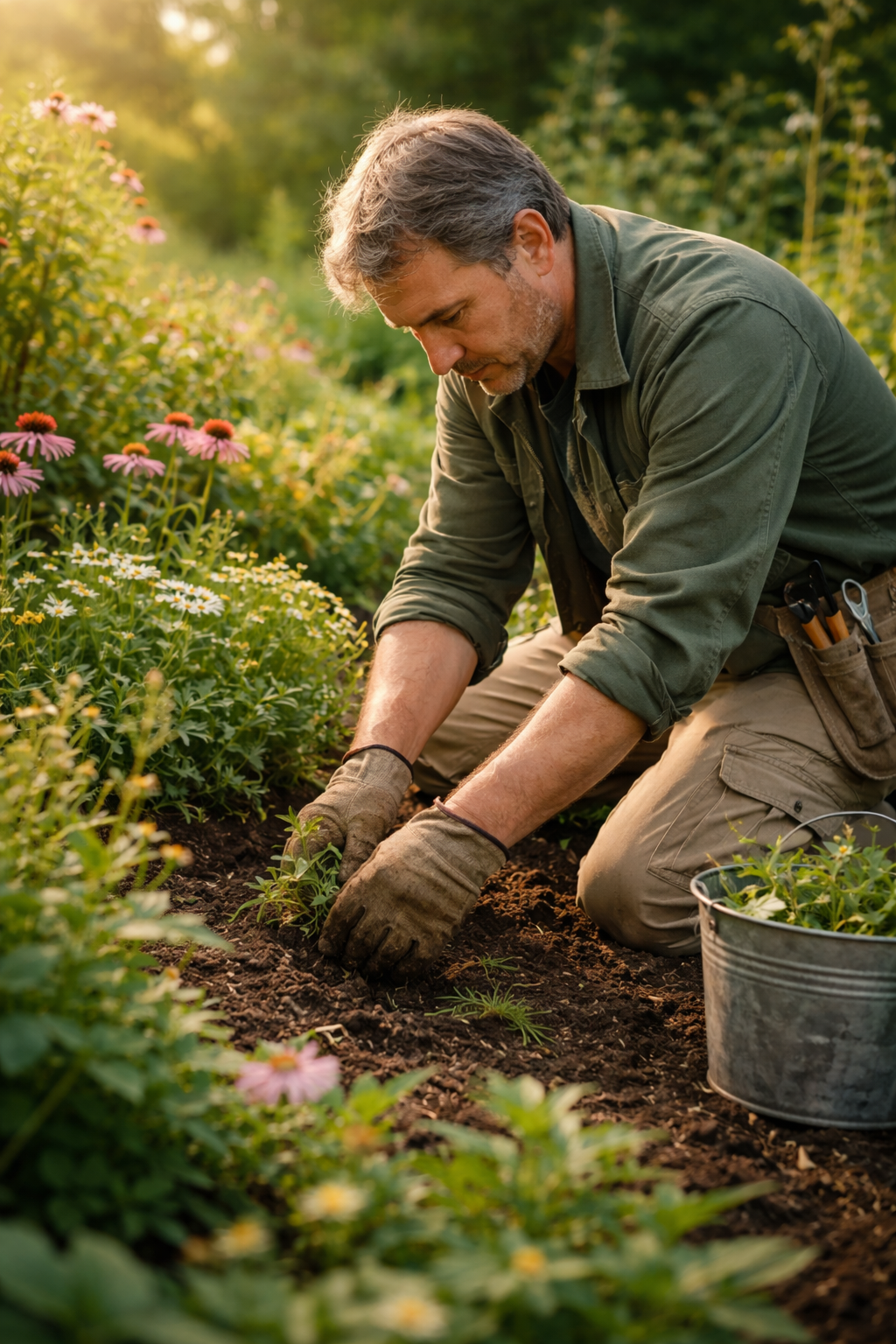
| I’m weeding a bed. It’s one of those jobs that barely registers anymore — hands moving automatically, roots teased out cleanly, soil falling back into place with a soft sound you only notice if you’ve done this long enough. My body knows what to do. My mind wanders. That’s usually when the bigger thoughts arrive. Gardening gives you space to think because the work is honest. There’s no performance in it. You either do the job properly or the garden tells on you later. You can rush, but you can’t cheat time. Plants don’t care about intention, policy, or optimism. They respond to conditions, timing, and restraint. That makes a garden a good place to think about the future. I’ve watched trends come and go. Wildflower phases. Neat phases. Pollinator drives. Rewilding buzzwords. Every few years, there’s a new idea about what gardens should be, how land should be managed, how nature should be “fixed.” But the soil I’m kneeling on has been here longer than any of that. It’s seen more plans than I ever will. It responds not to targets, but to attention. When you weed regularly, you stop seeing weeds as enemies. They’re messengers. Chickweed tells you one thing. Bindweed tells you another. Moss creeps in where drainage has been ignored. Compaction shows up before plants fail. A garden speaks quietly, but constantly. The problem with many big systems — environmental targets included — is that they don’t listen for signs. They count outcomes. Gardens don’t work like that. They run on signals. That’s why so many grand biodiversity plans struggle on the ground. They’re designed to be measured, not tended. They reward installation, not maintenance. They prefer visible change to slow improvement. A garden teaches you the opposite lesson early on: most of the work that matters looks like nothing at all. As I work, my thoughts drift further ahead. Ten years. Twenty. Fifty. A hundred. Not in a dramatic way — more in the background hum of things. You can feel the world tightening a bit. Systems feel stretched. The weather is less predictable. Costs higher. Supply chains are thinner. Confidence in big solutions is weaker. None of this feels sudden if you spend your life outdoors. You see change arrive gradually, then all at once. Gardens, though, remain repairable. A neglected bed can be brought back. Soil structure can be improved. Balance can be restored. That matters. In a future that feels increasingly brittle, repairability becomes one of the most valuable traits anything can have — landscapes included. This is where thoughts about technology, and especially AI, start to creep in. You hear a lot of noise about it replacing jobs, transforming work, and reshaping everything. Some of that is true. Some of it is hype. From where I’m kneeling, the picture looks clearer and quieter. AI is very good at certain things. It can analyse patterns quickly. It can optimise schedules. It can model climate data, predict outcomes, handle paperwork, generate plans, and tidy up complexity. In gardening and land work, it will absolutely have a role. It can help with planting plans, irrigation timing, soil analysis, reporting, forecasting, and administration. It will change how offices function. It will change how decisions are supported. But there are limits that become obvious the moment you touch the ground. AI doesn’t feel soil readiness. It doesn’t notice when something is just slightly off. It doesn’t smell rotten before it’s visible. It doesn’t make sense for a plant to be stressed before symptoms appear. It doesn’t read a garden as a living history shaped by previous hands, past weather, old mistakes, and quiet successes. Most importantly, it doesn’t care. And care is not an optional extra in land work — it’s the whole job. The future gardener isn’t replaced by AI. If anything, the role deepens. The job shifts away from brute labour and toward stewardship. Toward judgment. Toward knowing when not to act. When to leave space. When to stop tidying. When to say no to a well-meaning idea because the ground isn’t ready. Restraint is a skill. Patience is a skill. Attention is a skill. None of them automates well. As the world becomes more mediated by screens, dashboards, and abstract models, gardens become something else entirely. They become cooling systems. Flood buffers. Food supplements. Wildlife corridors. Places of mental repair. They become proof that not everything needs to scale to be valuable. A well-kept small space can do more for real resilience than a poorly managed grand scheme. This changes how I think about the future of work. The people who will cope best aren’t necessarily the ones who can move fastest or extract the most. They’re the ones who can maintain. Who can notice early? Who can fix small problems before they become expensive ones? Gardeners sit firmly in that category, even if the world hasn’t fully caught up with that yet. There’s also something else that happens as systems become more complex: trust shifts. People trust individuals more than institutions. They trust the person who turns up, who knows their land, who remembers last year, who notices things they’ve missed. That quiet trust is built slowly and lost quickly. It can’t be generated by software. When I think fifty or a hundred years ahead, I don’t picture a collapsed world or a utopia. I picture a slower one. A smaller one. One where maintenance matters more than growth. Where land skills carry real weight. Local knowledge is valued because global systems are expensive and fragile. Where people understand that living systems don’t respond well to force, but thrive under care. AI will be part of that world. It will help us plan better, waste less, and see patterns we used to miss. But it won’t replace the human role in living systems. It will sit alongside it, useful but secondary. The danger isn’t AI itself. The danger is forgetting what can’t be delegated. I pull the last weed from the bed and sit back for a moment. It’s not perfect. It never is. But it’s healthier than it used to be. That’s usually the best measure of good work. Improvement, not transformation. Continuity, not control. Gardening teaches you that the future isn’t something you conquer. It’s something you tend. Slowly. Repeatedly. With your hands in the soil and your eyes far enough ahead to notice what’s changing — but close enough to care about what’s right in front of you. |
Unless stated, featured images are my own work, created independently or with the assistance of AI.

