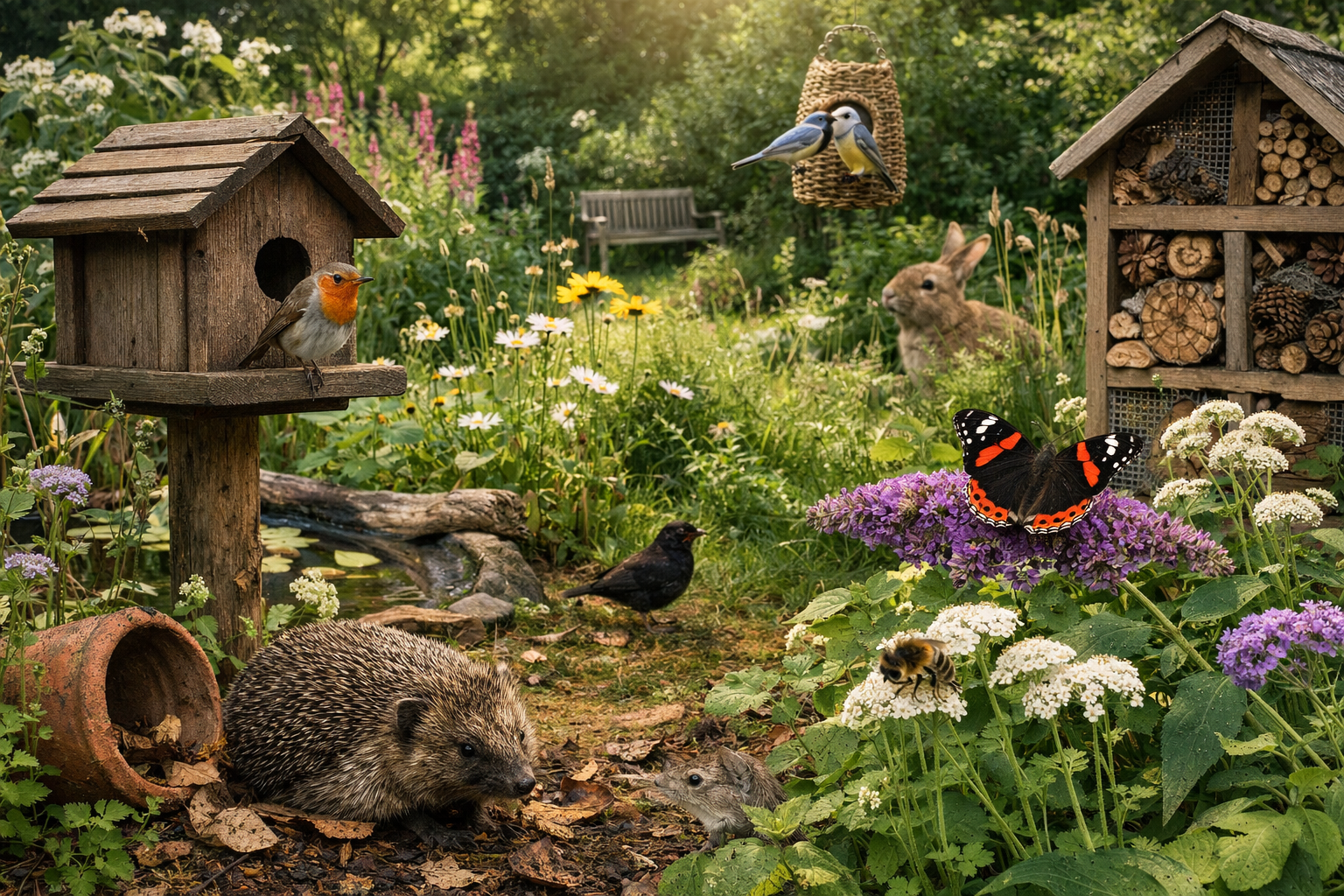
| Gardening is often spoken about in terms of people. What we like. What looks good? What feels orderly. What adds value? But the longer I’ve worked with gardens, the clearer it’s become that people are only one part of the equation — and not always the most vulnerable one. Every garden is already occupied long before we arrive with tools. Birds, insects, mammals, soil organisms — they don’t ask permission, but they do depend on the decisions we make once we take responsibility for a space. They don’t get a say in how often something is cut, cleared, sprayed, lit, or stripped back. And yet those choices determine whether they survive there at all. That’s where gardening quietly becomes something else. Not just maintenance. Not just aesthetics. But advocacy. The garden that changed how I see things There is one garden I work in that I often think of as a reference point. It belongs to a client who wants it kept wild — but not abandoned. It still needs to function as a garden. Paths must remain passable. Growth needs managing. But control is not the priority. I treat it as a goodwill garden. A place where gardeners can learn restraint. Where we can slow down, observe, and understand what happens when you stop trying to dominate a space and instead work with it. But personally, it does more than that. That garden has a particular calm. Not the neat calm of clipped edges, but a deeper steadiness. Birds arrive before you see them. Insects don’t scatter at the first disturbance. You’re aware of movement at ground level — small mammals passing through, unseen but present. Standing there, it becomes obvious that while people enjoy the space, they are not its primary residents. They’re visitors. The garden belongs, first and foremost, to the life already living in it. That was the point at which I stopped thinking of gardening as something done purely for clients and started seeing it as work done on behalf of others who have no voice at all. What gardens are actually doing A garden is not neutral. Every action taken within it has consequences. Cutting, clearing, spraying, lighting, paving — none of it is passive. It either removes habitat or preserves it. It either interrupts life cycles or allows them to continue. Modern gardening culture often leans towards control. Lawns are cut weekly. Borders stripped clean in autumn. Hedges clipped hard at the wrong time of year. Leaves removed because they look untidy. We call it care, but much of it is about making nature behave in ways that suit human preference. Wildlife doesn’t thrive in perfection. It survives in complexity. Shelter comes from mess. Food comes from flowering, seeding, and decaying plants. Overwintering insects rely on leaf litter and hollow stems. Birds rely on hedges that aren’t reduced to green walls. Soil life relies on being left alone often enough to do its work. Gardening as advocacy means recognising that what looks “done” to us can look like erasure to everything else. The tension between expectation and responsibility The biggest tension I encounter in my work isn’t between effort and reward — it’s between expectation and consequence. Some clients want perfectly disciplined gardens. Crisp edges. Immediate results. A sense that nothing is left to chance. Often, there’s no malice in this. It’s cultural. It’s how gardens have been presented for decades. What’s missing from that expectation is an understanding of what those choices remove. Shelter. Food. Continuity. Resilience. Thankfully, most of the gardens I work in allow for balance. But when the pressure for control appears, it’s my job to pause and consider who pays the price for that control. Because it’s rarely the person who owns the garden. Advocacy doesn’t always mean refusal. Sometimes it means negotiation. Slowing the pace. Suggesting alternatives. Leaving areas untouched. Allowing parts of the garden to exist without constant interference. Lines I won’t cross There are certain things I simply won’t do. I don’t use chemical treatments in gardens. Not because it sounds virtuous, but because I’ve seen what they do. They don’t just target a problem — they disrupt entire systems. They silence soil life. They remove insects that other species rely on. They simplify environments until very little can survive. Instead, I use organic remedies wherever possible. They take longer. They require observation rather than reaction. They ask you to understand why a problem exists rather than just remove the symptom. When I explain this to clients, I keep it straightforward. Quick fixes often come with long-term damage. And once living systems are removed, they don’t return on demand. Who the garden is really for People often ask which creatures I focus on protecting. The answer is all of them. Insects. Birds. Soil life. Mammals. None operates in isolation. Gardens work as systems, not features. Remove one part and the rest weaken. Soil life supports plants. Plants support insects. Insects feed birds. Birds help regulate balance. Mammals move seeds and shape edges. Every part matters, even the ones we rarely see. Advocacy isn’t about favouring one species over another. It’s about recognising interdependence and choosing not to break it for the sake of appearance. Restraint as a form of care One of the most valuable skills in gardening isn’t knowing when to act — it’s knowing when not to. Leaving seed heads through winter. Allowing ivy to flower. Letting leaves settle where they won’t cause harm. Reducing noise. Working with seasons rather than against them. These aren’t signs of neglect. They’re signs of attention. Restraint allows life to continue without constant disruption. It gives space for things to recover, adapt, and persist. In a culture that values speed and visibility, restraint can feel uncomfortable. But for the creatures living quietly within our gardens, it’s often the difference between presence and absence. The quiet responsibility gardeners carry Gardens are one of the last places where ordinary people make daily ecological decisions without regulation or oversight. That makes them powerful, whether we acknowledge it or not. Gardeners carry a responsibility that doesn’t come with titles or platforms. We decide what stays. What goes. What survives. What doesn’t? For me, that responsibility comes down to accountability. Managing every garden with an awareness that it is more than a backdrop. It is a habitat. It is a shelter. It is part of a wider, fragile network. Gardening as advocacy doesn’t require speeches or slogans. It happens quietly, through choices repeated day after day. And over time, those choices accumulate. That’s why it matters. |
Unless stated, featured images are my own work, created independently or with the assistance of AI.

