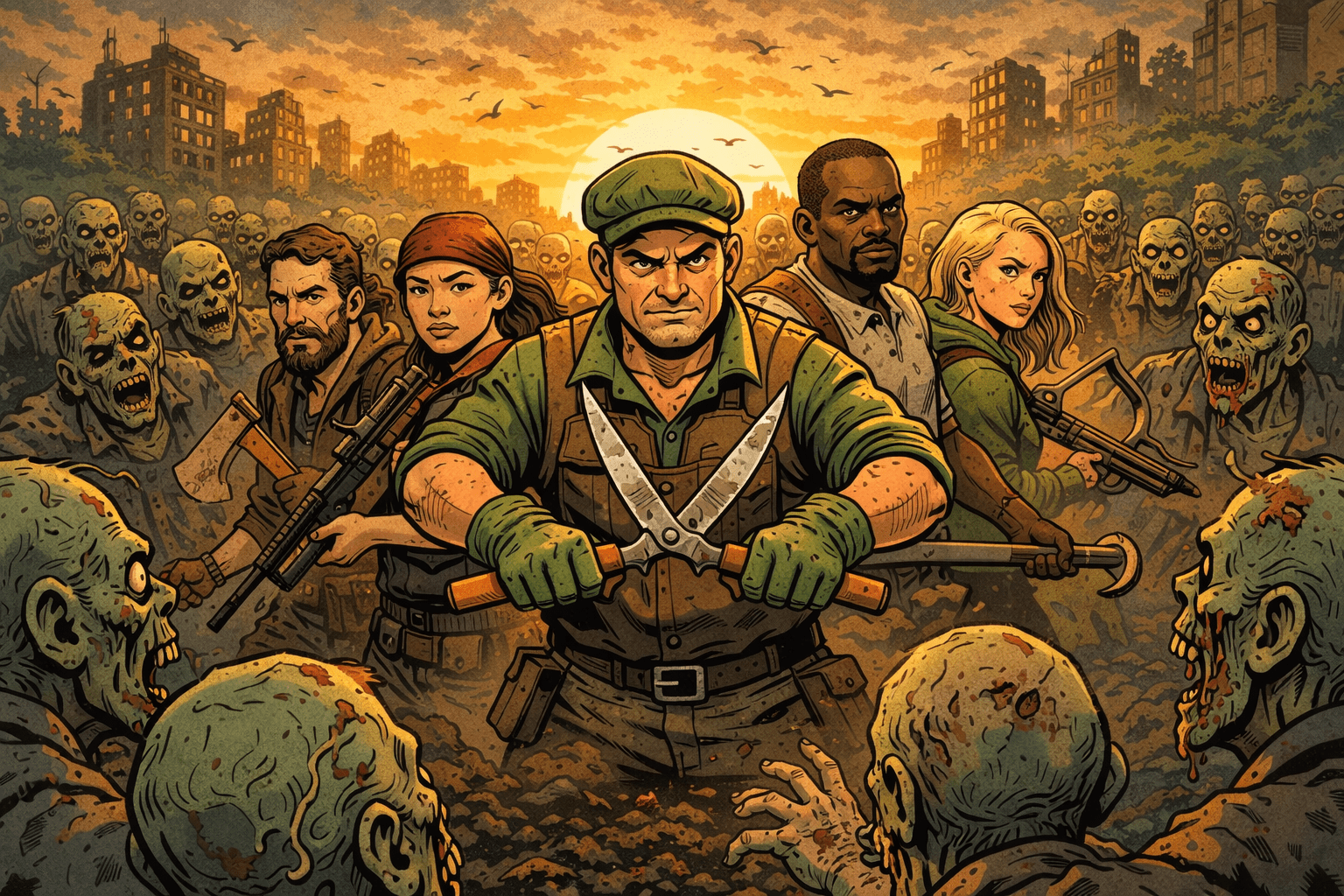
| Why You’d Want a Gardener on Your Team This piece exists because of a comment. Not a grand theory. Not a manifesto. Just a throwaway line left beneath a blog post, by King Ben’s Grandma, wondering — with more sense than she probably realised — whether gardening might turn out to be a surprisingly useful career if the world ever truly fell apart. So let’s take that idea seriously. Not literally, but properly. With mud on our boots and a clear eye. Let’s imagine the zombie apocalypse arrives. Not as metaphor or social commentary, but in the old-fashioned sense: shambling dead, collapsed infrastructure, supermarkets stripped bare in days. Power goes. Phones die. The internet has become something people talk about in the past tense. Once the screaming stops, the question isn’t how to kill zombies. That bit is always over-explained. The more interesting question is what happens next — to land, to food, to labour, and to the planet itself. And quietly, this is where the gardener becomes useful. |
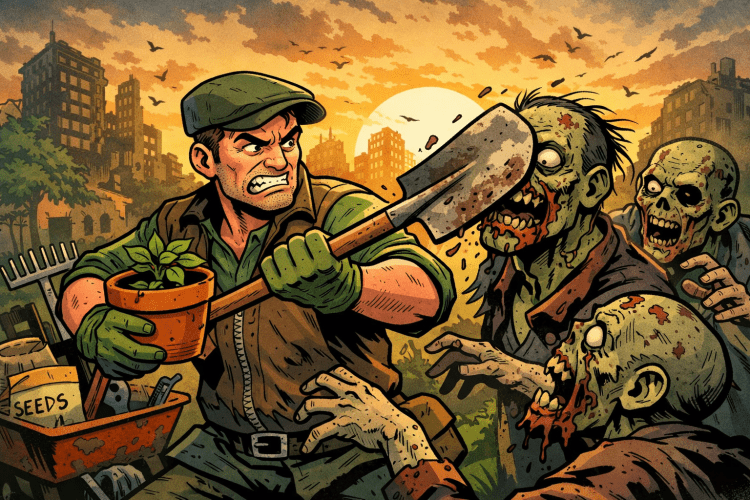
| When Human Order Pauses, Nature Accelerates One of the first things a gardener would notice is how fast the world begins to soften. Tarmac cracks. Gutters green over. Buddleia and willowherb colonise the places where cars once sat. Lawns revert to something wilder and more honest. Borders ignore their original intentions entirely. This isn’t speculation. We already know how quickly this happens. Leave a garden alone for a year, and it doesn’t become empty — it becomes busy. A zombie plague would be catastrophic for people, but oddly restorative for everything else. Industrial noise drops away. Emissions collapse. Wildlife returns to places it never really left, just learned to avoid. Gardens, allotments, parks and small agricultural plots become some of the last functioning human systems, not because they are romantic, but because they already operate without complexity. They rely on soil, water, time, and attention — nothing more. A gardener wouldn’t be surprised by this. They have watched the order unravel and reassemble on a smaller scale throughout their entire working lives. Why Gardeners Don’t Panic (Much) Gardeners are often described as optimists. This is a misunderstanding. What gardeners actually have is a working relationship with failure. Crops fail. The weather turns. Soil degrades quietly when neglected. Plans collapse without drama. The apocalypse would simply be a larger version of the same truth: not everything survives, and nothing behaves exactly as intended. One of the first internet myths to die would be the idea that you can “just grow your own food.” You can’t — not quickly, not easily, and not without knowledge that is learned slowly and usually the hard way. Gardeners understand limits. They understand seasons. They understand that soil must be built before it can be relied upon. They also understand that eating all the seed potatoes is a mistake you only make once. Survival, in this context, isn’t about heroics. It’s about restraint, planning, and accepting that nature does not negotiate. After the Panic: The Zombie Problem Nobody Likes to Discuss Zombie stories tend to end once the living win. They rarely linger on the awkward middle chapter where the threat is reduced but not erased. Let’s assume humanity adapts. It always does. Populations stabilise. Outbreaks are contained. The undead become less an existential horror and more an ongoing logistical nuisance. Eventually, someone asks the question nobody wants to say out loud: What do we do with them now? Killing them all is brutal and wasteful. Locking them away requires resources that no longer exist. Leaving them to wander isn’t an option. This is where the gardener — usually the quiet one — starts thinking differently. |
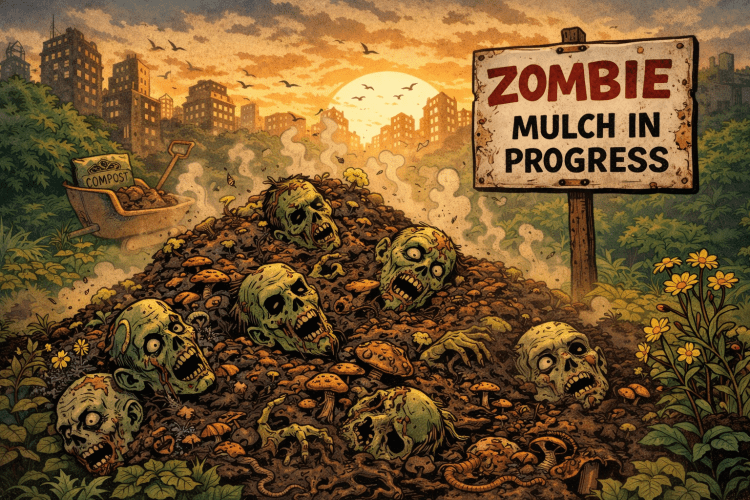
| The Unavoidable Question of Nutrients And then there is the final, deeply uncomfortable thought. Gardeners think in terms of inputs and outputs. What feeds the soil? What exhausts it. What returns, eventually, to usefulness. Death, in a garden, is never the end of the story. It is a transition. So when zombies finally stop walking, the question follows naturally: what then? A human body is, at its most basic level, a bundle of nutrients. Nitrogen, phosphorus, potassium, calcium. Trace elements are accumulated over a lifetime. Strip away the sentiment, and what remains is material. This is not fertiliser in any quick or tidy sense. Fresh organic matter is dangerous. It burns. It stinks. It harbours pathogens. Any gardener who has dumped too much green waste in one heap knows how fast things can go wrong. But time changes everything. Laid out across a field, left to weather, broken down slowly by fungi, bacteria, insects and worms, those bodies would eventually lose all identity. Years later, nothing recognisable remains — just darkened organic matter, crumbly, diggable, biologically neutral. Not fertiliser in a bag. Mulch in the truest sense: material that has stopped being itself. There’s a grim poetry in that. Not punishment. Not justice. Just ecology doing its indifferent accounting. A gardener wouldn’t celebrate this. Nor would they recoil. They would treat it as they treat fallen trees, spent crops, animal remains — with caution, respect, and gloves on. Because one of the quieter truths gardening teaches is this: Nothing is wasted by nature — only misplaced by humans. Rebuilding Isn’t Fast. It’s Careful. Once survival stabilises, the real work begins. And it isn’t dramatic. Rebuilding doesn’t start with cities. It starts with food systems, water management, soil repair, and places that can function year after year without collapsing under their own weight. Another myth dissolves here — that progress is linear. Gardeners know progress loops. Seasons repeat. Gains are temporary unless maintained. Systems either regenerate or degrade. There is no neutral. The post-apocalypse world wouldn’t look futuristic. It would look agricultural. Local. Slower. Less impressed with scale. And calmer. A Quiet Ending The reason King Ben’s Grandma’s comment landed isn’t that it was funny — though it was — but because it touched something true. When complex systems fail, what remains valuable are people who understand cycles, limits, and care. Gardeners don’t save the world in a single heroic moment. They save it by turning up, noticing what’s failing, and making small corrections over time. Even at the end of the world — especially then — you’d still want a gardener on your team. |
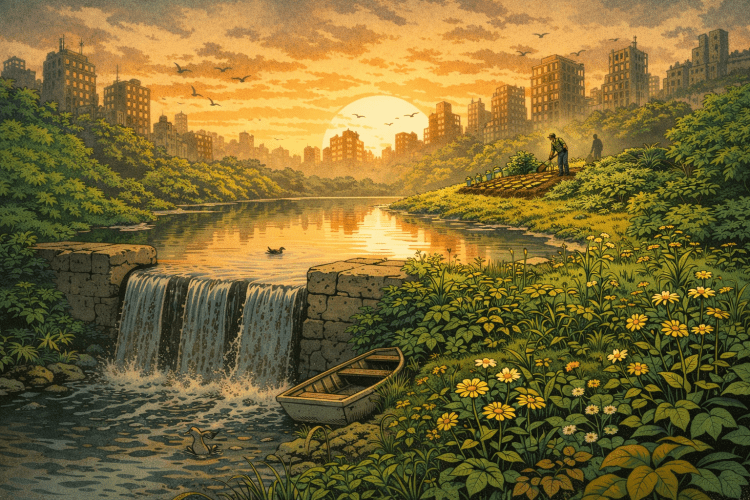
| Epilogue There’s also a certain relief that this thought experiment didn’t wander into robots. A robot apocalypse is all cold edges and hard stops. They don’t rot, don’t compost, don’t quietly disappear into anything useful. When robots fail, they just sit there — inert, toxic, and in the way. A field of broken machines is not a future; it’s a permanent problem. Zombies, for all their inconvenience, at least understand the assignment. They break down. They return. They eventually feed something else. From a gardening perspective, that’s the difference between a mess and a system. One you can work with. The other, you’re stuck with forever. |
| When the World Stops Working From time to time, it’s worth stepping back and looking at the garden not as something decorative, or even something to manage, but as a system that continues to function regardless of how well everything else is holding together. The idea of a zombie apocalypse is, of course, unlikely, but it serves as a useful starting point. Not because it’s realistic, but because it shifts the question away from dramatic survival and towards something more grounded — what already works when the wider systems we rely on begin to falter, slow down, or stop behaving as expected. Gardens do not panic. They adapt, rebalance, and carry on, often revealing problems gradually rather than all at once. Those who spend time in them tend to notice these changes earlier than most — when water becomes inconsistent, when soil begins to lose structure, when growth either struggles or quietly exceeds control — and these shifts rarely announce themselves. They simply become harder to ignore. This series, When the World Stops Working, will explore a range of unlikely scenarios, not as predictions or entirely as entertainment, but as a way of paying closer attention to the systems we already depend on. Each piece will take a small step away from the ordinary and ask what changes, and more importantly, what doesn’t. Because if things ever did begin to shift — whether suddenly or, more likely, gradually — the garden would continue in much the same way it always has. The question is whether we would understand it well enough to keep up. |
| About our writing & imagery Many of our articles are written by us, drawing on real experience, reflection, and practical work in gardens and places we know. Some pieces are developed with the assistance of AI, used as a drafting and research tool rather than a voice or authority. Featured images may include our own photography, original AI-generated imagery, or—where noted—images kindly shared by other creators and credited accordingly (for example, via Pixabay). All content is shaped, edited, and published by Earthly Comforts, and the views expressed are our own. |


A humorous look at the unthinkable future. How is Ange. Is she blogging still?
LikeLiked by 1 person
Morning Sadje, l haven’t heard from Angie for quite some time, l don’t think she is still blogging – she has made a few comments in the last six weeks, but we haven’t emailed each other for months. I will add that to my list of to do’s – how are you?
LikeLiked by 1 person
I’m good my friend. I hope you and Suze are doing well too. How is the situation with the other eye?
I miss Angie and did email her once long time ago. But from her last post I gathered that she is bogged down in more responsibilities. If you get in touch with her, give her my love.
LikeLiked by 1 person
Morning Sadje, today l finally have a pre-assessment for my left eye, with a view to getting the left eye surgery performed next month. Wrong time of the year in truth as l am at my busiest, but hey, the other side of the coin is that the left eye’s vision is fading, so the work needs to be done.
LikeLiked by 1 person
I know, but eyesight is much more important. All the best Rory
LikeLiked by 1 person
Very true Sadje,
LikeLiked by 1 person
👍🏼👍🏼👍🏼
LikeLiked by 1 person