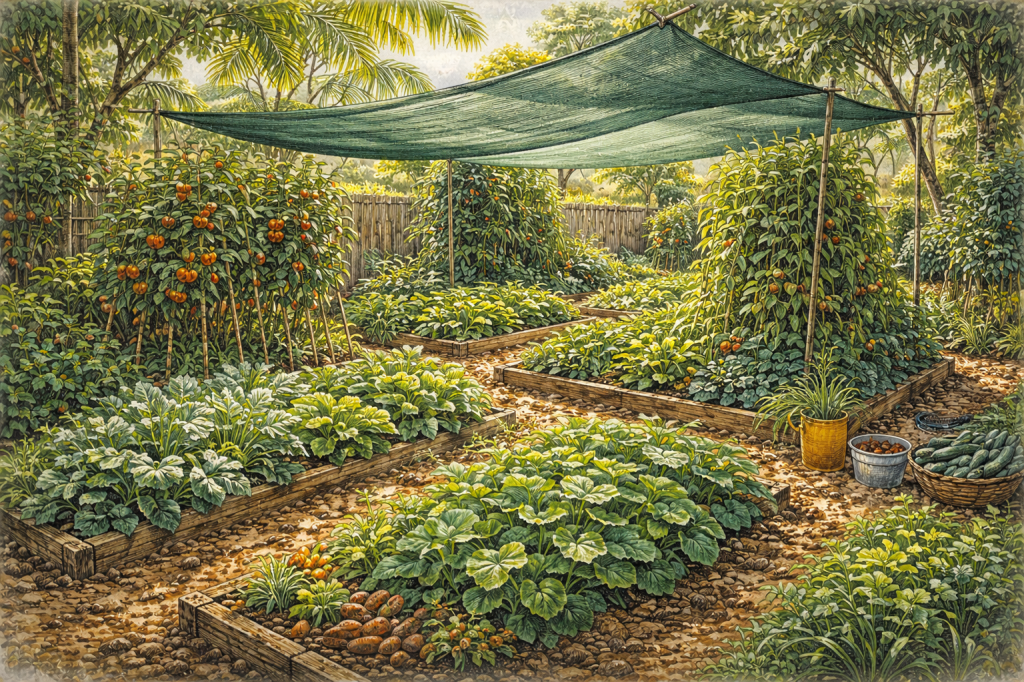
| Episode 14: Mark Valencia (Self Sufficient Me) Practical Self-Sufficiency in a Hot, Unforgiving Climate If Gardening Australia establishes the broad context of growing food across a vast and varied continent, Mark Valencia shows what that knowledge looks like when applied, tested, and refined in one place — day after day, season after season. Based in Queensland, Valencia is the creator of Self Sufficient Me, a platform built around doing rather than theorising. His vegetable gardens are shaped by heat, humidity, pests, and intense rainfall — conditions that quickly expose weak ideas and reward practical ones. Gardening Where Conditions Are the Teacher Subtropical Australia is not forgiving. Summers are long and humid. Pests are persistent. Growth is fast, but so is failure. Mark Valencia’s approach begins with acceptance: Plants will grow quickly — and collapse just as fast. Soil can degrade rapidly without protection. Pests are part of the system, not anomalies. Rather than fighting these realities, Self Sufficient Me focuses on working with them, adapting techniques until they hold up under pressure. Vegetables First, Always While the channel touches on broader self-sufficiency topics, vegetables remain central. Beds are continuously planted, harvested, replanted, and adjusted. Valencia consistently demonstrates: Succession planting to manage rapid growth cycles Heavy mulching to protect the soil from heat and rain Varietal selection suited to subtropical climates Simple structures for shade and airflow Nothing is presented as perfect. Everything is presented as usable. Learning Through Visible Results One of the defining features of Self-Sufficient Me is immediacy. Viewers see what works — and what fails — in real time. Experiments are not hidden behind edits or explanations. If a crop struggles, the reason is examined openly. If something thrives, it is repeated until its strengths and limits are understood. This transparency makes the channel especially valuable for gardeners in similar climates, who often struggle to translate advice from cooler regions. Low-Cost, High-Return Gardening Valencia places strong emphasis on cost-effective gardening. Expensive systems and specialist inputs are deliberately avoided unless they prove their worth. Common themes include: Homemade compost and soil mixes Repurposed materials Seed saving and propagation Avoiding unnecessary products This reinforces a key idea: self-sufficiency is not about owning more — it is about needing less. Why Mark Valencia Belongs in This Series Mark Valencia is included because he represents applied resilience. Within the Australian section: Gardening Australia provides breadth and authority. Self-Sufficient Me provides depth and proof. His work shows how vegetable gardening adapts to extreme conditions, but consistency matters. It also bridges the gap between education and lived experience — where theory is useful only if it survives contact with reality. A Global Audience for a Local Garden Although Valencia is rooted in Australia, its audience is international. Gardeners in tropical, subtropical, and increasingly warm temperate regions recognise their own challenges in this garden. As climates shift globally, the lessons demonstrated here — mulch deeply, shade intelligently, plant continuously, observe closely — are becoming more relevant far beyond Queensland. Where to Follow Self-Sufficient Me Self-Sufficient Me is shared primarily through: A highly active YouTube channel documenting vegetable growing, experiments, and self-sufficiency projects Social platforms focused on practical gardening updates. A long-running archive of climate-specific growing advice A Grounded Australian Voice As the fourteenth episode in this series, Mark Valencia brings the Australian section firmly down to earth. His garden is not symbolic or aspirational — it is functional. Vegetables are grown because they are needed. Methods are used because they work. And lessons are shared because others can benefit. In a world where gardening advice is often detached from conditions, Self Sufficient Me remains anchored in the one thing that never lies: the garden itself. |

