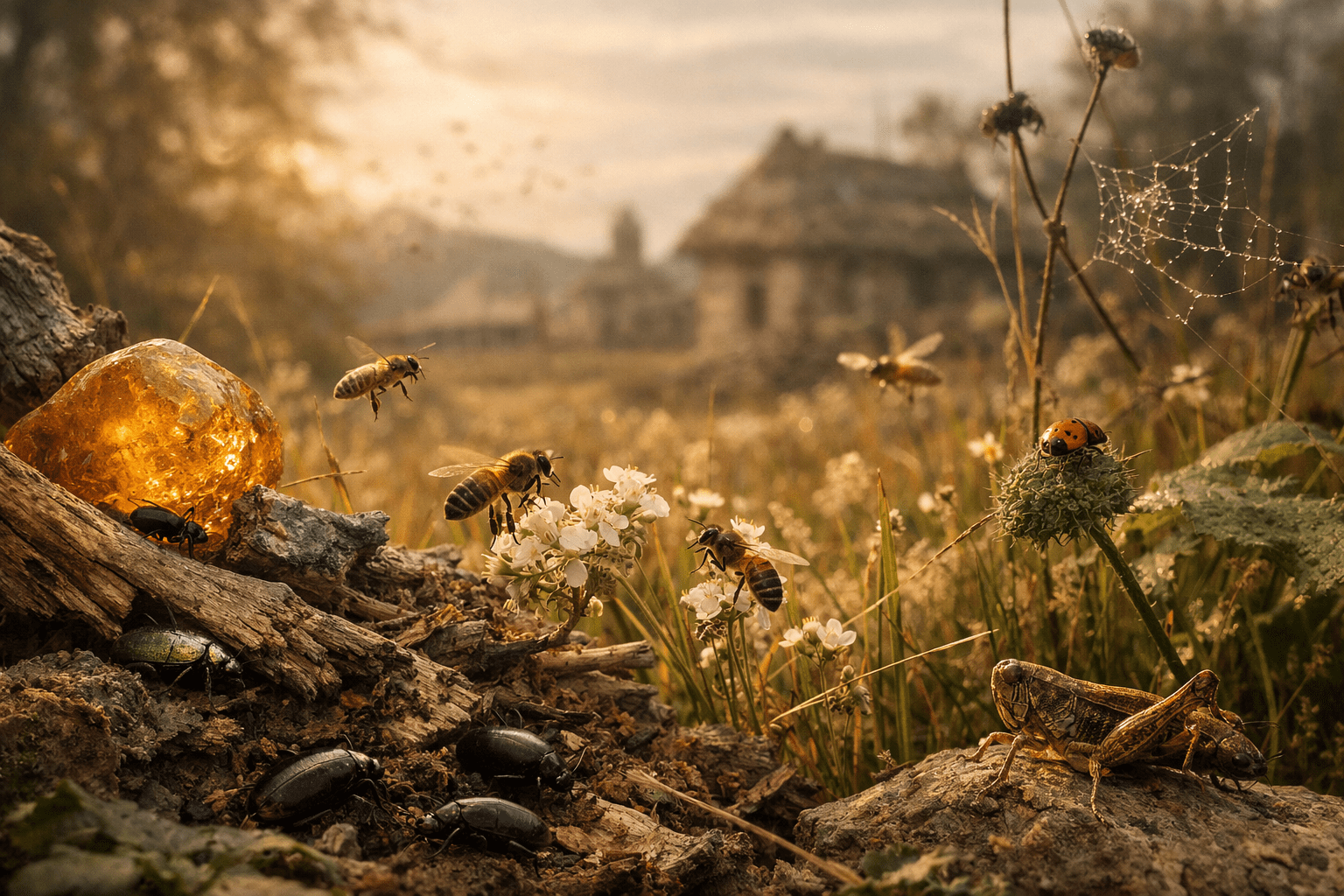
| How Insects Have Shaped Human History I’ve spent enough time with my hands in soil to know that history doesn’t only sit in books. It sits in the ground. It hums under hedges. It flickers briefly at the edge of vision and disappears again. Insects are like that. They don’t announce themselves, but they are always already there, doing the quiet work that makes everything else possible. When we talk about human history, we tend to picture tools, cities, wars, and trade routes. We draw timelines that jump from one big moment to another, as if the world politely held still in between. But beneath all of that—beneath the rise and fall and noise—there has always been a living layer that never stopped. Insects have shaped the conditions of human life for as long as humans have existed, and long before that, besides. They are not side characters. They are the stagehands, the engineers, the cleaners, the couriers, and sometimes the executioners. A world already at work By the time humans arrived, the planet was not raw material waiting to be improved. It was already organised. Insects had spent hundreds of millions of years shaping soils, pollinating plants, recycling death into fertility, and balancing populations. Flowering plants didn’t just “appear” and spread because they were attractive; they spread because insects evolved alongside them, forming relationships so tight that one often cannot survive without the other. That matters because early humans did not build civilisation from scratch. They inherited an ecological machine already in motion. The plants we ate, the animals we hunted, the water systems we relied on—all of it functioned because insects were already keeping things turning over. As a gardener, this is obvious in a way that’s hard to explain to someone who hasn’t seen it firsthand. You can strip a garden back to bare soil and, within weeks, life begins to organise itself. Not because of you, but because of what arrives uninvited. Ants mapping routes. Beetles breaking down what was left behind. Flies find an opportunity. Order emerging without instruction. Human history has always unfolded on the quiet competence of that kind. Farming: alliance and friction The shift from hunting and gathering to farming didn’t just change how humans lived; it locked us into a permanent relationship with insects. And like most long relationships, it has been equal parts cooperation and conflict. On the cooperative side, insects made agriculture viable. Pollinators allowed crops to reproduce reliably. Soil insects improved structure and drainage. Decomposers returned nutrients to the ground, allowing the land to be worked again and again. Even livestock systems relied on insects to manage waste and reduce disease. On the other side, farming created vulnerability. Concentrated food attracts attention. Anyone who has grown vegetables knows this instinctively: the moment you make something abundant, something else turns up to eat it. Scale that up to early civilisations, and insect pressure becomes a matter of survival. Grain stores drew beetles. Fields drew locusts. Entire harvests could vanish almost overnight. There’s a tendency, especially online, to imagine that “traditional” farming existed in perfect balance with nature, and that insects only became a problem with modern agriculture. That’s a comforting myth. Insects have always tested human food systems. What changed over time was not their impact, but our response—sometimes adaptive, sometimes destructive. Crop rotation, storage techniques, selective planting, and even early calendars were often responses to insect behaviour. Agriculture advanced not in spite of insects, but because of them. Wealth spun on small bodies. Some insects didn’t just shape survival; they shaped wealth and power. Silk is the obvious example, but it’s worth sitting with what that really means. A single insect species altered global trade, diplomacy, fashion, and political relationships for centuries. Knowledge of its life cycle was guarded more tightly than many military secrets. Routes formed, cities grew, and fortunes were made on the back of a creature that could sit comfortably on a fingernail. The same is true of dyes, wax, resins, and honey. These were not marginal products. They lit cities, sealed documents, coloured authority, and enabled record-keeping. Insects were not quaint rural companions; they were part of the economic infrastructure. From a gardener’s perspective, this isn’t surprising. You learn quickly that scale doesn’t equal importance. Some of the most consequential activity happens at the smallest level. Ignore it, and things unravel. Disease, movement, and the limits of power If insects helped build civilisations, they also set their limits. Insect-borne disease has redirected human history more decisively than many wars. Mosquitoes, fleas, lice—none of them set out to shape empires, but they did so anyway. Populations collapsed. Armies weakened. Colonisation stalled or failed entirely in places where insect pressure made long-term settlement impossible. What’s striking is how often this is framed as a historical footnote rather than a central force. We talk about military strategy and political ambition, then quietly acknowledge that disease “played a role”. In reality, insects often decided outcomes before human plans ever unfolded. Even now, with all our technology, we haven’t escaped this dynamic. Climate shifts are changing where insects can live and what they carry. Human movement, deforestation, and urban sprawl create new interfaces where old balances no longer hold. History hasn’t stopped; it’s just less obvious when we’re in the middle of it. How insects entered our thinking Beyond economics and survival, insects have always occupied a peculiar place in the human mind. They are familiar enough to be recognisable, alien enough to unsettle. They move differently. They live at scales we struggle to intuit. They act collectively in ways that challenge our sense of individuality. It’s no accident that insects appear again and again in symbolism and belief. They’ve been cast as models of order, omens of collapse, symbols of rebirth, warnings of excess. We read meaning into them because they sit so close to the boundary between control and chaos. I think this is partly because insects remind us, uncomfortably, that intelligence and organisation don’t require human traits. Watching ants solve problems or bees regulate a colony unsettles the idea that complexity belongs to us alone. Lessons learned sideways Humans have learned a great deal from insects, often without realising it at the time. Long before formal science, people observed patterns: how colonies functioned, how structures stayed cool, how materials performed. Termite mounds informed building design. Spider silk hinted at possibilities long before synthetic fibres existed. Swarm behaviour challenged top-down ideas of organisation. What’s important here is that these lessons weren’t extracted cleanly. They were noticed slowly, imperfectly, and often only after failure elsewhere. That’s still how learning tends to happen in gardens. You don’t impose a theory and expect the ground to agree. You watch, adjust, and accept that the system knows more than you do. The modern mistake The 20th century brought something genuinely new: the belief that insects could be controlled at scale. For a while, it looked convincing. Chemical controls reduced visible damage. Yields rose. Disease retreated in some places. Insects were rebranded as enemies, obstacles to progress, problems to be solved decisively. What that approach missed was context. Insects were never isolated variables. Removing them removes functions. Pollination declined. Soils lost resilience. Pests adapted faster than expected. The system responded, as systems do, but not in ways we liked. As a gardener, this shows up in small, everyday ways. You clear “everything”, and something worse moves in. You simplify, and fragility increases. Complexity turns out to be a form of strength. The idea that insects are optional—that we can pick and choose which ones we tolerate—is one of the quieter delusions of modern life. Insects as witnesses Today, insects are among the clearest indicators we have of environmental change. Their absence speaks as loudly as their presence. Fewer pollinators, fewer birds. Compacted soils, fewer beetles. Simplified landscapes, simplified life. This isn’t about nostalgia or sentimentality. It’s about recognising that insects are not accessories to nature; they are its operating system. When they falter, everything else becomes harder to sustain. What I find most telling is how often this is framed as a future problem. In truth, it’s already historical. We are living inside the consequences of decisions made decades ago, just as earlier societies lived inside the outcomes of theirs. A longer view Insects shaped the world before humans learned to name it. They will continue shaping it whether we pay attention or not. Our story, impressive as we like to think it is, runs through theirs—not the other way round. If there’s a lesson here, it isn’t that insects are noble or cruel or wise. It’s that they are persistent. They work at scales and timeframes that don’t care much about human confidence. They remind us that history is not only written by those who leave monuments, but by those who quietly maintain the conditions that make monuments possible in the first place. Stand still long enough in any garden, and you can feel that truth settling around you. |
| About our writing & imagery Many of our articles are written by us, drawing on real experience, reflection, and practical work in gardens and places we know. Some pieces are developed with the assistance of AI, used as a drafting and research tool rather than a voice or authority. Featured images may include our own photography, original AI-generated imagery, or—where noted—images kindly shared by other creators and credited accordingly (for example, via Pixabay). All content is shaped, edited, and published by Earthly Comforts, and the views expressed are our own. |


So very very important: if only all humans would think about the origins and development of their existence and their world!!
LikeLiked by 1 person
Oh absolutely!
LikeLike