| What it is, what it isn’t, and why gardeners keep circling back to it |
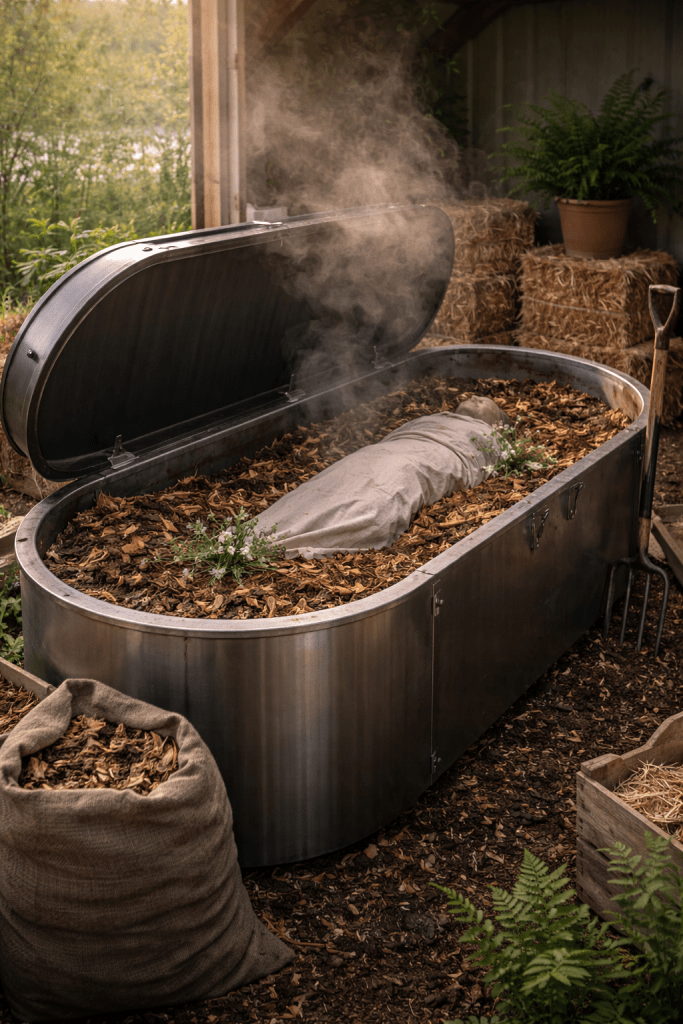
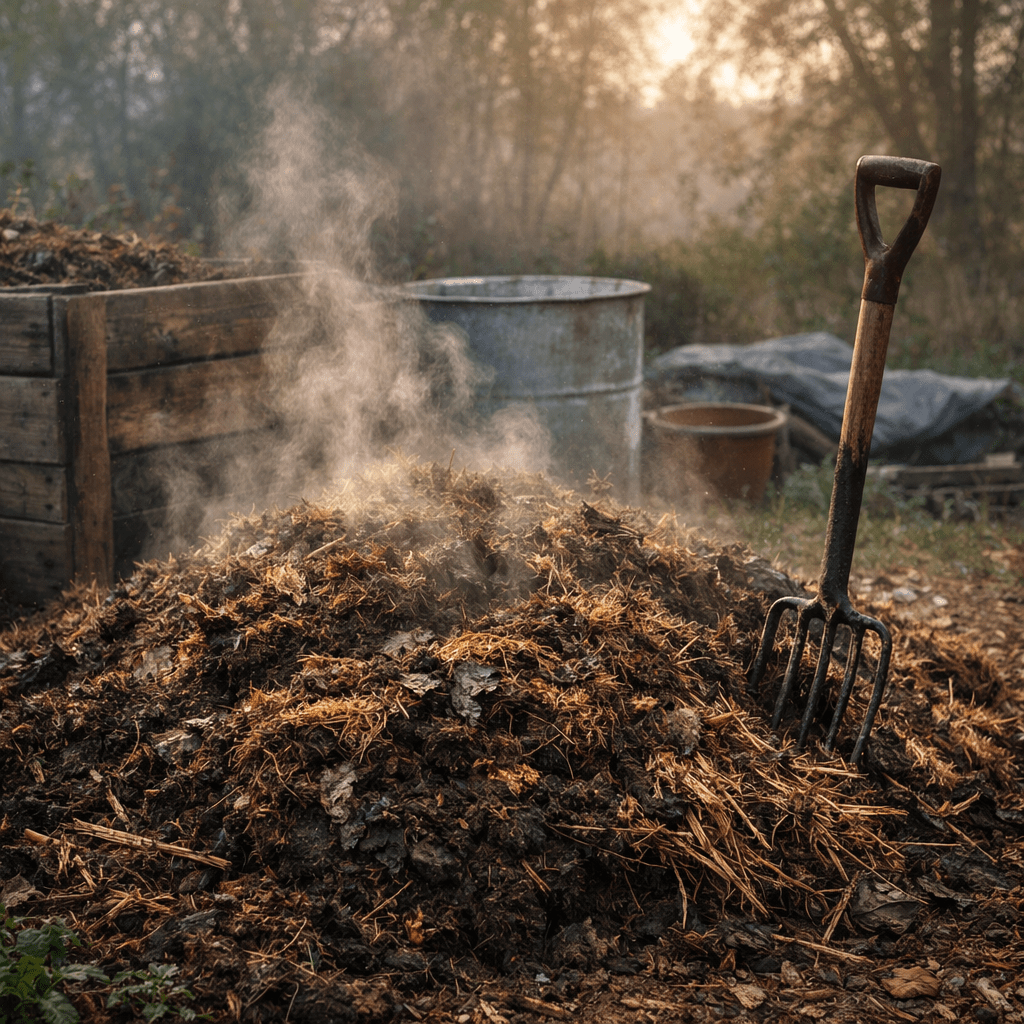
| I first heard the phrase human composting in the same way most people do now: half-glimpsed online, trailing a wake of raised eyebrows and nervous jokes. It sounds provocative, almost deliberately so. But once you put the phrase down and look properly at the practice it describes, it stops feeling like a stunt and starts to feel like something older, quieter, and oddly familiar. Gardeners tend to have a different relationship with endings. We spend a lot of time with decay, with the slow unravelling of structure, with the return of things to soil. That doesn’t make us mystical about it; if anything, it makes us practical. Rot is work. Breakdown is labour. It takes time, balance, and attention. Nothing simply disappears. Human composting — more formally called natural organic reduction — sits in that uncomfortable space where biology, culture, and grief overlap. It asks whether the same processes we accept everywhere else in the living world might also apply to us, and if so, how we feel about that. This isn’t a manifesto. It’s an attempt to look at the idea through the lens of soil, weather, and lived practice rather than headlines. What actually happens Stripped of the language that causes people to flinch, human composting is a managed biological process. A body is placed in a vessel with organic materials — typically wood chips, straw, and other carbon-rich matter — and conditions are carefully controlled. Over weeks, heat-loving microbes do what microbes have always done: they break complex structures down into simpler ones. The end result is soil-like material. Not soil in the romantic sense. Not something you’d spread under your roses without thought. But biologically stable, largely odourless, and recognisably part of the same continuum that governs every compost heap you’ve ever turned. What tends to surprise people is how undramatic it is. There is no spectacle, no urgency. The work is slow and largely invisible. As with any composting system, success depends on balance: oxygen, moisture, carbon, nitrogen, and temperature. Get those wrong and things stall or go sour. Get them right, and nature does the heavy lifting. The unease many feel comes less from the process itself than from the fact that it refuses to sanitise death. Cremation reduces the body to ash in a matter of hours, hidden behind industrial doors. Burial hides decomposition underground and outsources the work to time. Human composting keeps the biology front and centre, even if most people never see it. A gardener’s eye view Anyone who has stood over a steaming compost heap on a cold morning will recognise the principles at play. Heat is not an enemy here; it’s a sign of life doing its job. The smell, when managed well, is not rot but something sweeter, almost like damp woodland. When it goes wrong, it goes wrong quickly — and you learn to adjust. That practical familiarity changes how the idea lands. I don’t see human composting as radical so much as specific. It’s a controlled answer to a question gardeners quietly live with: how do you return material to the system without harm? In real gardens, compost is never neutral. What you put in matters. Treated timber, diseased plants, and persistent weeds — all require judgment. The same is true here. Human composting isn’t a poetic free-for-all; it’s regulated precisely because bodies are not blank inputs. Medicines, implants, and contaminants all need to be considered. One thing gardeners understand instinctively is that decomposition is not disrespect. Neglect is disrespect. Composting done badly is careless and unpleasant. Composting done well is attentive, contained, and oddly reverent. It acknowledges that breakdown is not failure but transition. The myth of “instant return.” One of the common internet myths around human composting is the idea of an immediate, circular return: you become soil, soil feeds the tree, the tree lives on as you. It’s a comforting image, but it’s also not how systems actually work. Even the best compost takes time to integrate. Nutrients don’t leap from heap to root overnight. There are pauses, lock-ups, and slow releases. The material produced by human composting is typically further cured before any use is considered, and its final destination is often carefully chosen or symbolic rather than practical. This isn’t a flaw. It’s honesty. Gardening teaches you that cycles are rarely neat. They are staggered, seasonal, and shaped by context. Expecting a clean loop does violence to how ecosystems really function. The more interesting truth is slower and less cinematic: matter becomes available again, eventually, under the right conditions, and not all at once. Environmental claims, with the brakes on It’s tempting to frame human composting as the green answer to burial and cremation, but that kind of language rarely survives contact with reality. Every method has trade-offs. Cremation uses significant energy and releases carbon. Traditional burial can involve land use, materials, and long-term management. Human composting requires infrastructure, monitoring, and space. It is not impact-free, and anyone suggesting otherwise is selling something. What it does offer is a different distribution of impact. Energy use is lower than cremation, but time and labour are higher. Space is used differently, but not infinitely. Regulation matters, because without it the risks — biological, emotional, cultural — increase. From a gardener’s point of view, this is familiar territory. There is no perfect system, only ones that align more closely with your values and context. Sustainability is not about purity; it’s about proportion. Death without marble There’s also a cultural question woven through all this. Human composting challenges the idea that permanence equals respect. Gravestones, vaults, sealed containers — they are all attempts to hold a moment still. Gardens teach the opposite lesson. Even the most carefully tended space is provisional. Paths shift. Trees outgrow their plans. Compost piles shrink. The work is ongoing, not final. For some people, that’s unsettling. For others, it’s a relief. The idea that you don’t need to leave a monument to have mattered. That your body, like every other living thing you’ve cared for, can be folded back into the processes that sustained it. That doesn’t make it suitable for everyone. Grief is not rational, and rituals exist for a reason. But it does widen the conversation beyond the narrow choice between fire and ground. Limits and boundaries One of the quieter realities of human composting is the level of trust it requires. Trust in operators, in regulation, in process. You are handing something profoundly personal over to systems and people you may never meet. Gardeners know this tension well. You can do everything right and still lose a crop to weather, pests, or timing. Control is always partial. The question is whether the system you choose fails gently or catastrophically. Human composting demands clear boundaries. Where does the material go? Who oversees it? How it’s handled. Without those, the romance collapses quickly. It also raises questions about scale. Composting works best when it’s matched to capacity. Pile too much in one place, and you lose balance. This is as true socially as it is biologically. Why the idea keeps resurfacing Every generation seems to rediscover human composting and react as if it’s entirely new. That alone suggests something unresolved. We are increasingly uneasy with the distance modern life puts between us and natural processes, especially at the edges: birth, illness, death. Gardening quietly resists that distance. You see failure. You see decay. You see the return. You learn that control is temporary and that care doesn’t end when something stops growing. Human composting doesn’t ask us to love death. It asks whether we can acknowledge it without pretending we’re exempt from the systems we depend on. For gardeners, that question feels less philosophical and more practical. We already live with the answer every time we turn a heap and feel the warmth rising back at us. Closing thought Whether human composting becomes commonplace or remains marginal is almost beside the point. Its real value lies in what it exposes: our discomfort with biology when it includes us. Gardens have a way of dissolving that discomfort, not by arguing but by showing. Nothing is wasted. Nothing is permanent. Care continues, just in a different form. If that thought makes you uneasy, it’s probably doing its job. |
| About our writing & imagery Many of our articles are written by us, drawing on real experience, reflection, and practical work in gardens and places we know. Some pieces are developed with the assistance of AI, used as a drafting and research tool rather than a voice or authority. Featured images may include our own photography, original AI-generated imagery, or—where noted—images kindly shared by other creators and credited accordingly (for example, via Pixabay). All content is shaped, edited, and published by Earthly Comforts, and the views expressed are our own. |

