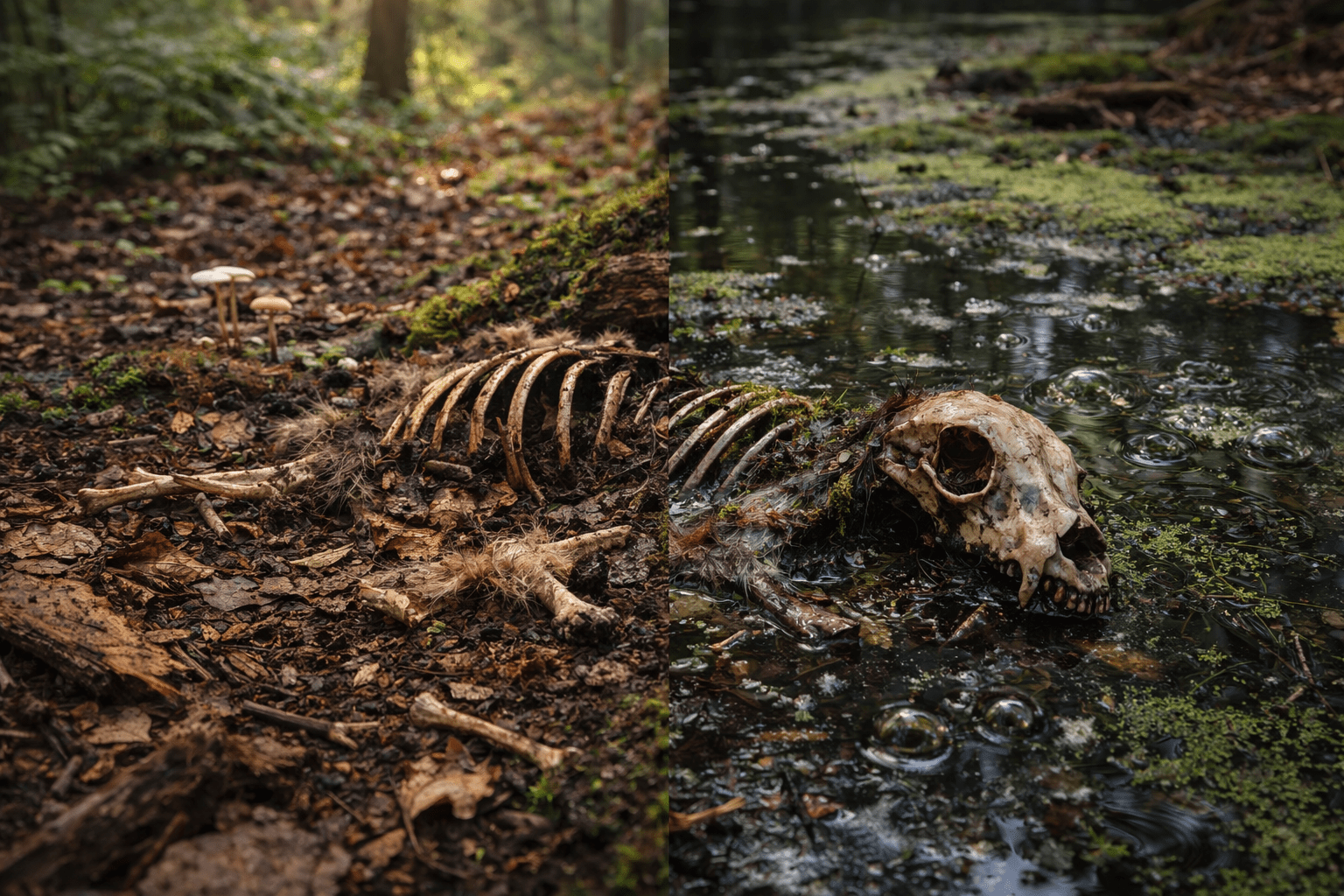
| How Decomposition Shapes Soil Fertility in Different Landscapes Part 1 When an animal dies in the wild, its final act is to become part of the living ground beneath it. Decay is not simply breakdown — it is transformation. As an animal decomposes, its tissues are chemically and biologically redistributed, creating nutrient pulses that influence soil life and plant growth. Studies of vertebrate decomposition have shown that as a carcass breaks down, nutrient-rich fluids enter the underlying soil, altering its chemistry and biological community. The area immediately beneath a decomposing body often exhibits much higher microbial and invertebrate activity than the surrounding soil, forming a distinct “cadaver decomposition island” where nitrogen, phosphorus, and carbon derivatives accumulate, stimulating local ecosystem processes. (ScienceDirect) The initial stages of decay are dominated by autolysis and microbial putrefaction, releasing organic compounds that fuel soil microbes. Research has documented predictable changes in soil bacterial and arthropod community structures in direct contact with decomposition zones compared with soils just a few metres away. (PMC) But the fate of these nutrients — and the broader implications for landscape ecology — vary considerably across environmental contexts, particularly between terrestrial woodlands and waterlogged wetlands. Decomposition on Dry Ground: Dynamic Cycling In well-aerated soils, such as those found in forests and grasslands, decomposition proceeds relatively quickly. Oxygen enables aerobic microbes and fungi to efficiently break down organic matter, cycling carbon and nutrients back into living biomass. Large carcasses in such settings have been documented to create long-lasting effects on soil and vegetation; the impacts of nutrient enrichment can persist for years, supporting enhanced plant growth long after visible remains have disappeared. (esajournals.onlinelibrary.wiley.com) These landscapes tend to have active nutrient turnover, meaning that carbon bound in dead tissue is rapidly released as carbon dioxide or incorporated into microbial biomass and plant roots. The result is a highly dynamic transfer of energy and elements that fuels ecosystems on short timescales. Wetlands: Slow Decomposition, Big Storage Wetlands — including bogs, fens, and peatlands — tell a different story. Because the soils are saturated, oxygen is scarce. Under these anaerobic conditions, the decomposition of organic material slows dramatically. Plant remains and other organic matter break down only partially, leading to the buildup of thick layers of soil organic carbon over time. (Wikipedia) Wetland soils are among the largest terrestrial carbon stores on Earth precisely because their waterlogged conditions suppress complete decomposition. Instead of fast nutrient cycling, wetlands favour accumulation. Carbon that would rapidly re-enter the atmosphere in a woodland may remain locked in peatland soils for centuries or millennia. (Wikipedia) This difference in decomposition pathways has important ecological consequences. Whereas dry ground channels nutrients back into living biomass quickly, wet ground sequesters carbon and stores organic matter long-term. This makes wetlands crucial carbon sinks in the global climate system — but also sensitive to changing water tables. If wetlands dry out, decomposition can accelerate, releasing previously stored carbon as carbon dioxide and potentially turning a sink into a source. (Wikipedia) Ecological Implications Across both landscapes, the decomposition of animal remains is not a single event but a cascade of processes that shape soil chemistry, biological communities, and vegetation patterns. In terrestrial ecosystems, decomposition islands mark fertile patches that can influence plant community composition. In wetlands, the slower cycling of organic matter ties into the long-term budget of carbon and nutrients. While the visibility of decomposition is fleeting, its ecological impact can be enduring — embedded in soil chemistry, microbial life, and the very structure of landscapes. |
| About our writing & imagery Many of our articles are written by us, drawing on real experience, reflection, and practical work in gardens and places we know. Some pieces are developed with the assistance of AI, used as a drafting and research tool rather than a voice or authority. Featured images may include our own photography, original AI-generated imagery, or—where noted—images kindly shared by other creators and credited accordingly (for example, via Pixabay). All content is shaped, edited, and published by Earthly Comforts, and the views expressed are our own. |

