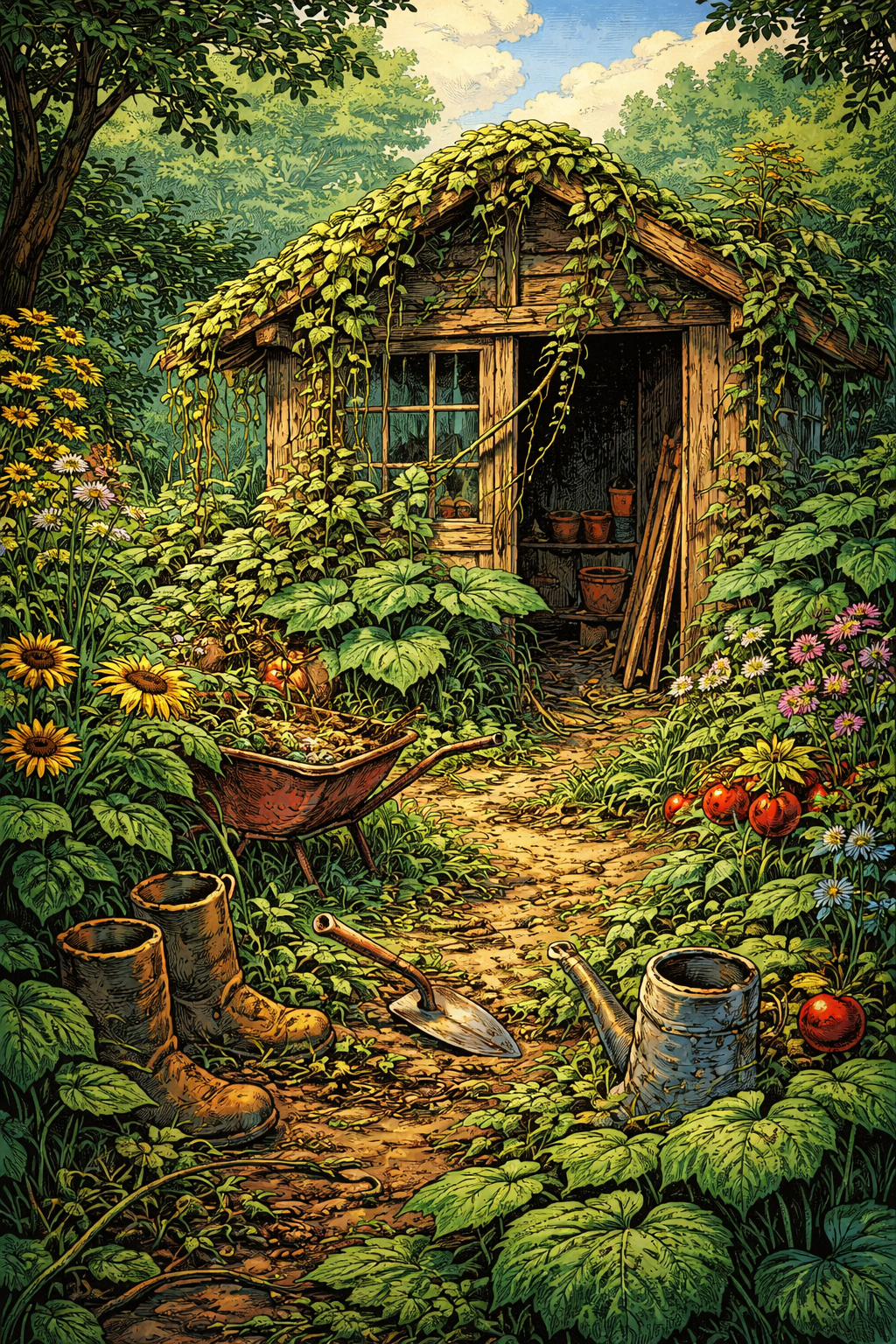
| There are moments, usually early in the morning or at the tail end of a long day. At these times, a garden looks as though it has quietly carried on without you. Not in a dramatic way. Nothing has changed all at once. But things seem to have moved on slightly — a new shoot appears, a plant leans differently, or a space feels more settled into itself. It’s easy to assume that the work we do is what holds everything together. We cut, shape, edge, and guide. We intervene often enough that the garden begins to feel like something that depends on us. And to a degree, that’s true. But only to a degree. Because the garden is not passive. It doesn’t wait for instruction. It responds, adjusts, competes, and recovers. It fills gaps, takes advantage of opportunities, and quietly reorganises itself in ways that don’t always align with what we had in mind. It’s worth considering now and then what would happen if the garden simply continued without us. Not as a dramatic collapse into wilderness, but as a gradual shift — a garden uninterrupted. |
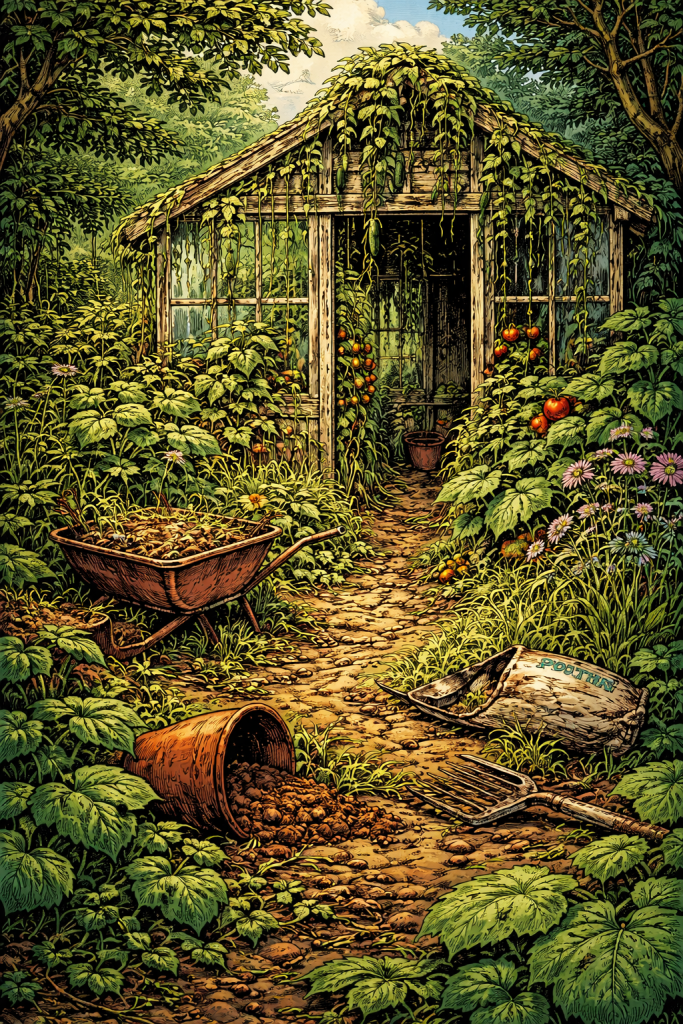
| At first, very little would appear to change. Lawns would grow slightly longer, borders would soften at the edges, and paths would begin to lose their sharpness. The structure would still be there, recognisable, just less defined. Most people would probably describe it as “a bit overgrown,” which tends to be the polite way of saying something is no longer behaving as expected. But here’s where things really begin to shift: what’s interesting is not the initial change. It’s what follows once the usual rhythm of intervention stops. Growth doesn’t slow down in the absence of management. If anything, it becomes more efficient. Plants begin to occupy space more decisively. Those well-suited to the conditions extend further, while others, less adapted, begin to fall back. It’s not a fair process, but it is consistent. A border that once held a mix of carefully chosen plants is beginning to reveal its hierarchy. Some plants spread confidently, filling previously open gaps. Others persist in small pockets, holding on where possible. A few simply disappear, not suddenly, but gradually edged out over time. You start to see which plants were being supported by attention, and which were quite capable of looking after themselves. It’s a useful distinction, though not always a comfortable one. There’s a common assumption that a well-kept garden is a healthy one, and in many cases, that holds. But it’s also true that some gardens look good because they are constantly corrected. Left alone, they don’t settle into a stable system; they unravel slightly, revealing that their balance was maintained rather than inherent. That’s not a criticism. It’s simply how designed spaces tend to behave. Without regular cutting, lawns don’t vanish. They transition. The fine, even surface gives way to variety — new grasses, broadleaf plants, opportunistic species that were always there but never had time to establish. The colour changes first, then the texture. Uniformity becomes a mixture. Eventually, something closer to a meadow forms, though not the kind you’d normally choose. Edges blur. Lines soften. The garden becomes less about separation and more about overlap. Some areas respond quickly. Gravel spaces seem low maintenance, but only stay that way with regular disruption. Without it, they host life almost at once. Small seedlings take hold between stones, roots push through compacted layers, and soon a static surface starts to shift. You could say the garden is reclaiming it, though that implies it was ever truly removed. It’s not that plants are trying to take over in any deliberate sense. They’re simply responding to conditions. Given space, light, and time, they will grow. Given competition, they will either adapt or be replaced. There’s no pause in this process, no moment where things hold steady and wait for instruction. This shift isn’t just theoretical. It soon plays out in practical terms. We already see what happens when attention drops. A missed visit, a delayed cutback, or a season that runs ahead of schedule are not unusual. The garden responds immediately — not aggressively, but decisively. Growth accelerates when it can, boundaries soften, and a sense of control loosens. It happens gradually but is easy to notice. Most of the time, we step back in and restore order. We cut back, redefine edges, and bring the space back to what it’s meant to look like. And it works, because the system still responds to that input. But it does raise a quiet question about how much of what we see as “normal” is actually the result of constant correction. There’s also a practical side to this. A garden that grows without intervention becomes harder to navigate, not just visually but physically as well. Access narrows, surfaces become uneven, and plants begin to encroach on spaces that were previously open. It’s not unmanageable, but it requires a different kind of movement, a different awareness of where things are and how they behave. You stop walking through the garden as if it were set out for you, and start moving through it more carefully, paying attention to what has changed. Some elements improve. Soil, for example, often benefits from less disturbance. Organic matter accumulates, microbial life becomes more active, and structure can recover if previously compacted. Less intervention allows some processes to re-establish. But this process is uneven. Gains in one area are typically offset by challenges in another. Over time, it becomes clear: the garden doesn’t fail without management. It shifts. It becomes something else — less controlled, less predictable, but not less functional. At this point, perception and reality begin to diverge. For most, a garden past its prime seems neglected. That’s partly true. But neglect implies decline, a loss of vitality. What happens is actually a redistribution of it. Energy is not lost. It’s redirected. Plants that were previously restrained take advantage of it. Others fade. The system continues, just along different lines. There’s a quiet irony in that. Much of gardening involves managing growth — encouraging it in some places, limiting it in others. Remove that layer of control, and growth doesn’t disappear. It simply becomes less selective. Nothing struggles from a lack of support. Things struggle because they are no longer protected from competition. And that’s a slightly different problem. This is where the gardener’s role becomes clear. It’s not about forcing a fixed shape or holding a state forever. It’s about guiding, intervening at the right moments, and understanding how different elements interact over time. Left alone, most gardens don’t become balanced, diverse systems. They tend toward dominance — certain plants, structures, or growth patterns outcompete others. Diversity, when present, often needs disturbance or intervention. That’s less obvious about gardening. Stability doesn’t always come from leaving things untouched. Often, it takes careful, regular involvement. So, the idea of a garden growing without us is less about abandonment and more about exploring what results when influence is withdrawn. And what remains is not chaos. It’s an order of a different kind. You begin to see which plants were suited to their position, and which were being supported into it. You notice how quickly space is occupied, how little is left unused. You see the pace of change when it is no longer interrupted. It’s not alarming, exactly. But it does have a way of adjusting your perspective. It becomes clear that the garden was never as dependent as we thought. It was responsive. It used what was offered, and when conditions changed, it adjusted. The darker edge of that, if there is one, is not that the garden would take over or become unmanageable beyond recognition. It’s that it would carry on quite comfortably without us. There would be no dramatic tipping point. No single moment where things cross the line. Just a steady, consistent shift toward something that makes sense in its own terms, not ours. And if you’ve spent enough time working in gardens, that’s not entirely surprising. Most of the effort goes into maintaining a particular version of the space — one that meets expectations and aligns with how we think it should look and function. Remove that effort, and the underlying system becomes more visible. Not better or worse, just different. It’s easy to assume that our role is central, that without it, things would fall apart. But more often than not, they don’t fall apart. They reorganise. And that’s a useful thing to keep in mind, not just as a thought experiment, but as a way of understanding what we’re actually doing when we work in a garden. We’re not creating something from nothing. We’re stepping into an existing system and temporarily shaping it to suit us. Which means that if things ever did stop working as expected — if attention became inconsistent, if resources became limited, if the usual routines were interrupted — the garden wouldn’t collapse. It would continue. The question is whether we would recognise what it was becoming, or spend our time trying to return it to something it no longer had reason to be. |
| About our writing & imagery Most articles reflect our real gardening experience and reflection. Some use AI in drafting or research, but never for voice or authority. Featured images may show our photos, original AI-generated visuals, or, where stated, credited images shared by others. All content is shaped and edited by Earthly Comforts, expressing our own views. |

