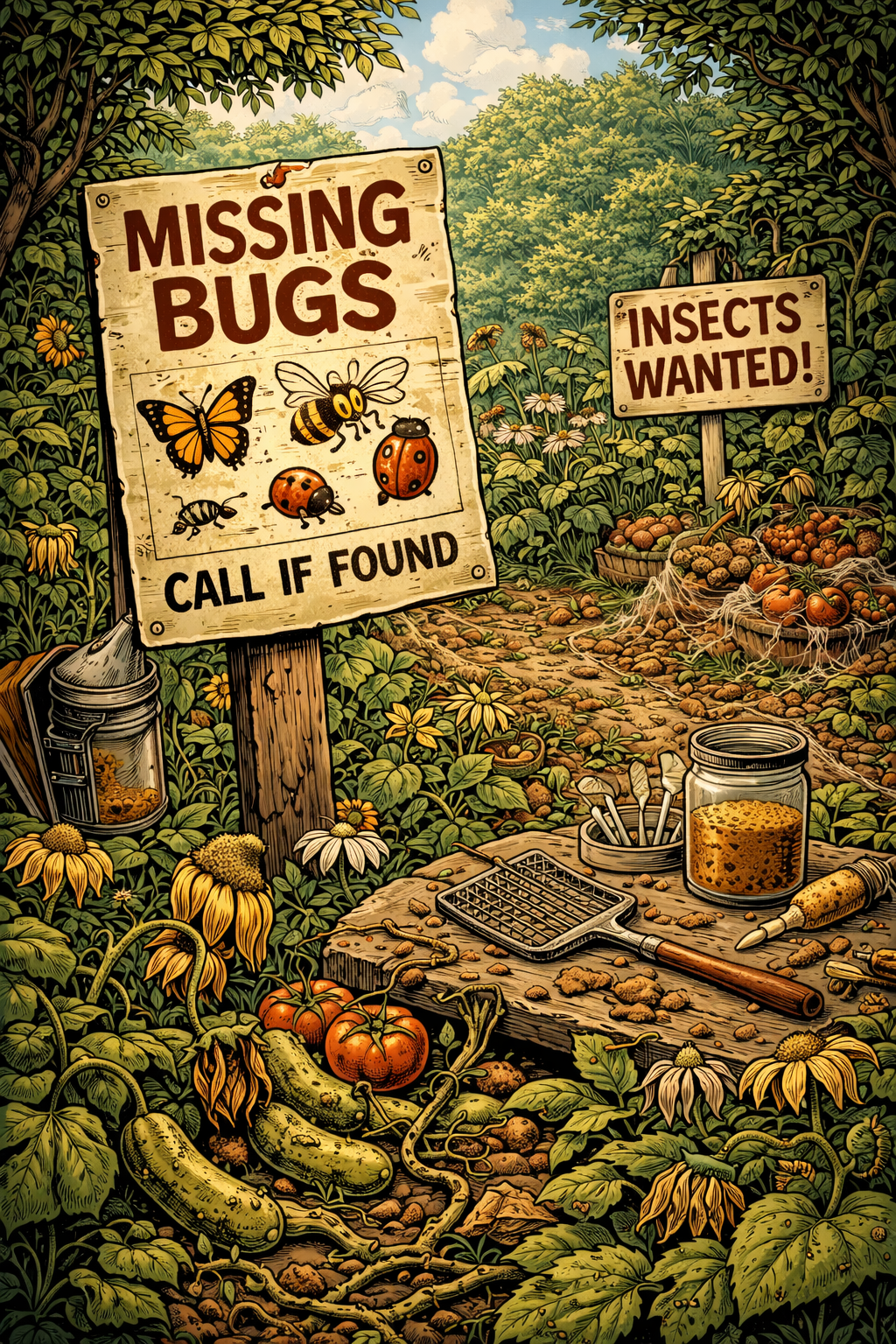
| We’ve all said it at some point, usually at the wrong end of an evening in the garden: “Damn these mosquitoes, I wish they didn’t exist.” It tends to feel like a reasonable position at the time. They are, after all, difficult to appreciate in the moment. But it does raise a slightly awkward question. What would actually happen if they didn’t? Not just mosquitoes, but insects more generally. If they simply weren’t there. It wouldn’t be obvious to begin with. That’s the first thing. The garden would carry on as it always has, at least on the surface. Growth would continue, leaves would emerge, borders would fill out, and if you were not paying close attention, there would be very little to suggest that anything fundamental had shifted. In fact, it might feel, briefly, like an improvement. Fewer interruptions, less movement, a quieter sort of space. That tends to be how these things start. Nothing stops. It just becomes slightly less busy. |
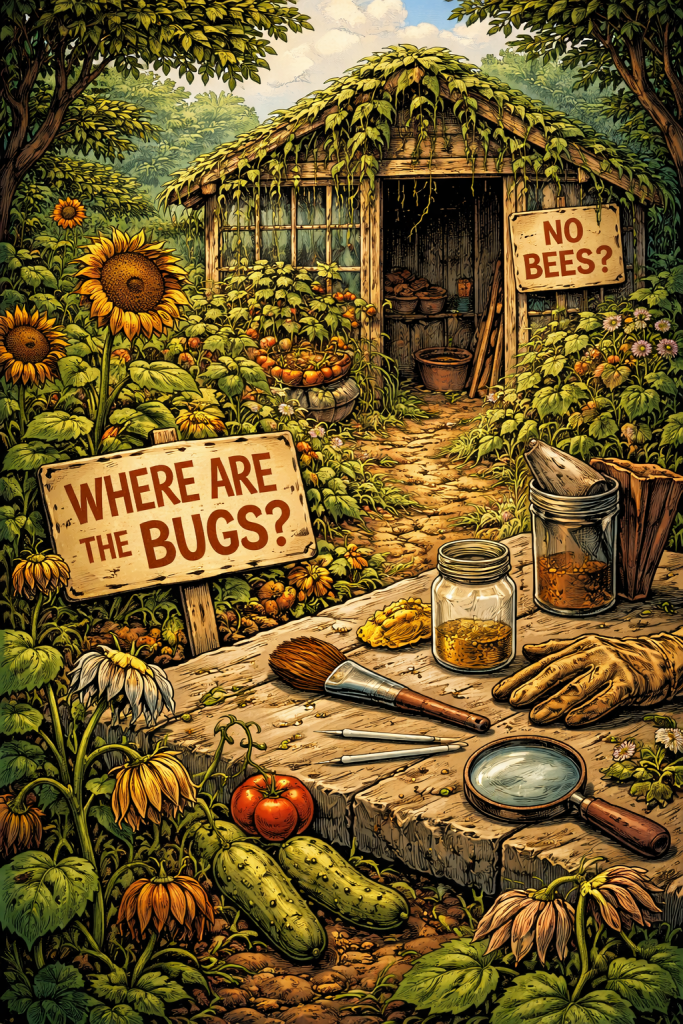
| The early signs would be subtle and, unhelpfully, inconsistent. Flowers would still appear, and in many cases, they would look as good as ever. But what follows would begin to vary. Fruit might set on one plant and not the next, or appear in smaller numbers without any clear reason. A border that usually carries itself from one year to the next through self-seeding would begin to thin, though not evenly enough to draw immediate concern. It would feel like a slightly poor season rather than a pattern, and then perhaps another one like it. Pollination is one of those processes that sits quietly in the background until it doesn’t, and when it doesn’t, it has a way of becoming noticeable all at once. Without insects moving pollen between plants, the link between flowering and fruiting becomes unreliable. Not absent, just uncertain, which is often harder to work with. Things would still happen, just not consistently enough to rely on. You might get results, but only after the fact, which is rarely when you need them. Over time, that inconsistency begins to shape the garden in ways that are not immediately dramatic but are difficult to reverse. Some plants cope better than others. Those less reliant on insect pollination continue much as before, while others begin to fall back. The shift is gradual but directional. Diversity narrows, not because growth has stopped, but because fewer things can complete their cycles reliably. The garden doesn’t fail. It simplifies, which sounds efficient until you realise what is being removed. There is also the quieter work that tends to go unnoticed when it is functioning properly. Insects contribute to the breakdown of organic matter, to the movement and cycling of nutrients, and to the general activity within the soil that allows it to respond as it should. Without them, decomposition slows, though not to the point of immediate concern. Things still break down, they just take longer, often in places you would prefer they didn’t. The soil becomes less responsive, holding onto material slightly too long, releasing it slightly too late. It continues to function, just not quite as cleanly. Balance shifts as well, though again not dramatically. Insects not only support the garden; they regulate it. Predatory species keep others in check, populations rise and fall, and most of the time, this happens without intervention. Remove that layer, and the system does not collapse, but it loses some of its ability to adjust itself. Certain pressures build where they might previously have been moderated, while others disappear altogether. The result is not chaos, but a kind of unevenness that is harder to read. From a working perspective, that is where the difficulty begins to show. A well-functioning garden offers signals. You can see when something is thriving, when it is under pressure, when it is finding its place. Without insects, some of those signals become less reliable. A plant may appear healthy but fail to produce. Another may persist in a reduced state without ever fully declining. You can respond, but you do so with less information and often a little later than is ideal. There would, inevitably, be an attempt to compensate. Hand pollination, for example, becomes an option, at least in theory. It is entirely possible in small areas, for certain plants, for a period of time. What becomes clear quite quickly is how much work insects were doing without being asked. Replicating that across a garden is not impossible, but it is rarely practical, and it tends to change how decisions are made. You begin to favour what works reliably without assistance. Not as a design choice, but as a necessity. Variety gives way to consistency, and the garden adjusts accordingly. It still grows, still produces, still responds, but within a narrower range of what can be sustained without constant input. There is a quiet irony in that. The absence of insects might feel like a reduction in nuisance, but it comes with an increase in responsibility. Processes that once took care of themselves now require attention, and often more of it than expected. The garden becomes calmer, but also more dependent. Nothing stops entirely, which would be easier to deal with. Instead, things continue to function just well enough to delay any real adjustment, and by the time the pattern becomes obvious, it is already established. That tends to be the way with these systems. They do not break cleanly. They drift. And the garden does carry on. It always does. It simply does so with fewer of the small corrections that once kept everything in balance, leaving the larger ones to be noticed a little later than is comfortable. It is easy to think of this as a distant possibility, something unlikely to affect a single garden in any immediate way. But parts of it are already visible, if not at this scale. Pollinators are becoming less reliable, seasons are shifting slightly out of step, and there are small inconsistencies that are easy to overlook or explain away. Nothing has stopped working. It has just become a little less predictable. Which, in practice, can be harder to manage. So the next time the mosquitoes make themselves known, it may still feel reasonable to wish them elsewhere. That part is unlikely to change. But it is worth remembering that they are part of a system that does more than inconvenience us. Remove them, and the garden does not fall apart. It simply becomes something that asks a little more of you than it used to. |
| About our writing & imagery Most articles reflect our real gardening experience and reflection. Some use AI in drafting or research, but never for voice or authority. Featured images may show our photos, original AI-generated visuals, or, where stated, credited images shared by others. All content is shaped and edited by Earthly Comforts, expressing our own views. |

