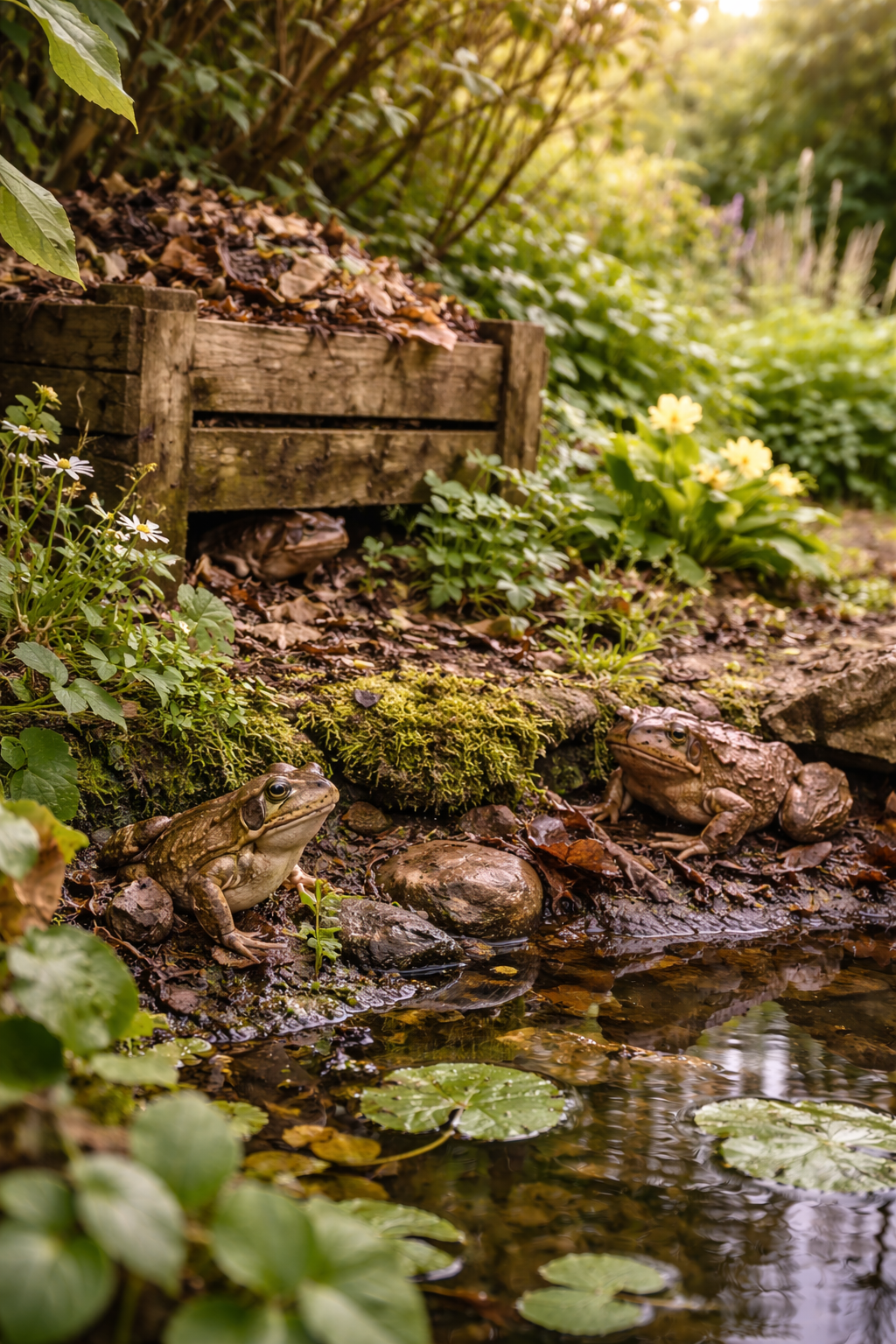
| Why damp corners are garden gold Spring does not always announce itself with birdsong or blossom. Sometimes it arrives quietly — in the form of movement where there was none before. A sudden ripple in a pond at dusk. A shape shifting beneath a compost heap. A soft, deliberate hop across damp ground after rain. Frogs and toads are among the most ancient garden residents, and spring is the moment when their hidden lives briefly surface. For much of the year, they remain out of sight, folded into the background of the garden. But as temperatures rise and moisture returns to the soil, they begin to move — guided by memory, instinct, and a deep reliance on places many gardens no longer value. To understand frogs and toads in the garden is to understand the importance of dampness, stillness, and spaces that are left alone long enough to matter. |
| Creatures of two worlds Frogs and toads live between worlds. They depend on water for breeding, yet spend much of their adult lives on land. Their skin absorbs moisture and oxygen directly, making them exquisitely sensitive to dryness, chemicals, and disturbance. In spring, this sensitivity becomes especially apparent. As nights warm and rainfall increases, frogs and toads begin migrating — often returning to the very pond or damp area where they were born. This journey can involve crossing multiple gardens, navigating fences, walls, and paths in landscapes that were once far more permeable. When they arrive, they are not looking for perfection. They are looking for familiar dampness. |
| Ponds: more than ornamental water A pond is one of the most valuable features a garden can offer frogs and toads — but it does not need to be large, deep, or decorative. Spring ponds provide: Breeding sites Shelter from predators A stable, humid microclimate Food for adults and tadpoles Frogs favour still or slow-moving water with plants that offer cover for spawn and developing tadpoles. Toads are often less particular and may breed in deeper or more shaded water, returning year after year to the same location. Importantly, a pond’s value extends beyond its edges. Frogs and toads spend much of their time away from water, sheltering in nearby damp ground, vegetation, and crevices. A pond without surrounding cover is only half a habitat. |
| Compost heaps: unexpected sanctuaries One of the most overlooked refuges for amphibians is the compost heap. Warm, moist, undisturbed, and rich in insects, compost heaps provide ideal conditions for: Daytime shelter Overwintering Protection during dry or cold spells In spring, frogs and toads may emerge from compost heaps that have remained intact through winter — often just as gardening activity resumes. Sudden turning or removal of compost can expose animals that have relied on that stable environment for months. This does not mean compost should never be used — only that awareness matters, particularly in early spring when amphibians are re-emerging. What looks inert may be alive with quiet dependency. |
| Damp corners and soft ground Frogs and toads avoid dry, exposed areas. They favour: Shaded borders Long grass Leaf litter Dense planting Areas near water but not in it Damp corners provide the humidity needed to regulate body temperature and prevent dehydration. In spring, when the weather can shift rapidly from warm to cold, these microhabitats offer a sense of consistency. Gardens that drain too quickly, are heavily paved, or are stripped back to bare soil often become inhospitable — even if a pond is present. Moisture held gently, not channelled away aggressively, makes all the difference. |
| Slug control without effort Frogs and toads are often celebrated — or misunderstood — as slug controllers. They do eat slugs, particularly small ones, but they are not selective pest managers. They feed on a wide range of invertebrates, contributing to balance rather than eradication. Their presence tends to coincide with: Reduced slug pressure over time Increased insect diversity Healthier soil ecosystems This happens not because frogs and toads remove every problem, but because they participate in a larger web where no single species dominates unchecked. In this sense, frogs and toads are indicators of balance rather than tools. |
| Why do amphibians disappear quietly? Frogs and toads are among the first garden animals to disappear when conditions become unsuitable. Chemical use, loss of damp habitat, sealed boundaries, and over-tidying all affect them disproportionately. Because they are nocturnal and secretive, their absence is often unnoticed until breeding stops entirely. A garden may still look green and active — but without amphibians, a key layer of life has gone missing. Spring is often when this absence becomes apparent, when ponds remain silent, and familiar movements do not return. |
| Moving carefully through spring Spring is a time of re-engagement with the garden, but for amphibians, it is also a time of vulnerability. Clearing leaf litter, lifting boards, turning compost, and cutting back dense planting can expose resting frogs and toads. Working slowly, in stages, and with awareness allows animals time to move away. It is not about avoiding activity — but about recognising that spring life often hides at ground level. |
| A measure of garden health Frogs and toads rarely tolerate instability. They return to gardens that remain predictable — where dampness persists, shelter remains in place, and routes are not suddenly blocked. When they are present year after year, it is a sign that the garden offers continuity across seasons. Their quiet persistence tells a story about what has been left, not just what has been done. |
| Garden gold in overlooked places Damp corners are rarely celebrated. They are shaded, muddy, slow to dry, and often considered areas in need of improvement or “fixed. But for frogs and toads, these are places of safety, feeding, and rest. In spring, when amphibians surface briefly before retreating again, the value of these spaces becomes clear — if we are watching closely enough. Because some of the most important life in the garden does not live where it looks best. It lives where it can stay damp, quiet, and undisturbed. |

