| Part 4 |
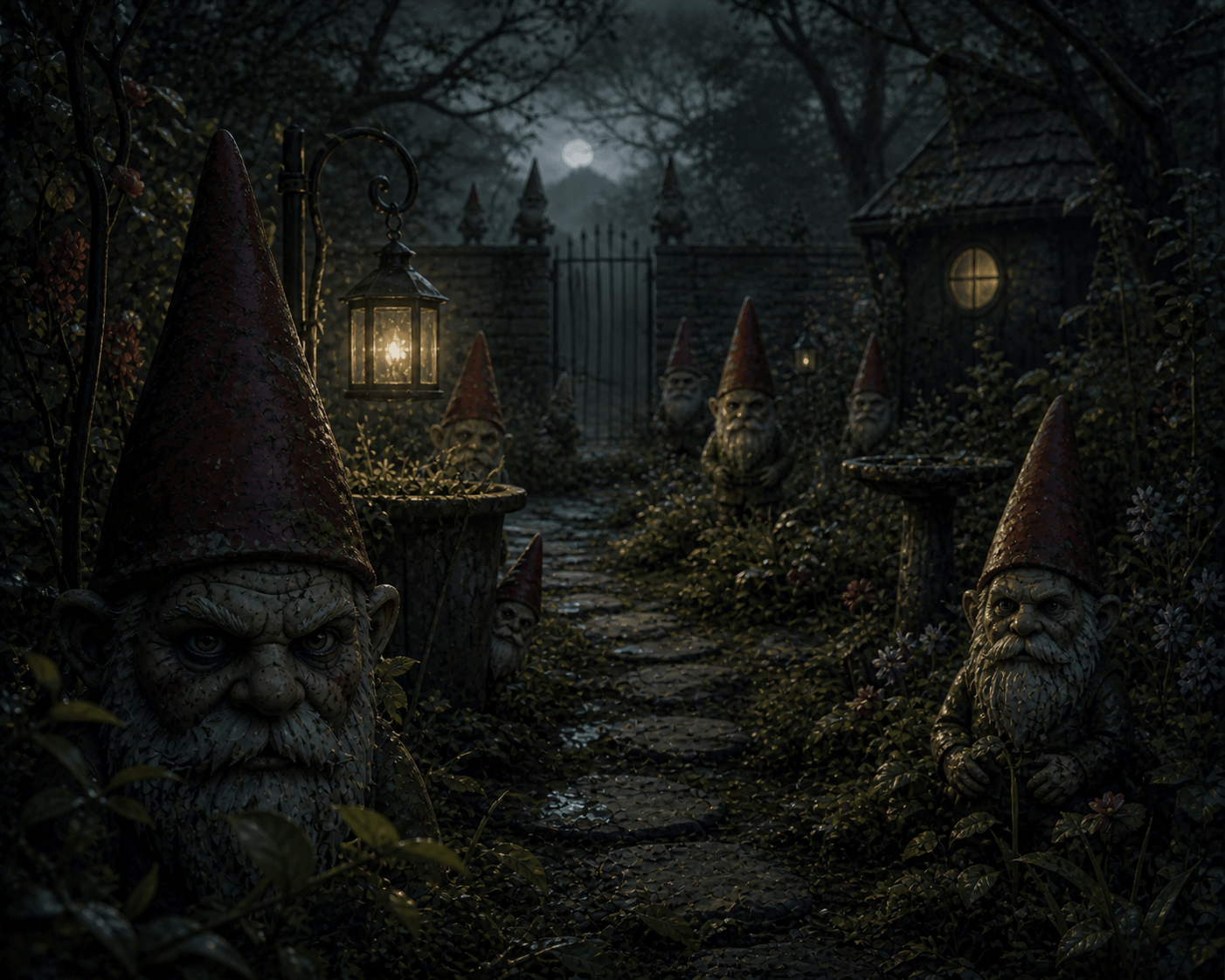
| I have never been particularly comfortable with gnomes, though I couldn’t explain why for a long time. Like most things you encounter repeatedly in other people’s gardens, you learn to accept them without much thought. They sit where they are placed, often long before I arrive, and they remain through seasons of work, weather, and gradual change. They are part of the job in the same way a difficult hedge or a poorly laid path is part of the job—something to work around rather than question. But over time, and more importantly, over repetition, something about them begins to settle differently. It is neither immediate nor dramatic. It builds slowly, through familiarity, through quiet observation, and through the accumulation of small, almost unnoticeable impressions that begin to align in a way that is difficult to dismiss once you’ve recognised it. A garden, as I have come to understand it, is never still. Even in its most controlled form, it is in a constant state of adjustment. Growth is only the most visible aspect of that. Beneath the surface, the soil is shifting, breaking down, reforming, holding and releasing moisture in response to conditions that change hour by hour. Roots expand, compete, and withdraw. Insects establish themselves, disappear, and return again in cycles that rarely align with human timing. Light moves across the space, altering not only how things look but how they behave. A garden left alone for a week is not the same garden you return to, even if nothing obvious has changed. Everything participates in that process. Even the elements we consider fixed—stone, timber, metal—show signs of it over time. They weather, settle, crack, soften, and take on the character of the place they occupy. They do not resist the garden; they are gradually absorbed into it. Gnomes, however, occupy a slightly different position within that system. They certainly take on the marks of time. Their colours fade, their surfaces roughen, moss begins to gather in the small folds of detail where moisture lingers. They become less distinct as objects and more visually integrated into the environment. But they do not respond. They do not shift in behaviour, only in appearance. They remain fixed in posture, fixed in orientation, fixed in a way that begins to stand out precisely because everything else does not. At first, this is easy to ignore. It registers as nothing more than a minor inconsistency within a complex environment. But the longer you work in the same gardens, the more these inconsistencies accumulate. You begin to recognise patterns, not because you are looking for them, but because repetition makes them difficult to overlook. There is a particular quality to the way gnomes are positioned, and it is consistent across gardens that have no other connection. They are rarely central. They do not occupy the garden’s primary space, where human activity is most concentrated. Instead, they sit at the edges, in transitional areas where one part of the garden gives way to another. At the base of trees, just inside the line of a hedge, slightly obscured by planting that is allowed to soften around them. These are not areas of focus but areas of passage, where movement occurs without much attention. And yet the figures themselves are almost always oriented toward that movement. Not directly, not in a way that feels staged, but with enough consistency that you begin to notice it. They face into the garden, toward paths, toward openings, toward spaces where someone might walk without thinking too much about where they are placing their feet. It is not a deliberate arrangement in the sense of formal design, but it is not entirely random either. Working alone in quiet hours makes this clearer. When immediate work demands drop and the rhythm slows, your awareness changes. The garden becomes more than tasks. Fixed elements stand out, not because they change, but because everything else softens around them. The gnomes hold their position. It is difficult to describe exactly what that does to the perception of the space, but it subtly alters it. They are not active in any sense, and I am not suggesting otherwise. But their presence introduces a point of reference that does not move, does not adapt, and does not participate in the garden’s ongoing life the way everything else does. They are, in that sense, outside of it, while still being entirely within it. Over time, gnomes feel less like additions and more like fixtures. That’s where unease, if that’s the word, emerges—through a slow shift in how you experience the garden. They stop being merely objects placed and start feeling as if they inexplicably belong. This is reinforced by the fact that they are rarely removed. I have worked in gardens that have undergone complete redesigns, where planting schemes have been stripped back and rebuilt, where structures have been altered or replaced, and where the entire logic of the space has been reconsidered. And yet, when the work is complete, the gnomes return. Sometimes they are returned to their original positions; sometimes they are moved slightly to accommodate the new layout, but they are not discarded. They persist through change in a way that nothing else does. Clients do not always articulate why. When asked, the answers are often vague or practical. They have always been there. They were given as a gift. They feel part of the garden. These are reasonable explanations, and there is no need to push beyond them. But taken together, across multiple gardens, they suggest something beyond simple decoration. The figures carry continuity. They anchor a sense of the garden that predates the current arrangement and will likely outlast whatever comes next. They are, in that sense, tied to the place rather than to its design. There is also something to be said for the way they change over time, not in form, but in presence. A new gnome is clearly an object. It stands out, its colours bright, its shape defined. It has not yet been absorbed into the garden, and so it reads as something separate. But as seasons pass, that separation diminishes. The edges soften, the colours dull, and the figure begins to take on the character of its surroundings. Moss settles into the creases, soil gathers at the base, small plants begin to grow around it, partially obscuring it, and then retreat again. Eventually, it stops looking like something that was placed there. It looks like something that has always been there. And that is where it becomes difficult to treat it as neutral. Because a garden is not a static environment. It is defined by change, by the constant interplay of growth and decay, by the way every element within it responds to conditions that are never entirely stable. To encounter something within that space that does not participate in that process, but instead endures unchanged in its form, creates a subtle imbalance. It is not enough to disrupt the garden, but it is enough to register. This does not affect the practical work. The soil behaves as it should, the plants respond as expected, and the presence of these figures has no measurable impact on the space’s health or function. But gardening is not only practical. It is also perceptual. The way a garden is experienced matters not only to those who spend time in it but also to those who work within it. And in that experience, the gnomes introduce a note that is difficult to ignore once it has been noticed. They do not move, but they are always present. They do not respond, but they are positioned in a way that suggests awareness. They do not change, but they accumulate time. They are not part of the garden’s living system, but they are not entirely separate from it either. They sit in that space between. It would be easy to dismiss this as projection, as the mind assigning meaning where none exists. There is truth in that. We constantly interpret our surroundings, drawing connections, recognising patterns, and filling in gaps where information is incomplete. But the consistency of the experience across different gardens, clients, and conditions suggests that there is something in the way these figures interact with the environment that produces this effect. Not intentionally, and not in any way that suggests agency, but as a consequence of how they are made, where they are placed, and how they are allowed to remain. They are, in the simplest sense, watchers. Not because they see, but because they are positioned to be seen from. They hold a line of sight within the garden that does not shift, and over time, that fixed perspective becomes part of how the space is understood. You register where they are without having to search. Their presence threads into your movement through the garden—not consciously, but as part of a broader sense of space. And in stillness, when the work slows and the garden quiets, that awareness becomes sharper. There is a particular point at the end of a day, just before leaving, when this becomes most apparent. The tools are put away, the immediate tasks are complete, and there is a brief pause before stepping out of the space. In that pause, the garden is no longer something you are working on, but something you are observing. It is then that the fixed elements stand out most clearly. The structure of the space, the shapes of the planting, the lines of movement—and among them, these small figures, positioned at the edges, holding their place. You become aware, in a way that is difficult to articulate, that the garden will continue without you. That everything within it will continue to respond to conditions, grow, shift, and adjust in ways you will not see until you return. And within that, there are elements that do not participate in that change but remain regardless. That is where the unease settles, if it settles at all. Not in the idea that something is happening beyond your understanding, but in the recognition that parts of the garden are constant in a way that everything else is not. The gnomes do not act. They do not influence the garden’s direction. They do not alter its course or its condition. But they stay, and in staying, they mark something that is otherwise difficult to define. They are not wildlife, and yet they occupy the same spaces. They are not part of the ecology, and yet they sit within it, absorbing its effects without contributing to its processes. They resemble something living, but they are entirely inert. They are, in that sense, the darkest of the garden’s inhabitants—not because they do anything, but because they do not. They lurk in the undergrowth, not as creatures, but as presences that have outlasted explanation. They gather the weight of time without participating in it, and in doing so, they create a quiet tension within a space that is otherwise defined by change. It is not enough to change how I work, and I would never impose it on a client’s understanding of their own garden. But it is there, in the background of the experience, shaping the way the space is perceived in small, almost imperceptible ways. And occasionally, as I close the gate and leave, there is a brief moment where that perception sharpens. The garden settles behind me, the movement reduces, and the fixed elements remain. The gnomes hold their place. And the garden, as it always does, continues without me. |
| About our writing & imagery Most articles reflect our real gardening experience and reflection. Some use AI in drafting or research, but never for voice or authority. Featured images may show our photos, original AI-generated visuals, or, where stated, credited images shared by others. All content is shaped and edited by Earthly Comforts, expressing our own views. |

