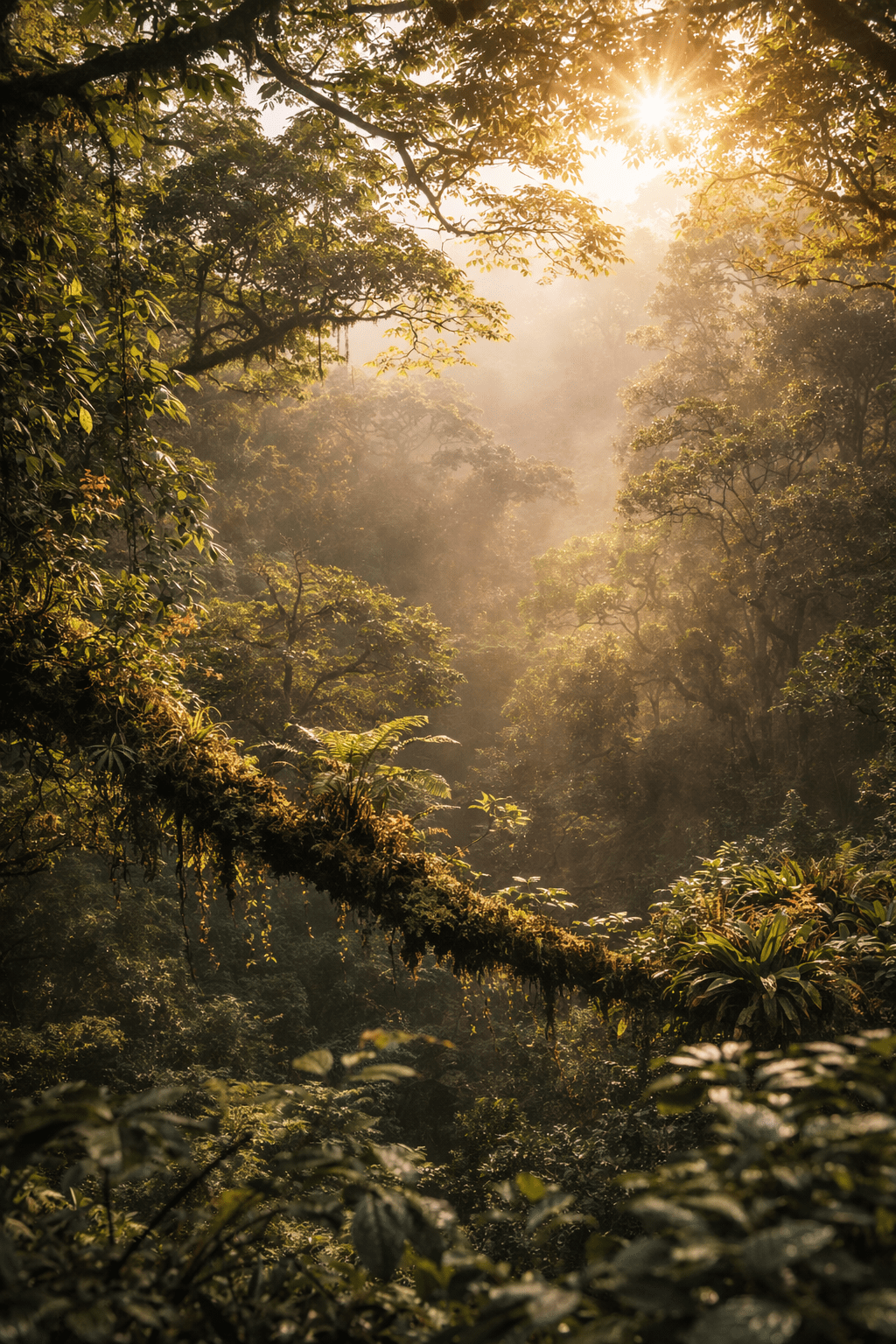
| Episode 3 Forest Canopy: Energy, Abundance, and Fragility The forest canopy is where life looks confident. Light is captured, growth is visible, and abundance is obvious. Birds, leaves, insects, wind — everything announces itself. This visibility trick makes us think the canopy is the forest. It isn’t. The canopy is an expression, not a foundation. It thrives when conditions allow and collapses quickly when they don’t. Storms tear it apart. Drought starves it. Fire resets it entirely. And yet, because it grows upward and fast, we mistake recovery for resilience. In practice, the canopy is dependent on everything beneath it. Soil decides how much energy reaches the leaves. Water determines how long that energy can be used. When those supports fail, the canopy cannot compensate, no matter how well-adapted the trees appear to be. A common assumption is that forests are stable by default, and disturbance is an interruption. In reality, forests are conditional systems. They require continuous moisture, intact soil networks, and long periods without severe disruption. Remove any one of those, and the canopy becomes brittle. This matters after control because forests sit on a knife-edge between recovery and collapse. In some places, reduced human pressure allows rapid regrowth. In others, climate stress and degraded soil mean that what returns is scrub rather than woodland. The canopy teaches an uncomfortable lesson: visibility does not equal security. Growth does not guarantee persistence. And abundance is often the most fragile state a system can occupy. As gardeners, we recognise this instinctively. Lush growth is a signal, not a promise. The work is always happening out of sight. |
| About our writing & imagery Many of our articles are written by us, drawing on real experience, reflection, and practical work in gardens and places we know. Some pieces are developed with the assistance of AI, used as a drafting and research tool rather than a voice or authority. Featured images may include our own photography, original AI-generated imagery, or—where noted—images kindly shared by other creators and credited accordingly (for example, via Pixabay). All content is shaped, edited, and published by Earthly Comforts, and the views expressed are our own. |

