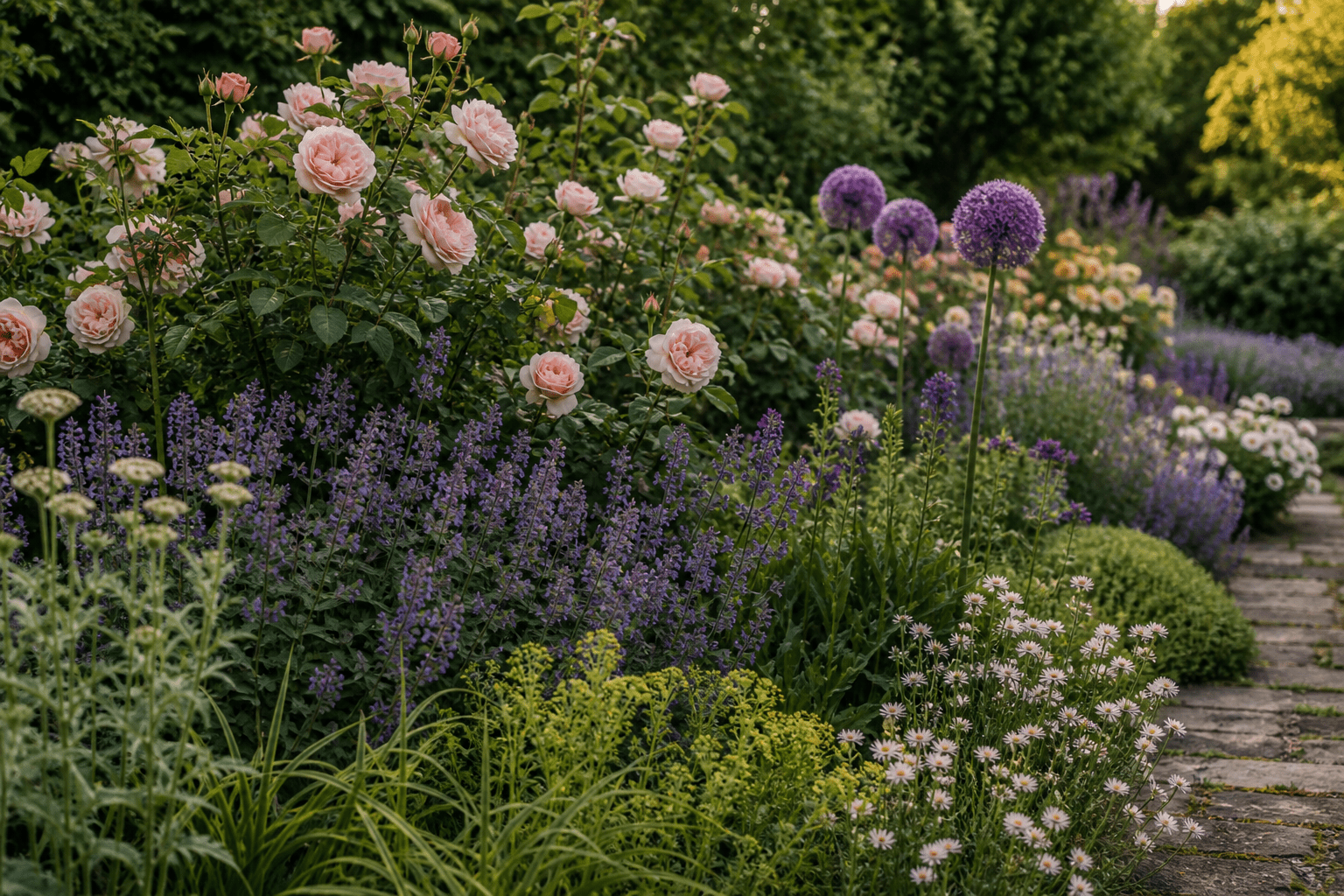
| There is something faintly theatrical about roses. Even now, after centuries of breeding, cataloguing, renaming, marketing, gifting, romanticising, and overcomplicating them, they still carry themselves with a kind of difficult confidence. A rose bush can sit in a border for most of the year looking frankly unimpressive — thorny stems, sparse leaves, awkward structure — and then, for three weeks in June, suddenly behave as though the entire garden exists purely to frame its performance. And perhaps that is the problem. Many people plant roses as isolated objects, surrounded by bare soil or gravel, as though they are museum pieces requiring distance and reverence. You still see it in older gardens: rows of hybrid teas standing in scorched earth like disappointed aristocrats waiting for servants who have all quietly resigned. The result is rarely beautiful for very long. It becomes a maintenance exercise. Spraying, feeding, deadheading, apologising. A rose by itself can easily become a creature of anxiety. But roses rarely look their best alone. In nature — insofar as cultivated roses have any remaining connection to nature — plants exist in communities. Roots overlap. Foliage intermingles. One species shades another. One flower while another rests. The most convincing rose gardens are not really rose gardens at all. They are layered plantings in which roses are simply important voices within a larger conversation. Companion planting, then, is not merely about pest control or old wives’ tales involving garlic bulbs and aphids. It is about atmosphere. Ecology. Timing. Scale. It is about understanding what a rose actually is when stripped of the mythology surrounding it. And roses, despite appearances, are surprisingly tolerant companions when treated sensibly. The first thing one notices working professionally in gardens is that roses are less delicate than rose literature would have you believe. They are certainly capable of sulking. Black spot will arrive eventually, usually with all the optimism of a damp British August. Greenfly will discover fresh growth within approximately six minutes of emergence. Some varieties collapse under rain like exhausted opera singers. But fundamentally, roses are survivors. Many are vigorous to the point of aggression if given decent soil and enough light. What they dislike most is not companionship, but competition without balance. A rose forced beneath a large evergreen shrub will struggle. A rose buried inside dense, damp planting with poor airflow will deteriorate. But a rose threaded through softer perennials, underplanted thoughtfully, or paired with plants that occupy different layers of space often becomes healthier, not weaker. You can see this immediately in older cottage gardens. The roses there are rarely immaculate. They lean, wander, tangle into other plants, and occasionally disappear entirely beneath clouds of nepeta or hardy geraniums. Yet they somehow feel more alive than the rigid exhibition roses displayed in pristine isolation. The planting absorbs imperfection. Black spot matters less when a border is textured and full. A brief pause between flushes matters less when salvias or campanulas continue the rhythm. The garden ceases to rely on a single performer. Lavender is perhaps the most obvious companion, though it has become so heavily repeated that one almost hesitates to mention it now. Entire housing developments appear contractually obliged to install lavender beneath roses, usually in soil entirely unsuitable for either plant. And yet, when conditions are correct, the pairing works beautifully. Part of the success lies in contrast. Roses often possess broad, slightly coarse foliage and extravagant flowers. Lavender offers restraint: silver foliage, fine texture, disciplined shape. One plant billows; the other anchors. Even when not flowering, lavender gives structure to the feet of roses, hiding the woody lower stems that so wide modern varieties develop with age. But lavender is also revealing because it demonstrates one of the quiet truths of companion planting: visual harmony often matters more than the supposed practical benefit. People like to say lavender repels aphids. Perhaps marginally. Perhaps sometimes. In reality, healthy gardens still contain aphids. The difference is whether predators exist alongside them. Hoverflies, lacewings, ladybirds, wrens, spiders — these are what regulate balance, not magical plant forcefields. Lavender’s real value is that it creates habitat, attracts pollinators, and visually settles the planting. The same is true of nepeta, or catmint, which in many British gardens is actually the more forgiving companion. Lavender can resent heavier soils and prolonged winter wet. Nepeta simply gets on with things. It sprawls, flowers endlessly, softens hard edges, and tolerates the indignities of weather and neglect with admirable stoicism. There is a point each June where roses and nepeta together seem to dissolve the boundary between cultivated garden and something looser, almost accidental. Bees drift between them lazily. The sharp geometry of paving softens. Even difficult roses begin to appear generous. One of the more interesting shifts in modern gardening is the gradual movement away from perfection. Twenty years ago, many clients wanted immaculate rose beds. Today, more people seem willing to tolerate movement, looseness, and seasonal untidiness. They want gardens that feel inhabited rather than staged. Companion planting plays directly into this. A rose emerging through alliums, for example, carries an entirely different mood than a rose standing alone. Alliums arrive briefly and theatrically, hovering above the border like suspended lanterns. They create an interruption. They stop the eye from settling too quickly. Even after flowering, their seed heads contribute structure long after many roses have begun their midsummer exhaustion. Foxgloves achieve something similar but in a more woodland register. A rose beside foxgloves feels older somehow, as though the garden may have existed before the house itself. The combination is slightly unpredictable because foxgloves move around. They appear where they choose. A border begins to develop memory. This matters more than people think. Gardens become convincing not when every plant behaves perfectly, but when the planting begins to develop relationships beyond the gardener’s control. Self-seeding campanulas threading through rose roots. Alchemilla spilling onto paths after rain. Geraniums quietly stitch gaps together while nobody notices. These are the moments that prevent gardens from becoming static. Hardy geraniums deserve particular respect in this regard because they perform one of the least glamorous but most valuable jobs in horticulture: they make everything else look intentional. Under roses, they suppress weeds, moderate soil temperature, soften awkward spacing, and continue flowering long after the first rose flush has faded. Good companion planting is often invisible in this way. The supporting plants quietly absorb the stars’ weaknesses. There is also a practical truth here that gardening books rarely discuss openly enough: roses are often unattractive at ground level. Professional gardeners know this instinctively. Many modern shrub roses develop sparse lower growth. Floribundas become woody. Hybrid teas can resemble bundles of thorny wiring for much of the season. Companion plants conceal these structural realities without pretending they do not exist. The myth of the pristine rose specimen has perhaps done more damage to rose gardening than black spot ever managed. Once one abandons the fantasy of perfection, roses become far easier to live with. This extends to pest management as well. Entire industries exist around convincing gardeners that roses require constant intervention. Sprays, tonics, feeds, fungicides, specialist pruning systems, complex seasonal schedules. Some of this has merit. Much of it originates from exhibition growing rather than ordinary garden life. A mixed planting naturally buffers problems. Aphids spread less aggressively through biodiverse borders. Predators establish themselves more easily. Soil moisture remains more stable beneath layered planting. Fungal issues lessen when roots are shaded, and soil structure improves. None of this creates immunity, but gardens are rarely improved through sterilisation. In fact, one begins to notice that the healthiest roses often exist in slightly messy gardens. Not neglected gardens. There is a difference. Neglect is simply the absence. But lived-in gardens — gardens with layered planting, insects, imperfect spacing, self-seeding companions, patches of shade and fluctuation — often develop resilience precisely because they are not overmanaged. The rose industry sometimes struggles with this idea because immaculate roses photograph better. Real gardens are another matter entirely. One of the more overlooked companions for roses is actually herbs. Chives, thyme, sage, fennel, and even parsley in the right setting. Not because they possess mystical protective properties, but because they integrate gardens into daily life. A rose border threaded with herbs becomes harder to reduce to an ornament alone. Chives flowering beneath pale roses create extraordinary colour and texture combinations. Thyme spilling at the edge of paving beneath climbing roses catches heat and releases scent underfoot. Sage provides structure through winter when many companion perennials vanish entirely. And perhaps more importantly, herbs attract life. Hoverflies especially seem drawn to these layered spaces. One begins to understand that healthy gardens are less about eliminating pests than about encouraging complexity. Complexity stabilises systems. This is true in ecology and increasingly true in human life too, though gardening remains one of the few places where people still encounter the principle physically. There is a temptation in modern horticulture to simplify everything into certainty. Plant this to repel that. Feed this in April. Prune this by exactly one-third. Reality is less obedient. Soil varies street by street. Rainfall changes yearly. One client’s glorious rose companion becomes another client’s invasive nuisance. Mint is a good example. Beautiful in theory beneath roses. Catastrophic in practice unless heavily controlled. Some salvias thrive magnificently beside roses in dry summers, then vanish after wet winters. Delphiniums can create astonishing combinations with roses for approximately eleven days before collapsing sideways into existential despair. Gardening requires tolerance for these fluctuations. Perhaps that is partly why roses still endure despite endless predictions of their decline. They force engagement with imperfection. They bloom magnificently, then rot suddenly. They demand pruning that feels slightly brutal. They punish neglect but also punish excessive control. And the best companion plants understand this rhythm. There is also an emotional quality to successful rose companionship that is difficult to quantify. Some combinations simply alter the psychological atmosphere of a space. A white rose among silvery herbs feels cool and restrained. Deep crimson roses pushing through grasses feel darker, more unstable somehow. Apricot roses paired with foxgloves and campanulas create softness that borders on nostalgia. The garden becomes narrative rather than decoration. Professional gardening increasingly reveals that clients are often responding emotionally long before they understand what they are looking at botanically. They say things like: “It feels calmer.” “It feels softer.” “It feels more natural.” Usually, what they mean is that the planting relationships make sense at a subconscious level. Good companion planting creates coherence without rigidity. And perhaps that is the real intelligence of planting around roses. Not pest control. Not tradition. Not even aesthetics alone. It is the creation of context. Because roses without context can become oddly exhausting. Every flaw becomes visible. Every damaged petal feels like failure. Every fungal spot appears catastrophic. Surround a rose with living complexity, however, and suddenly the eye relaxes. The garden becomes more forgiving. More truthful. There is a broader lesson hidden inside this, too, though gardening often smuggles philosophy in quietly while pretending merely to discuss plants. Nothing ornamental survives long in isolation. Not gardens. Not landscapes. Not people. Everything functions better within systems of support, contrast, interruption, and coexistence. Roses tolerate companions because life itself depends upon companionship at every scale — roots sharing fungal networks underground, insects navigating overlapping blooms, shade protecting moisture, one season preparing the next. Gardens merely make these relationships visible. And perhaps this is why heavily companion-planted rose borders often feel emotionally richer than formal rose beds. They contain evidence of negotiation. Of coexistence. Of time passing through multiple layers simultaneously. The rose still flowers. Still performs. Still briefly dominates the scene. But it no longer needs to carry the entire garden alone. |
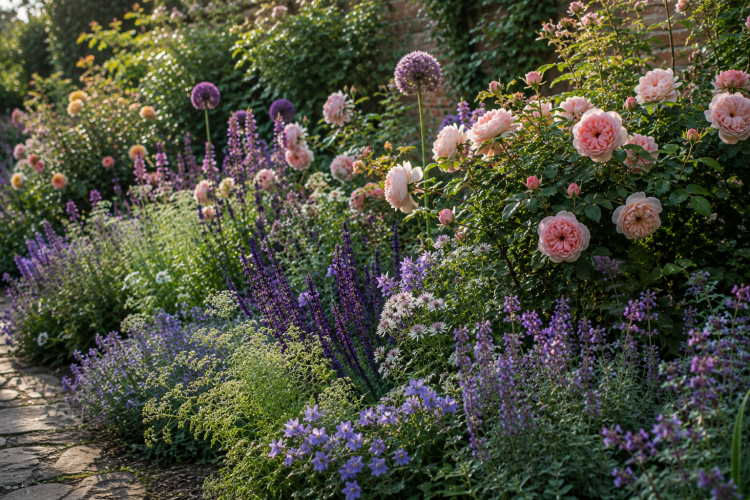
| About our writing & imagery Most articles reflect our real gardening experience and reflection. Some use AI in drafting or research, but never for voice or authority. Featured images may show our photos, original AI-generated visuals, or, where stated, credited images shared by others. All content is shaped and edited by Earthly Comforts, expressing our own views. |

