| What Was Once Taken Seriously |
| On occasion with gardening, you happen to come across a garden that inspires you – this entire series from gnomes to beyond was inspired by what l call The Matilda Project – a garden l found myself lucky to be working in here in Sandwich that was home to a truly marvellous tree by the name of Matilda. A copper beech with a TPO attached [Tree Preservation Order], which is easily 200 + years of age. Her presence instantly reminded me of the days when l used to read Enid Blyton’s Magic Faraway Stories. |
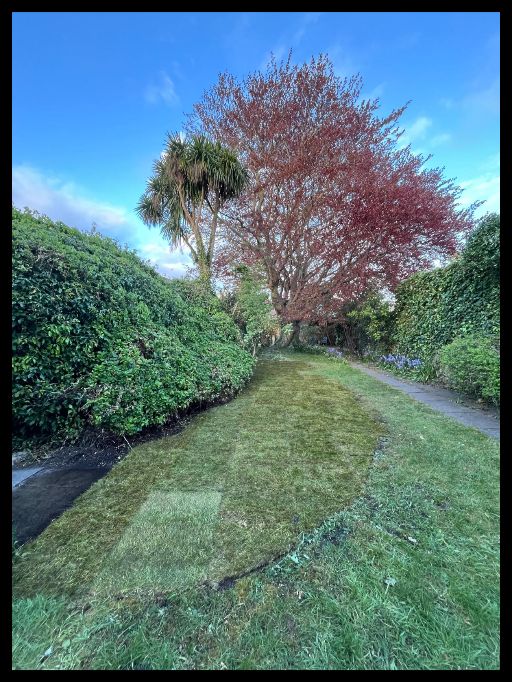
Matilda the Copper Beech
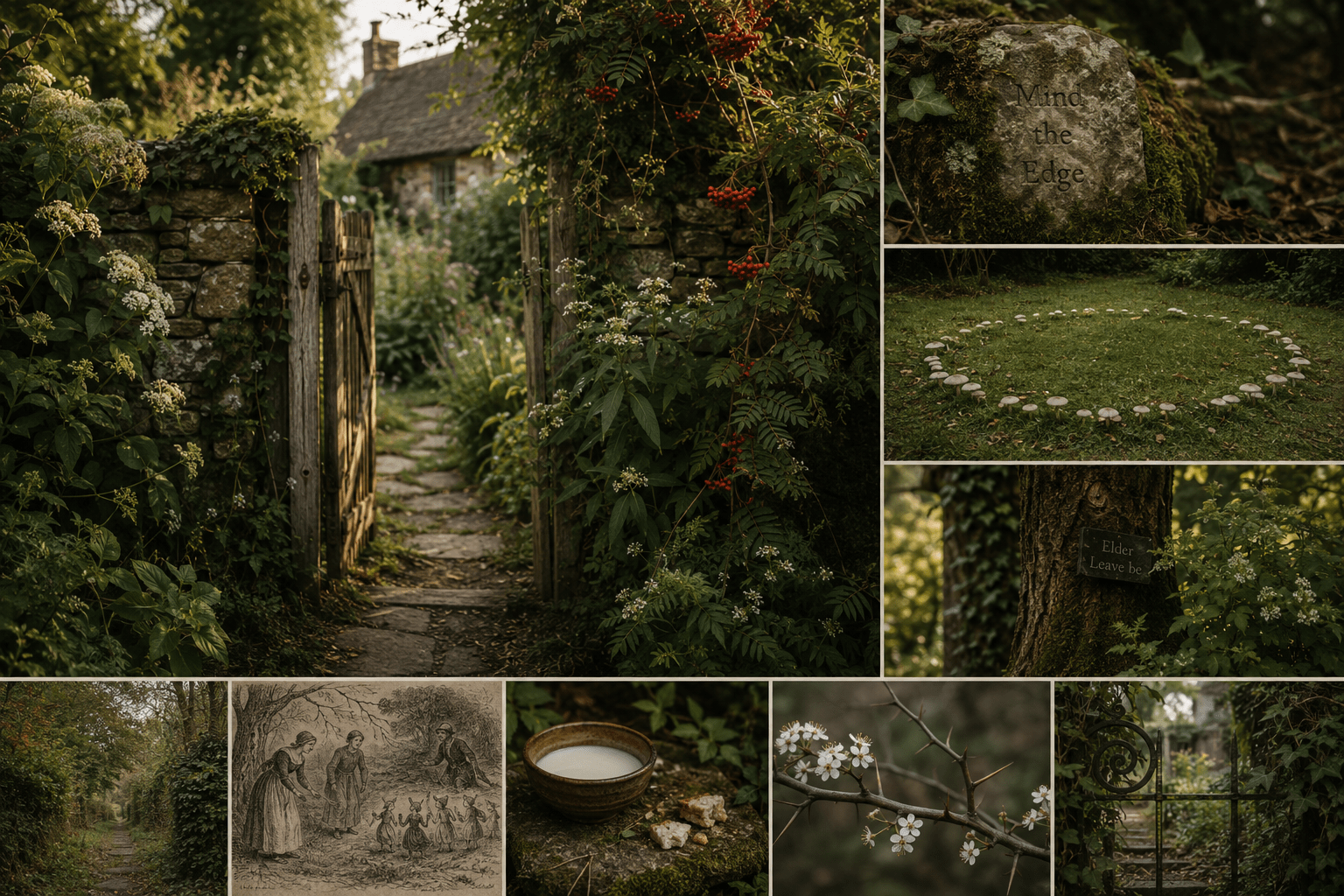
| There is a tendency, when speaking about woodland folk now, to treat the subject as merely decorative—something relegated to garden borders or whimsical corners. This approach frames the idea as harmless nostalgia, disconnected from the land’s practical realities, and overlooks the garden’s deeper relationship with ideas of shared presence. But this perception is a recent development. For a long time, people took the idea that gardens were shared with something unseen seriously, as a fundamental part of how space was understood. This meant the land was never considered empty, but occupied and shaped by influences that required respect. This more expansive view shows how closely gardens and beliefs about presence were once connected. This was not a belief in the sense in which it is often implied now. It was closer to an extension of observation—an attempt to account for patterns that did not always align with immediate explanation, and to act accordingly. The Threshold — Where the Garden Begins Historically, the boundary between the domestic space and the wider landscape was not treated as a simple line. It was a point of transition, and it commanded a level of attention largely absent now. Gates, doorways, and entrances to gardens were often deliberately marked, not only for practical reasons but also because they represented a change in condition. Certain plants were placed at these points—herbs, thorned species, or evergreens—not just because they were useful or resilient, but because they were understood to hold or define the space in some way. It was not uncommon for rowan, hawthorn, or elder to be associated with protection. Whether this was based on observed properties or something more interpretive is difficult to separate, but the pattern is consistent. The entrance to a garden was not neutral. It was acknowledged. Even now, you still see traces of this without it being consciously recognised. A gate framed by planting, a narrowing of space before entry, a sense that movement into the garden should be defined rather than open. The structure remains, even if the reasoning has shifted. The Edge of the Garden — Not Fully Yours If the threshold marked entry, the edges of the garden marked uncertainty. Hedges, walls, and borders were not simply there to contain space. They were understood as points where different conditions met, and where activity that did not belong entirely to the garden could still influence it. This is where much of the folklore settles—fair folk, spirits, or what might now be described more neutrally as presence. It was often advised not to disturb these edges unnecessarily. Certain areas were left less managed, not because they were forgotten, but because they were not considered entirely appropriate for intervention. The reasoning behind this varies by source, but the outcome is consistent: a recognition that the garden’s boundary is not absolute. From a modern perspective, this aligns closely with how wildlife uses these spaces. Edges provide cover, routes of movement, and access between environments. What was once described as something more interpretive may well have been an early way of understanding a pattern that was not fully visible. Circles, Rings, and the Ground Itself Few features carry as much folklore as the circular patterns that appear in grass. Fairy rings, as they came to be known, were not treated lightly. They were avoided, not stepped into, and certainly not interfered with. The explanation given was that they marked places where something had occurred that should not be disturbed. From a modern perspective, these are understood as fungal growth patterns that expand outward beneath the soil and alter conditions as they move. The explanation is clear, and there is no need to assign anything beyond that. But the response remains interesting. Even now, people hesitate. They recognise the pattern as unusual, and even when they understand it, there is often a moment where they pause before stepping into it. The shape itself suggests a boundary, and that suggestion is enough to alter behaviour. What was once described as folklore may simply have been a way of expressing that instinct. Trees — Not All Treated Equally Trees have always held a particular position within these beliefs, though not all trees were approached in the same way. Some were considered ordinary, part of the landscape that did not require special attention. Others were treated with caution, not to be cut or disturbed without good reason. Elder, in particular, appears frequently in this context, often associated with the idea that it should not be removed lightly. Again, this is not something that needs to be taken literally to be understood. Trees alter the conditions around them in significant ways. They shape light, affect soil, and influence what can grow beneath them. Removing them changes the space in ways that are not always immediately predictable. The idea that certain trees should be respected may have been an early recognition of this, expressed in the language available at the time. There is also the matter of how certain trees are experienced. Even now, there are occasions where a tree feels more central to a space than others, not because of its size alone, but because of how it holds the surrounding area. This is not something that requires explanation beyond observation, but it is consistent enough to be recognised. Offerings and Small Acts In some parts of the UK, it was not unusual for small offerings to be left within gardens or at their edges. These were not grand gestures, but simple acts—food, milk, or other items—left in specific places. The reasoning behind this is often described in terms of appeasement, though that may not fully capture it. It may have been less about fear and more about maintaining balance, acknowledging that the garden was not entirely separate from what surrounded it. It can be challenging to interpret this from a modern standpoint. Still, it reflects a broader understanding that space was shared, and that actions within it had effects beyond what was immediately seen. What Remains Now Much of this has fallen away, at least in its original form. Gardens are now understood primarily in terms of their function and appearance. They are maintained, designed, and adjusted according to clear principles, and the idea that they might be influenced by something unseen is generally treated as symbolic at best. But not everything has disappeared. The hesitation at the edge of a space. The instinct to frame an entrance. The sense that certain areas are better left undisturbed. The recognition that not all trees feel the same. These are not beliefs in the traditional sense, but they are responses that persist. A Gardener’s Reading of It Working in gardens, there is no need to adopt any of the explanations that were once used to describe these patterns. The conditions can be understood, measured, and managed without reference to folklore. But the observations that gave rise to that folklore remain valid. There are spaces that behave differently. There are patterns that form without a clear cause. There are areas that resist certain approaches. And there are moments where the garden feels as though it holds itself in a way that is not entirely neutral. These do not require belief to be acknowledged. They require attention. Closing Thought What is often described as woodland folk is not necessarily about figures or beings. It is about recognising that the garden is shaped not just by what we place in it, but by deeper conditions, unseen patterns, and influences beyond immediate control. These ideas linger, altering our responses to the space even as the language around them changes.d. The language used to describe this has shifted over time. But the experience of it has not entirely gone. |
| About our writing & imagery Most articles reflect our real gardening experience and reflection. Some use AI in drafting or research, but never for voice or authority. Featured images may show our photos, original AI-generated visuals, or, where stated, credited images shared by others. All content is shaped and edited by Earthly Comforts, expressing our own views. |


Wow! Matilda The Copper Beech is magical, Rory.
LikeLike