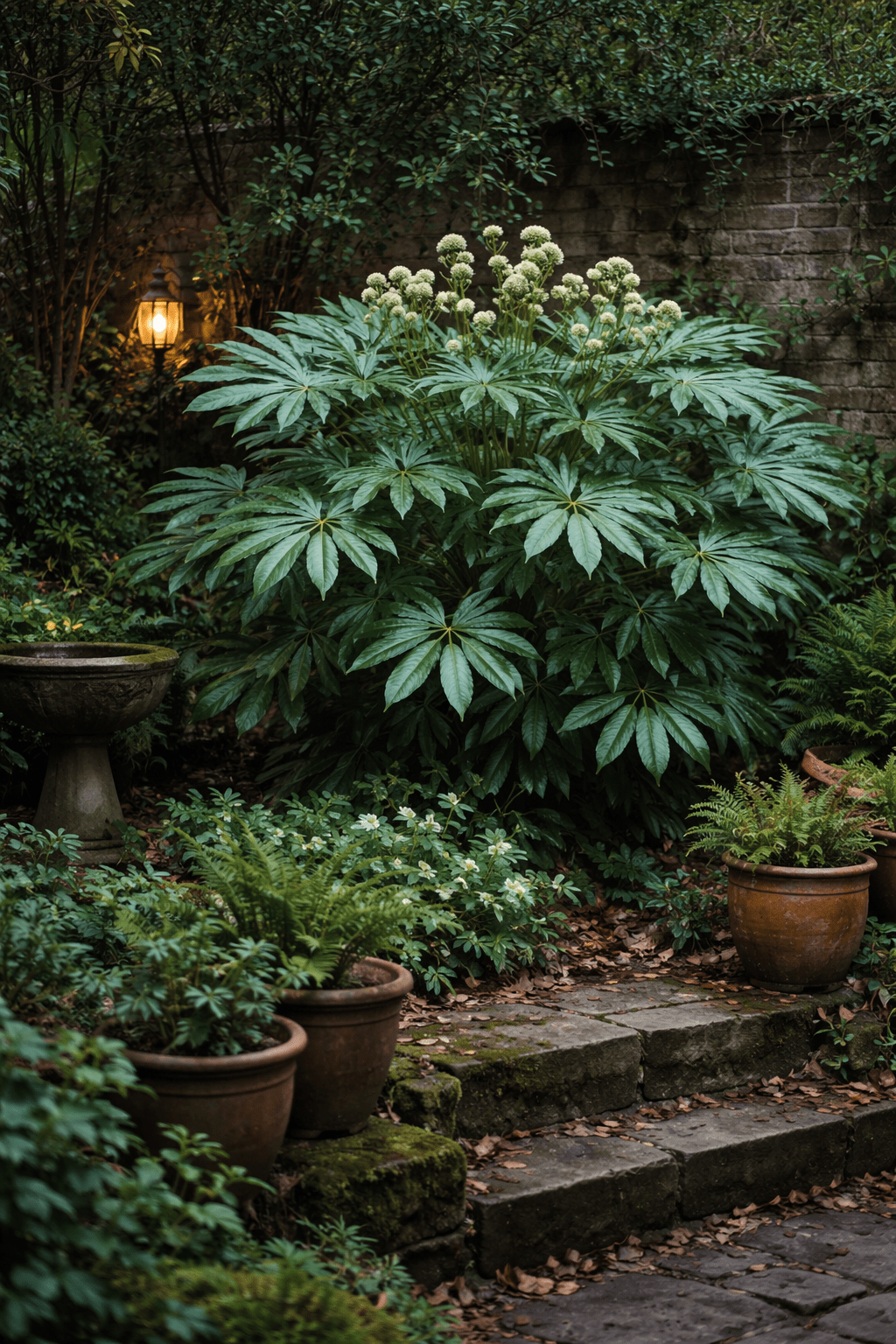
| Fatsia japonica The plant that looks out of place—and thrives anyway There are plants that seem to arrive with a sense of certainty. You look at them and think: of course you belong here. Lavender in gravel. Hawthorn in a hedge. A beech on a chalk slope. And then there are plants like Fatsia japonica, which appear to have missed a turning somewhere between climate zones and ended up in a damp British corner by mistake—only to settle in, unbothered, and quietly do very well. I’ve planted and maintained fatsias in places where, on paper, they shouldn’t work. North-facing courtyards. Narrow town gardens hemmed in by brick. Wind-tunnel alleys between buildings where little else wants to linger. And each time, the same mild astonishment: not only does it survive, but it also looks composed. Glossy. Self-possessed. As if the whole situation suits it. The true appeal of Fatsia japonica lies in how it consistently defies our expectations. Rather than standing out because of rarity or trendiness, it challenges our assumptions about what plants should thrive where—prompting us to reconsider microclimate, expectation, and how resilient plants quietly rewrite gardening rules. A tropical-looking plant for a temperate life Fatsia japonica wears the costume of a rainforest understory plant. Large, leathery, palmate leaves. A sheen that suggests warmth. Structure that reads as architectural rather than pastoral. If you didn’t know better, you’d assume it wanted heat, humidity, and protection from anything colder than a mild evening. And yet, it copes with British winters far better than its look suggests. Snow will sit on its leaves like icing sugar. Frost will take the edge off new growth, sometimes blackening tips, but rarely doing lasting harm. I’ve seen fatsias sulk after particularly sharp winters, only to push out new leaves in late spring as if resetting themselves. The mistake is assuming appearance equals requirement: big leaves must mean sun, gloss must mean warmth, exotic form must mean fragility. Fatsia undoes all of that, preferring shade or dappled light, tolerating cold, and accepting neglect more than fuss. The very essence of Fatsia’s appeal is this contrast between look and performance. That unexpected resilience, disguised as fragility, is its defining strength. Shade, but not absence One of the most common questions I hear about fatsia is whether it will “grow in full shade”. The honest answer is yes—but with nuance. Full shade in gardens often isn’t natural shade. It’s not woodland light filtered through the canopy and seasons. It’s a permanent shadow cast by buildings, fences, or high walls. Fatsia will live there, and sometimes that’s enough. But where it really finds its rhythm is in moving light: the brief morning sun that reaches a courtyard, the winter brightness that arrives when deciduous trees drop their leaves, the reflective light off pale walls. In those conditions, fatsia doesn’t stretch or fade. The leaves stay dark and broad. The plant holds itself upright rather than leaning. It becomes a presence rather than a compromise. This is one of the first grounded lessons Fatsia teaches: shade is not one thing. It’s a spectrum. And plants that tolerate shade are often responding not to darkness, but to rhythm. The value of bulk in small spaces Fatsia is often described as “architectural”, which is a word that gets overused in gardening until it loses meaning. In this case, though, it’s accurate in a specific way. Fatsia has bulk without chaos. In small gardens—especially urban ones—there’s a temptation to use many small plants to avoid crowding. The result is often visual noise. Fatsia does the opposite. One well-placed plant can anchor a space. It gives weight. It gives calm. I’ve seen a single fatsia transform a paved courtyard that had previously felt like a leftover space. Not by filling it, but by occupying it with confidence. The leaves catch light. The stems create depth. The plant becomes a visual pause. This runs counter to another quiet myth: that small gardens need small plants. Often, they need fewer, larger gestures. Fatsia is one of the few shrubs that can make that argument convincingly in shade. Evergreen, but not static Because fatsia is evergreen, it’s sometimes treated as background—something that simply stays put while other plants do the seasonal work. But if you pay attention, it’s surprisingly dynamic. New leaves unfurl in spring like slow fireworks, each one bigger than the last, glossy and pale before deepening in colour. Older leaves age and drop, leaving clean stems that reveal the plant’s structure. In autumn, mature plants produce domed clusters of creamy-white flowers—subtle, not showy, but generous. They’re followed by blackberries that persist into winter. None of these shouts. It doesn’t announce itself the way flowering shrubs do. But over a year, fatsia changes enough to reward noticing. It asks for a slower kind of attention, the kind you develop when you work in the same gardens week after week. This is another insight from practice: evergreen doesn’t mean unchanging. It just means the changes are quieter. Urban toughness, quietly worn Fatsia copes well with urban conditions in ways that aren’t immediately obvious. It tolerates pollution. It doesn’t mind compacted soils as much as many shrubs, provided drainage isn’t catastrophic. It accepts reflected heat from walls while also handling cold shade at ground level. I’ve planted fatsias in soil that I wouldn’t describe as good—thin, tired, laced with rubble—and watched them establish steadily over a few seasons. They don’t rush. They don’t collapse. They make do. There is a trade-off here. In poor soil, growth will be slower, leaves will be slightly smaller, and the plant will be less lush overall. But it remains dignified. That matters more than exuberance in many gardens. The assumption that all shrubs need rich, well-worked soil to thrive doesn’t hold up everywhere. Fatsia reminds us that resilience often looks like patience, not speed. A plant that respects boundaries Fatsia works well in tight spaces because it respects its space. It doesn’t send runners or scramble, and expands outward predictably. This doesn’t mean it stays small—it can become a substantial shrub over time—but it does so honestly. You can see where it’s heading. You can decide whether to let it go there. Pruning, when needed, is straightforward. Stems can be cut back hard, and the plant will reshoot. This makes Fatsia forgiving of changing circumstances. If light levels alter or space is reclaimed, it adapts. In working gardens, adaptability is worth more than perfection. Plants that panic when conditions shift rarely last long. Fatsia rarely panics. The flower nobody plants it for Most people don’t choose fatsia for its flowers, and that’s probably why they’re so satisfying. They arrive late in the season, when much of the garden is winding down. Pale globes held above the leaves, attracting insects at a time when forage is thinning. There’s something generous about a plant that flowers without fuss, without demanding attention for itself. The blooms feel like a quiet offering rather than a performance. And then there are the berries, which hang on into winter, catching low light. They don’t rival holly or ivy, but they add depth to the colder months. Here again, Fatsia resists the idea that plants must justify themselves with spectacle. It contributes by being present when others aren’t. Not quite wild, not quite tame Fatsia sits in an interesting middle ground. It doesn’t naturalise in the UK as some introduced plants do. It doesn’t seed itself aggressively. But neither does it feel overly cultivated. In the right setting, it can look as though it has always been there—especially in older gardens, or in places where boundaries blur between built and planted space. Against brick, stone, or weathered timber, it feels at home. This subtle ability to blend in and settle is Fatsia’s greatest contribution. It makes gardens feel lasting and intentional, rather than just following fashion—illustrating the text’s main argument that adaptation, not spectacle, is what endures. For someone interested in gardens as lived-in places rather than displays, that matters. When fatsia doesn’t work It’s worth saying where Fatsia struggles. Exposed, windy sites can shred the leaves, leaving them tatty. Very dry, free-draining soils in full sun will stress it, producing smaller, duller foliage. Waterlogged ground can cause a slow decline. These aren’t failures so much as reminders that even adaptable plants have preferences. The danger is assuming that because Fatsia is tough, it’s indifferent. It isn’t. It just expresses discomfort quietly, over time. This is one of the limits of experience-led gardening: you learn to read small signs rather than waiting for dramatic collapse. With fatsia, dullness often precedes damage. A pause in growth tells you more than a single bad winter. The long view Fatsia japonica improves with age. Young plants can look slightly awkward—too stemmy, leaves oversized for the frame. Given time, they balance out. Stems thicken. The canopy fills. The plant gains gravitas. This long view is easy to forget in a culture of instant gardens. But fatsia rewards patience more reliably than many shrubs. It doesn’t peak and fade quickly. It settles in. This is Fatsia’s quiet lesson: true value in a garden often comes from a plant’s ability to grow into its place over time, rather than rush to impress—underscoring the main argument that adaptation is more meaningful than appearance. A final reflection I don’t think fatsia is ever the star of a garden in the way a tree or a dramatic border can be. But it’s often the plant that makes a difficult space feel intentional. It turns the absence of sun into an atmosphere. It reframes constraint as character. In a world of gardening advice that often pushes optimisation—more flowers, more yield, more impact—Fatsia offers something else. It suggests that fitting well matters more than shining. Ultimately, that’s why fatsia endures. It doesn’t demand attention; it quietly earns its place, transforming overlooked spaces and proving that a plant can be essential not because it shines the brightest, but because it endures—trustworthy, adaptable, and always at home. |
| About our writing & imagery Most articles reflect our real gardening experience and reflection. Some use AI in drafting or research, but never for voice or authority. Featured images may show our photos, original AI-generated visuals, or, where stated, credited images shared by others. All content is shaped and edited by Earthly Comforts, expressing our own views |

