| Part 6 |
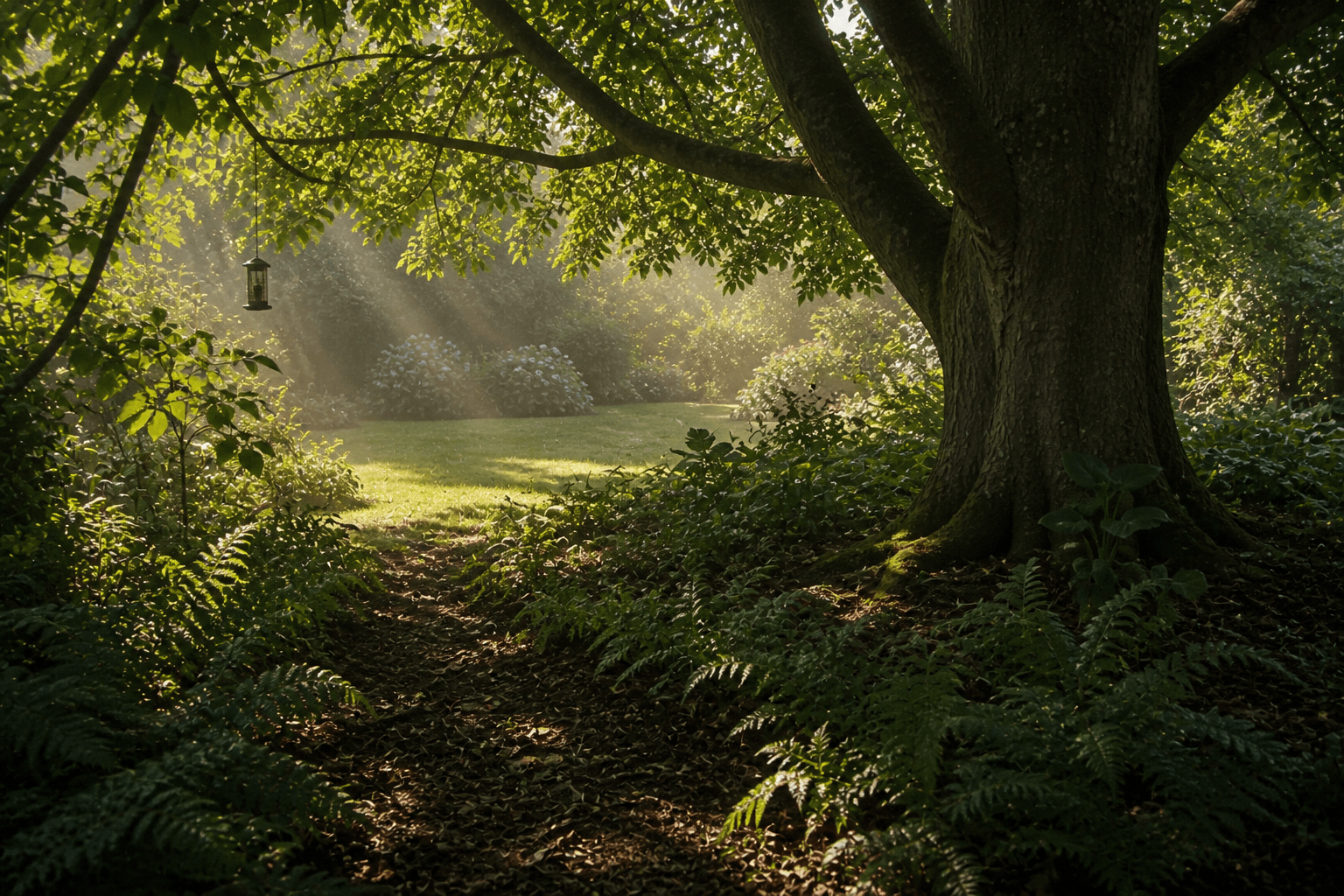
| Once you begin to notice patterns that are not placed there by design, it becomes easier to recognise that some elements of a garden do not simply sit within it, but shape it in ways that extend beyond what is immediately visible. The circle in the grass reveals a system working beneath the surface, forming structure without intention, but other forms of influence are far more apparent and yet no less difficult to fully account for. Among these, trees stand apart, not simply because of their scale, but because of the way they alter the space around them in ways that are both physical and perceptual. In most gardens, planting can be adjusted, replaced, or refined over time. Borders are reshaped, shrubs are cut back or removed, and the overall structure of the space can be guided with a reasonable degree of control. Trees resist that kind of flexibility. They establish themselves over years, sometimes decades, and once they have reached a certain point, the garden begins to arrange itself around them rather than the other way around. This is not always acknowledged directly, but it becomes evident in the way decisions are made, often without being consciously recognised. You see changes in the ground first. Areas beneath mature trees behave differently, not in a way that is immediately obvious, but in ways that build up over time. The soil is drier in some places, compacted in others, and rarely consistent across the whole area. Roots spread out far beyond the canopy, drawing moisture and nutrients from the surrounding ground. This leaves conditions that are hard to correct without impractical or undesirable intervention. Planting attempts here often start with hope, then lead to acceptance that some things will not establish as expected. This is usually explained in practical terms, and correctly so. Shade limits growth, root competition restricts access to water and nutrients, and the soil’s structure reflects years of pressure and extraction. None of this is unusual, and none of it requires interpretation beyond what is already understood. But the experience of working in these spaces suggests something more than a simple set of conditions. It is not just that the ground behaves differently, but that the space itself feels altered in a way that is not entirely defined by those factors alone. Light is the first of these shifts to become noticeable. Under a dense canopy, it is not simply reduced; it is filtered and redirected, broken into patterns that move slowly across the ground as the day progresses. As a result, how the space is read shifts: some areas appear flattened while others seem deepened, creating a sense of enclosure that relies on neither physical boundaries. Consequently, the edges of the garden become less distinct, not because they are obscured, but because the light that defines them is no longer consistent. In these conditions, depth is harder to judge, and movement through the space becomes more deliberate, even if that is not consciously recognised. Sound changes as well. The garden does not go silent, but the quality of sound shifts. It is softened by the density above and around. Usual background noise feels more distant, less immediate. The space gains a contained quality that is hard to trace to any one factor. People often describe this as calm or sheltered, which is accurate, but the area feels distinct in a subtler way. Clients respond to these spaces in ways that reflect these changes, though rarely explicitly. Seating is often placed just at the edge of the canopy rather than directly beneath it, where the tree’s influence is present but not overwhelming. Planting schemes become simpler, sometimes reduced to ground cover or left more open than the rest of the garden, as though there is an unspoken understanding that this area does not require the same level of intervention. Over time, these decisions accumulate, and the tree becomes the central point around which the rest of the space is arranged, not because it has been designated as such, but because it has made other arrangements less viable. There are, of course, variations between different trees. Some allow light to pass more freely, creating a dappled effect that supports a wider range of planting, while others cast a more complete shade that limits what can survive beneath them. The canopy structure, foliage density, and root system all contribute to shaping the space. But regardless of these differences, the effect is consistent in principle. The tree does not simply occupy space; it defines the conditions within it. Working in these areas requires a different approach, though not one that is always formally acknowledged. You adapt to the conditions, adjusting expectations rather than forcing outcomes, recognising that the usual methods do not always apply. There is a point at which further intervention becomes counterproductive, where the effort required to alter the conditions outweighs the benefits. At that point, the work shifts from imposing a particular structure to maintaining what is already viable within the established limits. This is not a limitation in a negative sense. But it changes how you see control. The garden can no longer be shaped entirely by intention. It becomes a negotiation with elements operating on different scales and timelines. The tree does not act deliberately, but its presence always influences things. It holds the space not by blocking change, but by directing it to fit its own conditions. Over time, these trees create distinct areas of the garden without requiring any explicit boundary. You move from one part of the space to another and recognise the shift, not because you have crossed a visible line, but because the conditions have altered in a way that is immediately perceptible. This is similar, in some respects, to the way a circle in the grass defines a boundary that is not physically marked. In both cases, the space is shaped by processes that operate independently of the design imposed upon it. There is no need to add extra meaning. No extra meaning is required beyond what is clear. Trees affect light, soil, and moisture. These factors shape a garden’s behaviour. Still, the way people treat these spaces suggests their response is not purely analytical. People adapt instinctively, changing behaviour without always knowing why. They respond to the space in ways that are felt, not calculated. In enough gardens, this becomes something you anticipate rather than discover. You begin to recognise the signs of a space that will not behave like the rest, and you adjust accordingly, not as a matter of technique, but as a matter of understanding. The tree is not an obstacle nor simply a feature; it is a presence that shapes the environment beyond its visible form. And as with the patterns, like the patterns below the surface, the tree’s presence reminds us that the garden is not wholly governed by what we put in it. Some elements set their own conditions over time and require a response, not a directive. The tree holds the garden by shaping how change happens, not by stopping it. |
| Most articles reflect our real gardening experience and reflection. Some use AI in drafting or research, but never for voice or authority. Featured images may show our photos, original AI-generated visuals, or, where stated, credited images shared by others. All content is shaped and edited by Earthly Comforts, expressing our own views. |

