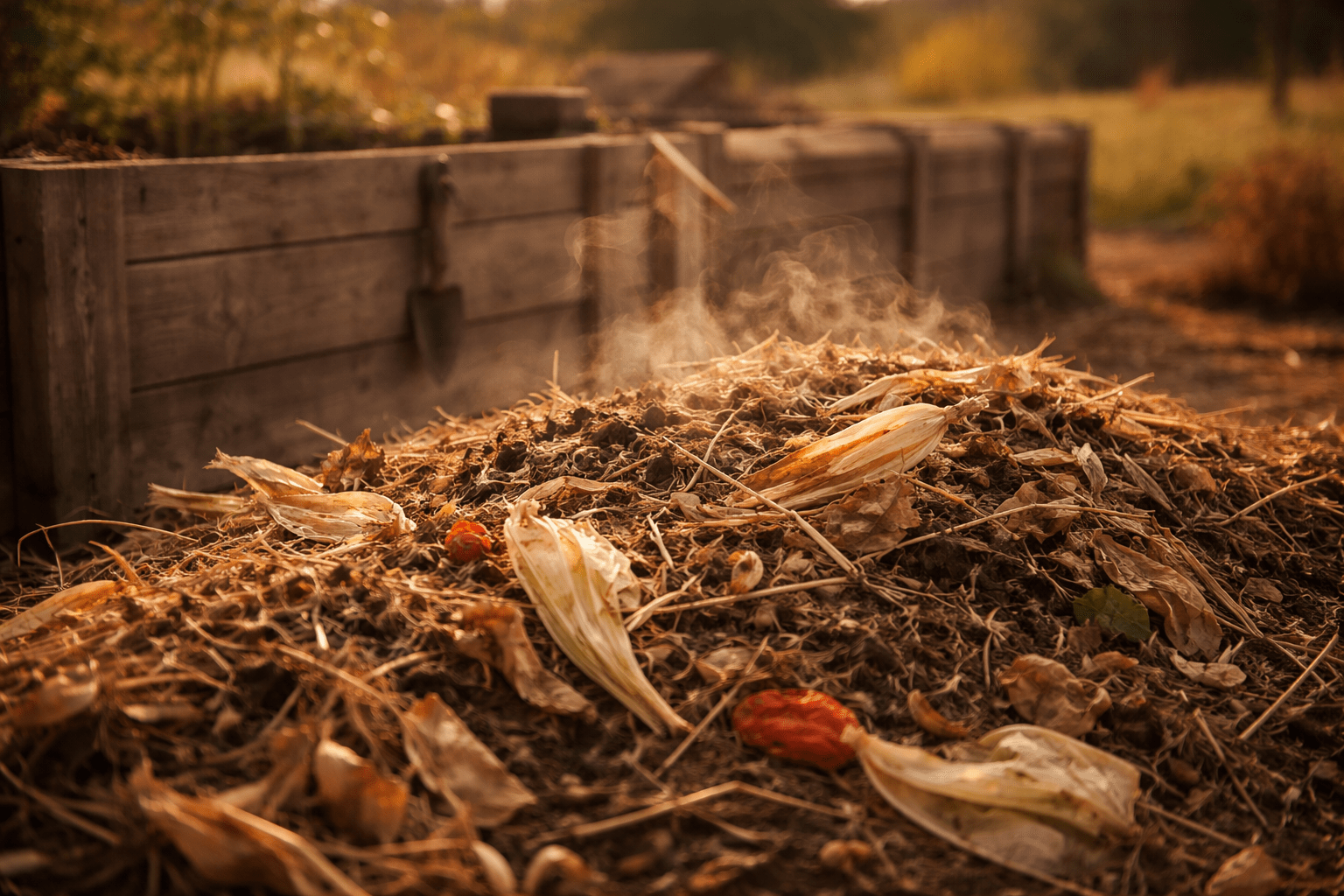
| Compost in a Summer That Won’t Behave There are summers when compost feels alive in the hands. You turn it, and it breathes back: warmth rises, faint sweetness drifts up, the distinct smell of woodland floor after rain fills the air. And then there are summers like the recent ones, when heat lingers too long, rain forgets to arrive, and compost behaves less like a quiet collaborator—a partner in transformation—and more like a sealed room that’s been shut up for weeks. You open the lid, and nothing much happens. No steam. No scent. Just a dry, papery hush, as if the process has stalled. Compost during drought reveals the garden’s limits—not the romance of abundance, but the truth of thresholds and timing. Compost doesn’t lie or rally in heatwaves. It slows or pauses. This isn’t a failure. It’s a signal. The Illusion of Heat as Progress There’s a common assumption—rarely stated outright, but often implied—that warmth speeds composting. Heat equals activity. Summer equals breakdown. Cold equals dormancy. Anyone who’s lifted a compost bin lid in August knows how partial that story is. Composting organisms—bacteria, fungi, invertebrates (organisms without backbones such as worms or insects)—do like warmth, but only within a narrow band. Heat without moisture is not acceleration; it’s interruption. Once the moisture content drops, microbial metabolism (the chemical processes within microbes that break down materials) falters. Enzymes (proteins that accelerate chemical reactions) don’t travel. Nutrients don’t move. The heap becomes, functionally, paused. What’s deceptive is that externally, nothing dramatic happens. There’s no collapse, no obvious failure. The heap simply… sits. Material that would normally soften, slump, and knit together remains recognisable. Cardboard edges stay sharp. Onion skins hold their shape. Even grass clippings, which usually vanish quickly, turn into crisp, straw-like mats. The compost hasn’t died. It’s waiting. Compost Is Not a Pile — It’s a System During drought, it becomes clear that compost is not simply a pile of material, but a process shaped by the environment. Here, water is not just an additive, but the very foundation that supports all composting actions. Without it, nothing else can progress. In practice, this means that during prolonged heat, a compost heap acts more like a store cupboard—where things are kept static—than a transformation space, where organic waste is actively broken down. Inputs such as peelings, coffee grounds, and hedge clippings accumulate but remain largely unchanged. You can keep adding them, but the conversion rate drops to near zero. This is where expectations misalign. People treat compost like a magical bin: waste goes in, compost comes out, rain or shine. Drought reveals the flaw. Compost is a living, responsive system; it cannot outrun the climate, any more than the rest of the garden can. Observation One: Dry Compost Preserves, It Doesn’t Break Down One of the stranger things you notice during a long dry spell is how well compost preserves material. Not rots—preserves. Banana skins dry into leathery ribbons. Tea bags bleach pale and stiffen. Weeds added in June reappear unchanged in September. This is preservation rather than decay. It’s closer to haymaking than to composting: moisture loss freezes microbial action, holding materials as they are. Sometimes, seeds survive far longer than in an active heap. In dry heat, compost can spread weeds rather than neutralising them. It’s a reminder that composting is not just about heat. It’s about moisture-mediated chemistry. Without water, nothing moves. The Quiet Chemistry of Water Stress What drought really does is interrupt the invisible traffic inside compost. Nutrients in compost are not static; they’re exchanged, transformed, and shuttled between organisms. Nitrogen cycles through forms. Carbon structures loosen. Fungal hyphae bridge gaps. All of this depends on water as a medium. When the heap dries, these exchanges stall. Nitrogen, especially, becomes prone to loss rather than transformation. Dry, hot conditions encourage volatilisation (the process by which nutrients, especially nitrogen, are lost as gases to the air)—nutrients drift into the air rather than being retained in the system. Compost doesn’t just pause; it leaks value. This has knock-on effects later. When rain finally arrives, and the heap rehydrates, the material may restart, but often poorer than before. Some of the richness has already gone. Observation Two: Compost Mirrors Soil More Closely Than We Admit During heatwaves, compost behaves uncannily like soil under drought stress. Both crack. Both shrink away from edges. Both develop dry zones that resist rewetting. And both can appear superficially fine while being biologically inert beneath the surface. This parallel matters. Compost isn’t separate—a prelude to “real” gardening. In dry summers, that line blurs. Compost and soil react to the same challenges. The lesson is not to treat compost exactly like soil, but to give it similar care. Neglecting a compost heap in drought is like ignoring a garden bed and expecting it to recover unaided. Sometimes recovery happens; sometimes it doesn’t. The Myth of the Self-Sustaining Heap There’s a comforting idea that a well-built compost heap looks after itself. Get the ratios right, layer properly, and nature does the rest. This is only partially true, and drought exposes the gap between theory and lived gardening. In prolonged heat, even ideal heaps stall. Browns dominate as greens dry out. The sponge collapses, and turning often releases precious moisture rather than helping. The idea that a compost heap manages itself holds true only when the weather cooperates. In harsh conditions, that self-sufficiency disappears. Observation Three: Intervention Has Costs as Well as Benefits Faced with a stalled heap, the instinct is to intervene. Add water. Turn more often. Add greens. But every action has trade-offs. Adding water in a drought can feel morally complicated. Is compost worth potable water when the garden itself is stressed? Using harvested rainwater helps, but in long dry spells, even stored reserves run out. Overwatering can also cause sudden anaerobic conditions—meaning the heap runs out of oxygen—if the heap rewets unevenly. Turning introduces oxygen, but also heat loss and moisture loss. Adding fresh greens can rebalance nitrogen, but if they dry immediately, they contribute little. In practice, there’s no perfect response. Sometimes the most honest approach is acceptance: recognising that composting, like everything else, slows in extreme conditions. Doing less can be a form of care. When Compost Becomes Thermal Mass One unexpected role compost plays during heatwaves is acting as a thermal ballast—a material that moderates temperatures. Large compost heaps absorb heat throughout the day and slowly release it overnight. This process creates compost-driven microclimates: zones that stay slightly warmer near the piles, impacting surrounding soil and plants. I’ve noticed beds bordering large compost bays behaving differently in hot summers: staying marginally warmer at night, sometimes drying faster, sometimes supporting unexpected fungal activity when moisture returns. Compost isn’t inert storage; it participates in the garden’s temperature story. This isn’t necessarily good or bad. It’s simply another way compost is entangled with its surroundings, especially when the weather becomes extreme. Observation Four: Compost Reveals the Time Lag We Ignore Gardening culture often talks about inputs and outputs as if they’re closely linked. You compost now, you enrich later. Drought stretches that timeline uncomfortably. Material added in the spring may not break down until autumn. Summer waste becomes next year’s compost, not this year’s. The lag becomes visible, and with it, a subtle frustration: Compost no longer feels responsive. But this delay is instructive. It reminds us that composting operates on ecological time, not human schedules. Heatwaves don’t just affect this season; they ripple forward. Rethinking “Finished” Compost Another assumption about drought challenges is that finished compost is a uniform, stable product. In dry years, compost often matures unevenly. Some pockets remain raw; others over-dry into dusty, carbon-heavy material. Applying this compost to beds requires discernment. Dry compost can initially repel water, forming hydrophobic layers (layers that resist water absorption) that shed rainfall. Used thoughtlessly, it can worsen drought stress rather than alleviate it. This isn’t a failure of composting, but a reminder that compost quality is contextual. Weather shapes not just how compost forms, but how it behaves when returned to the soil. Observation Five: Compost Teaches Restraint Better Than Abundance Perhaps the most quietly radical lesson compost offers during drought is restraint. It refuses to perform on demand. It won’t speed up because we want it to. It forces us to notice limits. In a culture still steeped in growth narratives—more productivity, faster cycles, constant improvement—compost in a heatwave is awkwardly honest. It says: not now. There’s something bracing about that. Compost becomes less a solution and more a teacher. Compost as Climate Witness As heatwaves become more common, compost heaps may be among the clearest everyday indicators of climate stress in gardens. Lawns brown and recover. Plants wilt and revive. Compost tells a slower, more cumulative story. A heap that repeatedly stalls each summer is signalling a shift. Not just in weather, but also in assumptions. Traditional composting rhythms—reliable breakdown over warm months—are being disrupted. This doesn’t mean composting is obsolete. It means it’s changing. Living With Imperfect Cycles There’s a temptation to frame drought-resistant composting as a problem to be solved. New systems, new bins, new methods. Some innovation will help. But there’s also value in accepting imperfection. Compost doesn’t need to be optimised to death. It needs to be understood. In dry summers, compost may simply become storage, holding material until conditions allow transformation. That’s still a function. A quieter one, perhaps, but not a pointless one. Gardening has always involved working with delays. Drought makes those delays more visible. A Closing Reflection When compost slows in heat, it’s not failing. It’s reflecting reality back to us. Moisture matters. Limits matter. Timing matters. In that sense, compost during drought is less about decay and more about honesty. It strips away the comforting fiction that nature will always process our excesses on schedule. It asks us to notice conditions, to accept pauses, to think in longer arcs. The heap waits. And in waiting, it tells us something worth hearing. |
| About our writing & imagery Most articles reflect our real gardening experience and reflection. Some use AI in drafting or research, but never for voice or authority. Featured images may show our photos, original AI-generated visuals, or, where stated, credited images shared by others. All content is shaped and edited by Earthly Comforts, expressing our own views. |

