| Part 7 |
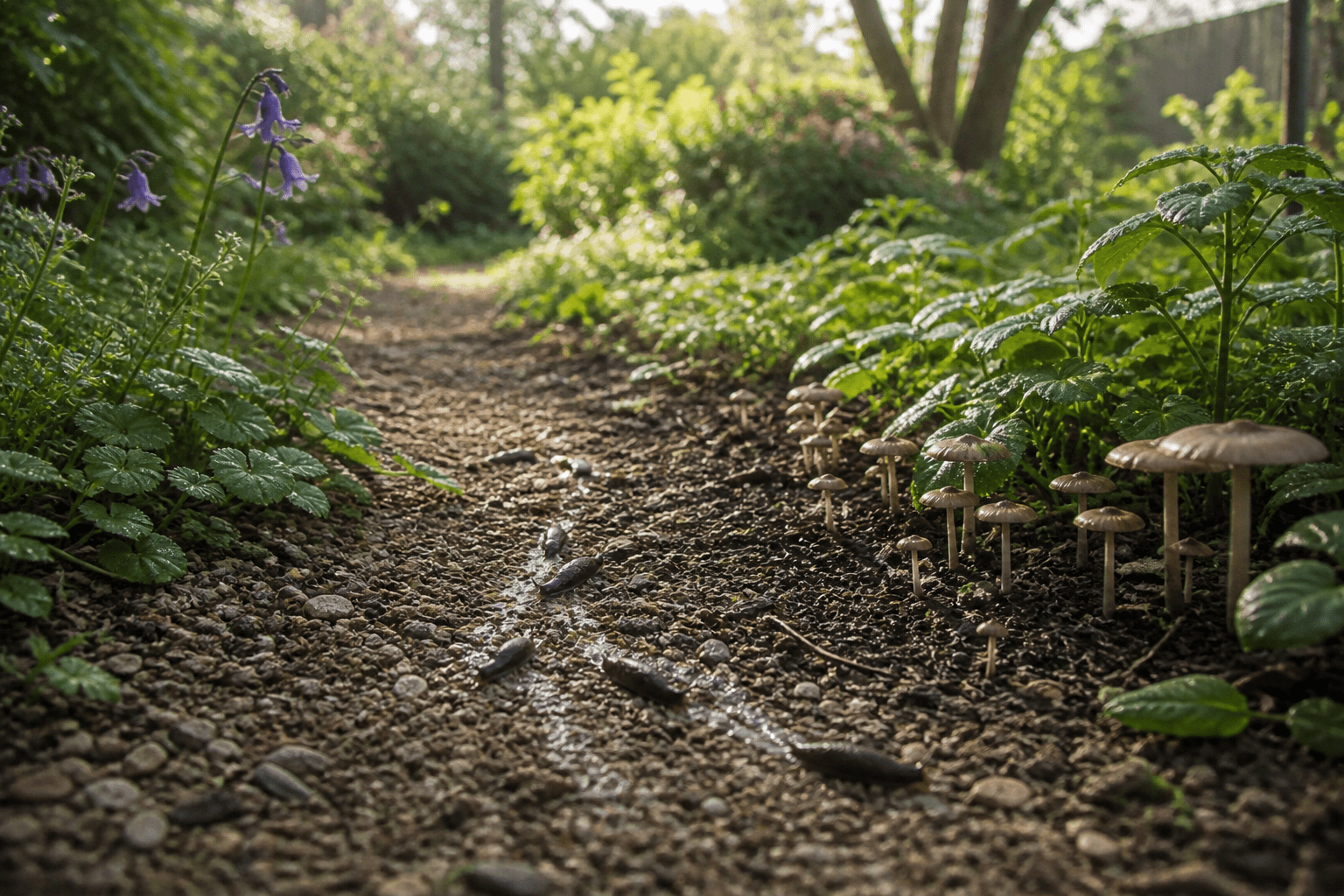
| Once you begin to recognise that the garden is not entirely shaped by what you do within it, but by processes that continue regardless of your presence, it becomes easier to notice the moments where that independence is briefly made visible. These moments rarely announce themselves in a way that demands attention; they tend to appear within familiar spaces, altering them just enough to register as different without immediately explaining why. It is not a dramatic shift, nor does it interrupt the work, but it introduces a subtle adjustment that sits alongside everything else you already understand about the place. This is most apparent when you return to a garden after even a short absence and find that something has changed without any direct cause. The structure is the same, the planting is broadly as you left it, and yet there are details that were not present before. Mushrooms have appeared where none were before, small and contained but numerous enough to suggest they have not emerged individually but as part of a coordinated process. Slug trails mark surfaces that were clear the day before, tracing routes that follow lines you did not create and that do not correspond to any obvious feature of the space. Soil has been disturbed in a way that suggests activity rather than accident; the ground has been turned or shifted, leaving no visible sign of what caused it. Each change is easily explained. Fungi respond to moisture and temperature, appearing quickly when conditions allow. Slugs and snails move when less exposed, leaving trails visible only as the light shifts. Small animals pass through, altering the surface. All of this fits known natural processes. What is more difficult to account for is the sense of timing that accompanies these changes. They appear not gradually, but all at once, as though the garden has reached a point where something that has been developing beneath the surface is suddenly expressed. You do not see the progression; you only see the result, which creates the impression of immediacy, even when the underlying process has been ongoing for some time. The garden does not reveal itself in stages that align with your presence; it presents you with the outcome of activity that has occurred in your absence, and it is that absence that shapes how the change is perceived. Working within this requires a shift in how continuity is understood. The garden follows its own rhythm, intersecting with your efforts but never fully defined by them. Returning to a familiar yet subtly altered space, your work becomes not just maintenance but adjustment, bringing your actions back in step with a system that continues without you. This is not a meaningful disruption. The changes that occur overnight are usually small, easily managed, and often temporary. Mushrooms appear and disappear within days, trails fade as surfaces dry, and disturbed soil settles back into place. But the pattern of their appearance remains consistent enough to be recognised. The garden does not remain static between visits; it moves through phases that are not always visible, and it reveals them in moments defined less by scale than by timing. Clients are often aware of these changes, though not always in detail. From their perspective, they may notice that something has appeared or that a part of the garden looks different from before, but they do not usually witness the process itself. Their experience is similar to your own in that sense, as it is shaped by the gap between what was and what is, rather than by the transition between the two. As a result, clients may perceive that the garden changes more quickly than it actually does, or that certain things occur without warning, when in reality they are the result of conditions that have been developing gradually. There is a tendency to respond to these changes by restoring the garden to its previous state as quickly as possible, particularly where appearance is a priority. Mushrooms are removed, surfaces are cleaned, and disturbed areas are levelled, returning the space to a condition that aligns with expectations. This is often necessary, but it can also obscure the processes that have produced the change in the first place. By removing the visible signs, the activity that created them becomes less apparent, reinforcing the impression of sudden appearance. Allowing these signs to remain, even briefly, changes how the garden is read. A cluster of mushrooms is no longer just something to be cleared, but an indication of conditions beneath the surface. Trails become evidence of movement rather than marks to be removed, and disturbed soil suggests presence rather than damage. This does not require a change in how the garden is managed overall, but it does alter how these moments are understood, shifting them from isolated occurrences to part of a continuous process. As with the patterns in the grass and the influence of trees, these changes point to the same underlying reality: the garden operates according to systems that are independent of your observation. The fact that you do not see them develop does not make them sudden, and the fact that they appear quickly does not mean they have no history. They are the visible expression of ongoing activity, revealed at the time of your return. Over time, this becomes something you anticipate rather than react to. You begin to expect that the garden will not be exactly as you left it, and that certain conditions will produce certain outcomes, even if you do not see them unfold. The work becomes less about maintaining a fixed state and more about working within a system that is constantly adjusting, aligning your actions with processes that continue whether you are present or not. This does not make the garden unpredictable, but it does limit how much of it can be directly observed. There will always be periods when activity occurs out of view, when changes take place without being witnessed, and when the surface reveals only the result of what has already happened. Accepting this does not reduce control, but it does redefine it, shifting the focus from managing every stage of the process to responding effectively to what becomes visible. In this sense, what arrives overnight is not an interruption but part of the garden’s ongoing development. Each visible change reinforces the central point: the garden is an ever-evolving space whose rhythms persist, asking only that you recognise this continuity rather than see each change as an isolated occurrence. Understanding this makes these moments less surprising and more a natural part of the cycle. |
| About our writing & imagery Most articles reflect our real gardening experience and reflection. Some use AI in drafting or research, but never for voice or authority. Featured images may show our photos, original AI-generated visuals, or, where stated, credited images shared by others. All content is shaped and edited by Earthly Comforts, expressing our own views. |

