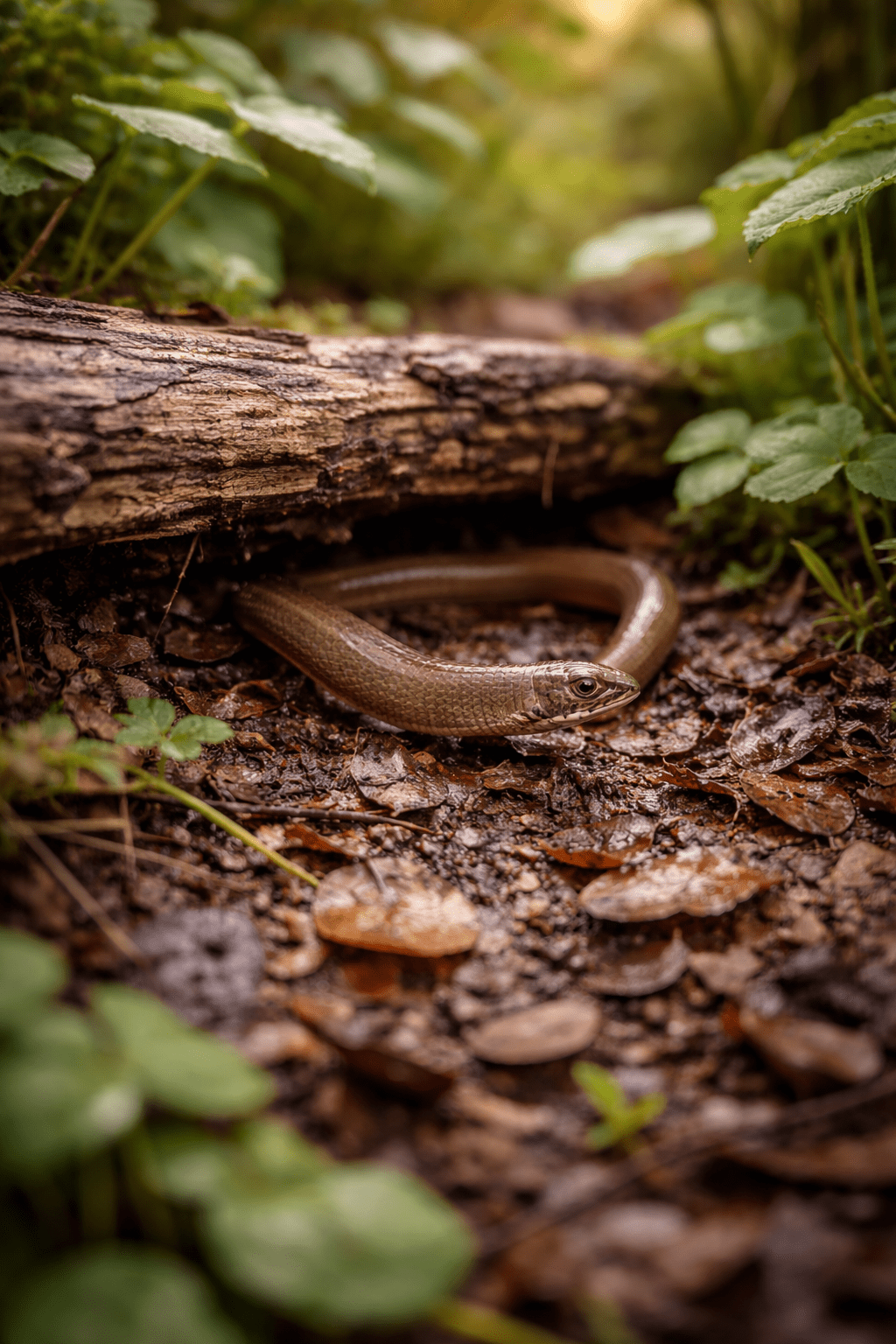
| The secretive neighbours living beneath our feet Slow worms are often discovered by accident. A glint of smooth bronze beneath a log. A sudden, fluid movement through compost. A shape that looks like a snake — until it isn’t. For many gardeners, the first encounter brings surprise, confusion, and sometimes concern. But slow worms are not visitors. They are residents. Quiet, ancient, and remarkably discreet, slow worms have learned to live almost entirely out of sight — relying on the overlooked, undisturbed parts of gardens to survive. When they appear, it is rarely because they want to be seen. It is because something in their hidden world has shifted. To understand slow worms is to understand the value of stillness, cover, and the spaces beneath our attention. |
| Not a snake at all Despite appearances, slow worms are not snakes. They are legless lizards — closer relatives of geckos than grass snakes. Their smooth, shiny bodies and slow, deliberate movements have earned them their name, though they are capable of surprising speed when needed. Unlike snakes, slow worms: Have eyelids and can blink Can shed their tails to escape predators Prefer cool, damp shelter to open basking sites. Spend most of their lives hidden. This combination makes them easy to overlook — and easy to misinterpret. |
| Creatures of cover and continuity Slow worms live almost entirely at ground level. They favour: Compost heaps Leaf litter Long grass Log piles Undisturbed borders Edges of lawns and paths These spaces offer warmth without exposure, moisture without flooding, and safety from predators. In spring, slow worms begin to emerge more frequently as temperatures rise, but they remain cautious, moving between cover rather than venturing into open ground. Gardens that change slowly — rather than being reset each season — are far more likely to support them long-term. |
| Why spring matters so much Spring is a vulnerable time for slow worms. After winter dormancy, they emerge to feed, regain condition, and breed. This coincides with the season when gardens are most actively tidied — compost turned, grass cut, borders cleared, materials moved. Because slow worms rely on warmth stored in organic matter, compost heaps and log piles are particularly important at this time. Sudden disturbance can expose slow worms to cold, injury, or predation. Their instinct, when threatened, is not to flee but to freeze — relying on camouflage rather than speed. This makes careful, gradual movement through spring especially important. |
| Feeding quietly at ground level Slow worms are carnivorous, feeding primarily on: Slugs Snails Soft-bodied insects Worms They hunt slowly and methodically, often at dusk or after rain. Their role in the garden is subtle — contributing to balance rather than control. Where slow worms are present, gardens often experience: Reduced slug pressure over time Increased soil activity A richer ground-layer ecosystem As with many garden allies, their impact is cumulative rather than immediate. |
| Hibernation and shared winter spaces In winter, slow worms hibernate — often communally. They may share hibernation sites with: Frogs and toads Newts Other slow worms These sites are chosen for stability: places that remain frost-free, undisturbed, and insulated by organic matter. Compost heaps, deep leaf piles, and old stonework become lifelines. Removing these features in autumn or winter can destroy hibernation sites long before spring arrives. Slow worms survive winter not through activity, but through reliability. |
| Why are they disappearing Slow worms have declined across much of the UK, particularly in urban and suburban areas. Their decline is linked to: Loss of undisturbed ground Over-tidying and frequent resetting Removal of compost heaps and leaf litter Fragmented gardens with sealed boundaries Because slow worms are rarely seen, their disappearance often goes unnoticed. Gardens may still appear healthy — but a layer of life has quietly gone missing. |
| Protection without intrusion Slow worms are legally protected in the UK. This protection exists because they are vulnerable to disturbance rather than persecution. Their survival depends not on active management, but on being left alone. Gardens that support slow worms tend to share certain qualities: Patience Predictability Tolerance for mess Respect for unseen life They are not wildlife gardens in name. They are simply gardens that allow space to remain space. |
| When you encounter a slow worm Seeing a slow worm is often a sign that the garden is functioning well. It means: The soil is alive Moisture is retained Shelter is continuous Disturbance is limited If a slow worm is uncovered during gardening, the safest response is usually to pause — allowing it to return to cover on its own. Slow worms know where they belong. They rarely need help finding it. |
| A measure of trust Slow worms do not adapt quickly. They return to the same places year after year, relying on memory and familiarity. When they choose a garden, they are placing trust in its stability. That trust is easily broken by sudden change — and slowly rebuilt through restraint. |
| The value of the unseen Slow worms remind us that some of the most important garden life happens below the surface. They do not sing. They do not fly. They do not decorate the air or the branches. They live in the margins — in soil, compost, shade, and quiet. And yet, their presence speaks volumes. A garden that supports slow worms is one that values continuity over control, patience over polish, and life that does not demand to be seen. In spring, when a slow worm slips briefly into view before disappearing again, it offers a rare glimpse into the hidden layers holding the garden together. Then, just as quietly, it returns to where it belongs. |

