| Part 8 |
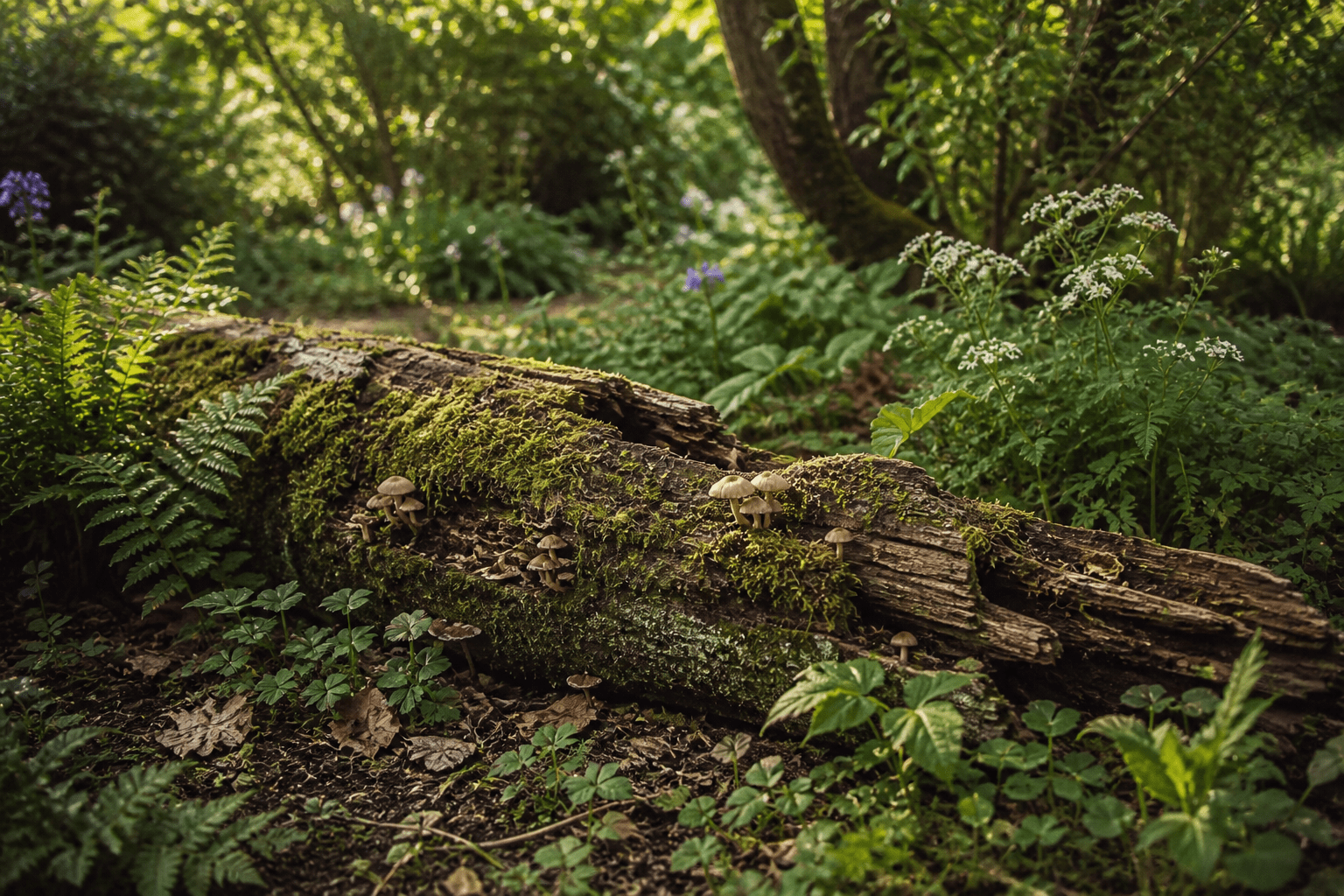
| By this point, it becomes difficult to look at any part of the garden as inactive, even when it appears to have reached an end. The patterns that emerge in the grass and the presence of trees that hold the space both suggest a continuity that does not rely on intervention, suggesting that the processes shaping the garden are not limited to growth alone. There is a tendency, particularly in maintained spaces, to associate activity with what is visibly alive, but this overlooks the extent to which the most significant changes often occur in areas that appear to be declining or finished. Within this context, decay registers differently. A fallen branch, rotting log, or broken-down planting is rarely left without question. The instinct is to remove and restore order, as if decomposition marks a lapse in care rather than a natural continuation. This reaction is understandable when presentation matters, but it overlooks the changes happening as these materials break down. When wood begins to rot, it does not simply deteriorate; it becomes a critical stage in the garden’s ongoing system. The structure softens, moisture is retained, and conditions emerge for organisms absent from fresher material. Fungi work through the fibres, breaking them down invisibly. Insects follow, drawn to the new structure, and join a network of activity that spreads throughout the garden. What looks like decline is, in fact, a focal point where essential processes concentrate. This is not an isolated occurrence. Soil itself forms through similar cycles: the accumulation of organic matter that has passed through stages of growth, death, and breakdown. Composting is simply a managed version of the same process, accelerated and contained for practical use. The difference, in a maintained garden, is that these processes are often separated from the visible space, confined to designated areas rather than allowed to occur within the garden itself. This separation reinforces the idea that decay is something to be managed discreetly, rather than recognised as an integral part of the environment. Leaving this material in place changes how the space is seen. A log left to decay softens into the ground, loses its edges, and merges with its surroundings. Moss covers its surface, moisture lingers, and small plants grow in the new substrate. Over time, the line between log and ground blurs, and what was once separate is absorbed into the system. Clients often respond to this in different ways, depending on how they interpret the garden’s purpose. Some prefer a clear separation between living and non-living materials, viewing decay as something to be removed to maintain order. Others are more open to allowing these processes to occur in place, particularly where there is an awareness of the ecological value they provide. In these cases, deadwood may be retained deliberately, not as a feature in the traditional sense, but as a recognition that its presence supports activity that would otherwise be absent. A tension persists between these approaches. Even in gardens that support wildlife, there is hesitation to let decay show, as if too much is unacceptable. This discomfort reflects a broader unease with the decline in well-maintained spaces. Visible rot disrupts the expectation of control and is hard to reconcile, even when valued. From a practical perspective, the decision to retain or remove decaying material is often context-dependent. In smaller, more formal gardens, space is limited, and the presence of rotting wood may not be appropriate or manageable. In larger or more naturalistic settings, there is greater flexibility to incorporate these elements without compromising the overall structure. The key is not to treat decay as either entirely beneficial or entirely problematic, but to recognise its role within the system and respond accordingly. What becomes clear over time is that decay is not a separate phase from growth but part of the same continuum. The processes that break down organic material are the same ones that contribute to soil formation, nutrient release, and conditions that support new growth. Without them, the system would not function as it does, and the visible vitality of the garden would be diminished as a result. This understaThis understanding may not change every garden’s management, but it does alter perceptions. A fallen branch is no longer simply waste to be removed, but a stage in an ongoing process. Intervention becomes a matter of how that process fits within the space, so a perceptual shift accompanies this. Areas of decay, once recognised as active, begin to draw attention in a different way. What initially appears as a breakdown becomes a concentration of detail, a place where multiple processes intersect. The surface may be uneven, the material softer, the structure less defined, but within that, there is a level of activity that is not present in more stable parts of the garden. In this sense, the most active areas are often those that appear least complete. They do not present themselves in the same way as established planting or maintained surfaces, but they are no less integral to the space’s functioning. The difference lies in how they are read, and whether they are recognised as part of the system or treated as something separate from it. As with the patterns in the grass and the influence of trees, the presence of decay reinforces the idea that the garden operates through processes that are not always immediately visible or fully under control. It is not necessary to allow these processes to proceed unchecked in every context, but it is important to recognise that they occur regardless of how the surface is managed. Once this is understood, the garden can no longer be seen as static or defined by visible completeness. What appears to be an end is in fact a transition; what looks like a loss of structure is often the start of processes equally significant to the garden’s vitality. Recognising these challenges, conventional distinctions between activity and inactivity, and reinforcing the garden as a system in constant change. |
| About our writing & imagery Most articles reflect our real gardening experience and reflection. Some use AI in drafting or research, but never for voice or authority. Featured images may show our photos, original AI-generated visuals, or, where stated, credited images shared by others. All content is shaped and edited by Earthly Comforts, expressing our own views. |

