| NIMBY-ism is shorthand for “Not In My Back Yard” — a term used to describe support for an idea or development in principle, while opposing its presence close to home. Many of you will remember that I used to volunteer at the Gazen Salts Nature Reserve here in Sandwich. It was a small, ordinary place by conservation standards, but, like most reserves, it depended entirely on people turning up, doing the work, and having somewhere to exist while they did. What we ran into was a very familiar form of NIMBYism. The residents behind the reserve liked the idea of having “nature” at the end of their gardens. They enjoyed the birds, the openness, and the sense of green space beyond the fence. What they struggled with was the practical reality that a nature reserve is not just scenery. We needed a modest area where volunteers could gather, take shelter, and store tools. Nothing dramatic. Nothing intrusive. Just the basic infrastructure that makes care possible. That was where the tolerance ended. Nature, it turned out, was welcome — but only if it remained silent, invisible, and self-managing. The moment it required people, presence, or paraphernalia, it became a problem. The wild garden was acceptable; the volunteers who tended it were not. I think about that often. Not because it was unusual, but because it was so typical. It revealed the gap between loving the idea of a place and accepting what it actually takes to keep one alive. |
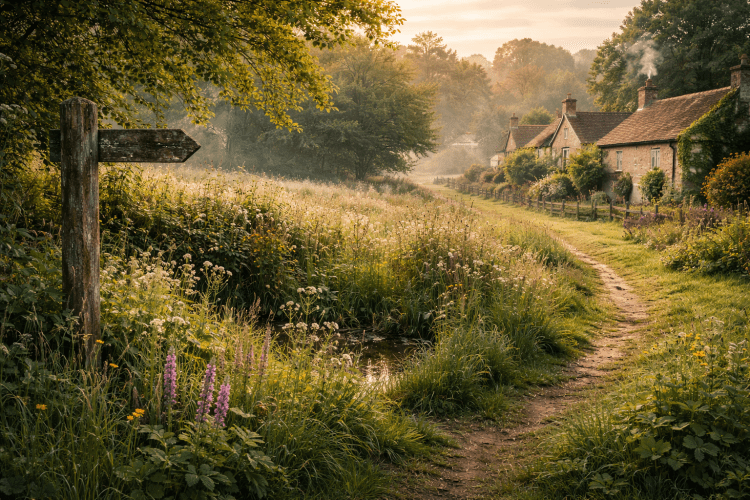
| On wildlife corridors, property edges, and the quiet decisions that shape what survives |
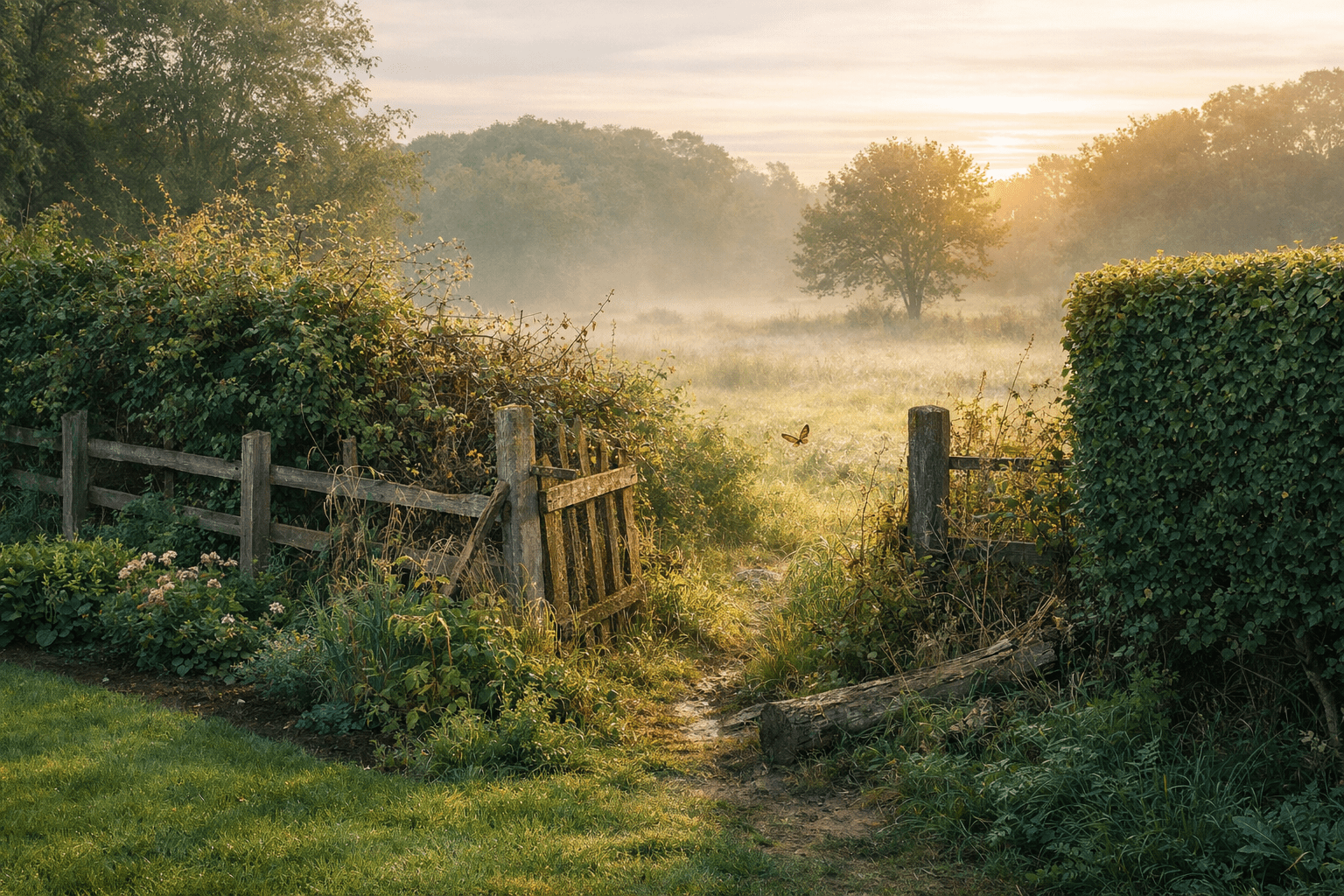
| There is a particular moment I’ve come to recognise in conversation, usually halfway through a sentence. Someone is talking about land — a field, a verge, a hedge, a garden edge — and they pause just long enough to soften what comes next. “I’m not against it,” they say. Or: “I do support it, in principle.” Sometimes: “It’s important, obviously — just…” The rest of the sentence is rarely hostile. More often, it’s practical. A concern about mess. About safety. About precedent. About what something might become if it’s allowed to continue. That pause is where land conflict lives. Not in shouting matches or protest banners, but in the careful space people create between what they believe is right and what they are willing to tolerate nearby. As a gardener, I work inside that space daily, not as a theorist or a campaigner, but as someone kneeling on other people’s ground, negotiating with soil, growth, boundaries, and expectations. NIMBYism — Not In My Back Yard — is often treated as a character flaw—a shorthand for selfishness or short-sightedness. But on the ground, it’s rarely that simple. What I see is something more human and more complicated: people who want good things to happen, just not at the cost of their own sense of order. Land doesn’t care about that distinction. It responds only to what is done. Wildlife corridors and the fiction of boundaries Wildlife corridors sound official. Purpose-built. Designed. They conjure images of mapped routes and protected strips of land. In reality, most of the corridors that still function in this country are accidental. They exist because someone didn’t quite finish a job, or because a place was too awkward to manage appropriately. A hedgerow was left slightly wider than planned. A ditch that stays wet. A back fence with a missing panel that no one bothered to replace. These spaces are connective tissue. They are how animals move through landscapes that are otherwise increasingly sealed. Hedgehogs don’t travel in straight lines; they move cautiously, following cover. Pollinators don’t leap gaps; they step from one food source to the next. Amphibians don’t detour politely around hard edges; they fail. Property boundaries, meanwhile, are designed to do the opposite. They are meant to be clear, enforceable, and final. They declare responsibility and ownership. From a legal perspective, that clarity matters. Ecologically, it can be catastrophic. I’ve been asked to “make that boundary more definite” more times than I can count. Usually, it means closing a gap, cutting a hedge back to a neat line, and removing the scruffy bit where everything seems to tangle together. And often, that scruffy bit is the only route left. The conflict here isn’t ideological. It’s practical. Wildlife needs permeability; property culture values certainty. When the two collide, permeability almost always loses — not because people dislike wildlife, but because boundaries feel non-negotiable. The irony is that the corridor only works because it looks unresolved. As soon as it looks deliberate, someone wants to tidy it. Wanting action, resisting consequence. There is no shortage of appetite for environmental action. People want to feel that things are improving, that damage is being addressed, that care is being taken. They support rewilding projects, biodiversity targets, and pollinator initiatives. They share articles, sign petitions, nod in agreement. What they often resist is consequence. Real ecological change is inconvenient. It interrupts routines. It alters familiar sightlines. It introduces uncertainty. Long grass hides things. Wet areas smell. Untidy edges invite questions from neighbours. I’ve noticed that many people are happy to support environmental goals so long as the outcomes remain abstract. A wildflower meadow in a photograph is charming. A wildflower meadow outside the kitchen window — complete with seed heads, collapsing stems, and wasps — is something else entirely. There’s a quiet assumption that reasonable solutions should be frictionless. That if an idea is right, it won’t demand adjustment. Nature has never worked like that. Environmental repair is embodied. It shows up physically. It asks us to live alongside processes that don’t conform to our sense of neatness or control. The moment action becomes tangible, support often thins. This isn’t hypocrisy so much as misunderstanding. People underestimate how much of their comfort relies on ecological suppression. Views as assets, life as adaptable Few things provoke land conflict faster than a threatened view. Views are spoken about with the language of inheritance and loss. They are treated as something that belongs to someone, even when they extend across land they do not own. Trees grow, hedges thicken, scrub returns — and suddenly the view is “going”. Objections are raised. Permission is sought to reduce, cut back, or remove. What’s striking is how rarely life is granted the same weight. Wildlife is assumed to adapt. Species will move elsewhere. Nature will find a way. Sometimes it does. Often it doesn’t. A view is static. Life is dynamic. When we consistently prioritise one over the other, we don’t just lose individual animals or plants; we lose the whole ecosystem. We lose systems. Feeding routes, breeding cover, seasonal rhythms — things that only function if space is allowed to change. I’ve stood with clients who understood perfectly well that a hedge supported birds, insects, small mammals — and still asked for it to be lowered because it blocked the outlook. The trade-off was acknowledged and accepted. The view mattered more. That decision is not neutral. Repeated across thousands of sites, it reshapes landscapes. Rewilding as language rather than outcome Rewilding has become a generous word. It’s used to describe everything from significant land-use change to simply stepping back. The danger is that intention replaces outcome. I’ve seen “rewilded” spaces that were nothing of the sort. Abandoned corners where compacted soil, invasive species, and neglect produced a thicket that looked wild but functioned poorly. Nettles flourished, but diversity collapsed—the appearance of wildness masked ecological stagnation. True rewilding is not the absence of care. It is a shift in the type of care offered. It requires patience, knowledge, and sometimes intervention. Selective removal. Long timelines. Acceptance that progress isn’t linear. Conflict arises when rewilding is embraced rhetorically but resisted practically. People want wild results without wild processes. They want nature to recover quietly, neatly, and on someone else’s land. Rewilding is slow. It does not respect schedules. It cannot be neatly framed as an improvement. When tidiness causes harm Tidiness is one of the most deeply ingrained values in British land culture. It signals effort, responsibility, and respect. A tidy garden is seen as a cared-for garden. Ecologically, tidiness can be lethal. Removing dead stems in autumn eliminates overwintering insects. Leaves cleared expose soil to erosion and frost. Hedges cut back at the same height year after year weaken, thin, and lose their structure. Margins stripped bare, remove refuge. What makes this difficult is that the harm often comes from diligence rather than neglect. People are doing exactly what they believe is right. They are maintaining. One of the hardest shifts I’ve tried to make in my own work is redefining what care means. Sometimes care looks like restraint. Sometimes it looks like letting something remain awkward longer than feels comfortable. Sometimes it means explaining that doing less is not the same as giving up. Tidiness is not morally neutral. It encodes a preference for control over function. Who gets to decide what land looks like Most land in this country is shaped by a narrow aesthetic tradition: short grass, clean edges, controlled growth. These preferences are rarely examined because they feel normal. They are not universal. They reflect history — who owned land, who worked it, and who observed it from a distance. They privilege visibility and order over process. Decisions about what land should look like are often made by those least affected by ecological loss. The costs are dispersed — declining species, fragmented habitats — while the benefits remain local and immediate. This is not an argument for disorder. It is an argument for humility. Land does not exist solely to reflect human taste. When appearance becomes the primary criterion, ecological function becomes optional. “If not here, then where?” This is the question that sits beneath most NIMBY debates, though it is rarely voiced. If wildlife corridors cannot pass through gardens, villages, verges, and edges — where exactly are they meant to go? If nature is welcome everywhere except where people live, what remains? There is a persistent belief that nature belongs elsewhere. In reserves. In designated zones. In places we visit rather than inhabit. But ecosystems depend on continuity. Fragmentation is what breaks them. Every small refusal shifts the burden outward. Someone else’s tolerance is tested. Someone else’s land must compensate. Eventually, “elsewhere” disappears. Stewardship versus ownership Ownership is about rights. Stewardship is about responsibility. They are not the same thing. You can own land and treat it as an object. You can steward land you do not own by recognising its role in wider systems. The gardeners I respect most tend to think in stewardship terms. They work with timeframes longer than seasons. They understand that land remembers — not sentimentally, but materially. Soil structure, seed banks, and water flows all respond to what is done, or not done. Land conflict sharpens when ownership is treated as absolute, when boundaries become walls rather than agreements. Stewardship asks something more complex. It asks us to accept that land is not just ours. A few things the ground has taught me After years of working in other people’s spaces, a few patterns have become unavoidable. Small decisions accumulate. One gap left open, one hedge spared, one edge allowed to soften can matter more than grand gestures elsewhere. People adapt faster than they expect. What initially feels untidy often fades into the background once it becomes familiar. Explanation matters. Resistance softens when people understand why something is being left or allowed. Mystery breeds suspicion; context invites patience. Conflict is not always a failure. It forces us to articulate what we value. And land responds. Not immediately, but inevitably. Letting the ending arrive NIMBYism is not simply selfishness. Often, it is fear of loss, of change, of being imposed upon. Land conflict exposes how fragile our sense of control really is. The question is not whether we support wildlife, rewilding, or ecological repair in principle. It is whether we are willing to accommodate them in practice, within the spaces we occupy. Stewardship does not demand perfection. It asks for tolerance. For restraint. For acceptance that land can be valuable without being tidy, functional without being controlled. Nature is already returning, in fragments and flashes. The real question is whether we are prepared to live alongside it — here, not somewhere else. |
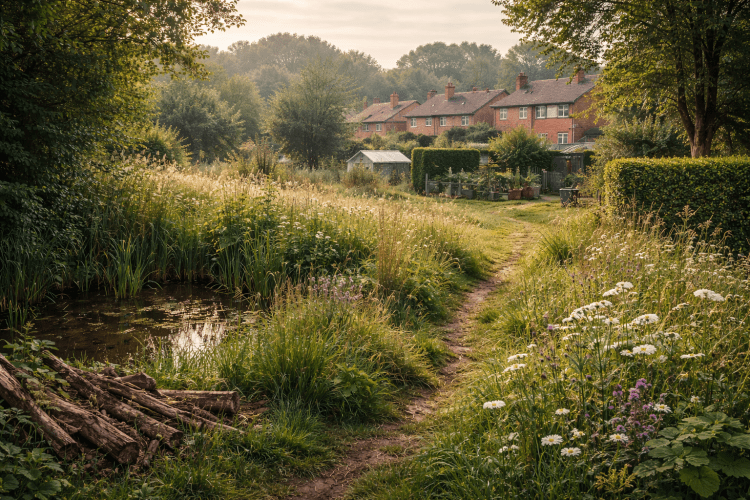
| Fact companion: grounding the observations The essay above is reflective, but the patterns it describes are well-documented. For readers who want factual grounding, the following sources support the ecological realities discussed. Habitat fragmentation and wildlife corridors Natural England outlines how fragmented habitats limit species movement and survival, particularly for hedgehogs, amphibians, and pollinators. https://www.gov.uk/government/collections/natural-england-open-data-geographic The Wildlife Trusts detail the importance of connected landscapes rather than isolated reserves. https://www.wildlifetrusts.org/wildlife/habitats Hedge cutting, boundaries, and biodiversity loss CPRE and Natural England both note the decline in hedgerow quality due to over-management and inappropriate cutting regimes. https://www.cpre.org.uk/resources/hedgerows/ DEFRA guidance highlights hedgerows as critical wildlife corridors when structurally intact. https://www.gov.uk/guidance/hedgerows Tidiness, gardens, and ecological impact The RHS acknowledges that “neat” gardening practices often reduce habitat availability for insects and birds. https://www.rhs.org.uk/wildlife Buglife documents the role of dead stems, leaf litter, and unmanaged margins in insect life cycles. https://www.buglife.org.uk/bugs/bug-homes/ Rewilding and limits of small-scale intervention Rewilding Britain stresses that rewilding is about restoring processes, not abandonment. https://www.rewildingbritain.org.uk/what-is-rewilding Natural England cautions that isolated rewilding without connectivity limits outcomes. https://www.gov.uk/government/organisations/natural-england Planning, views, and landscape conflict CPRE discusses tensions between landscape character, visual amenity, and ecological resilience in planning decisions. https://www.cpre.org.uk/resources/planning-for-the-countryside/ |
| About our writing & imagery Most articles reflect our real gardening experience and reflection. Some use AI in drafting or research, but never for voice or authority. Featured images may show our photos, original AI-generated visuals, or, where stated, credited images shared by others. All content is shaped and edited by Earthly Comforts, expressing our own views. |

