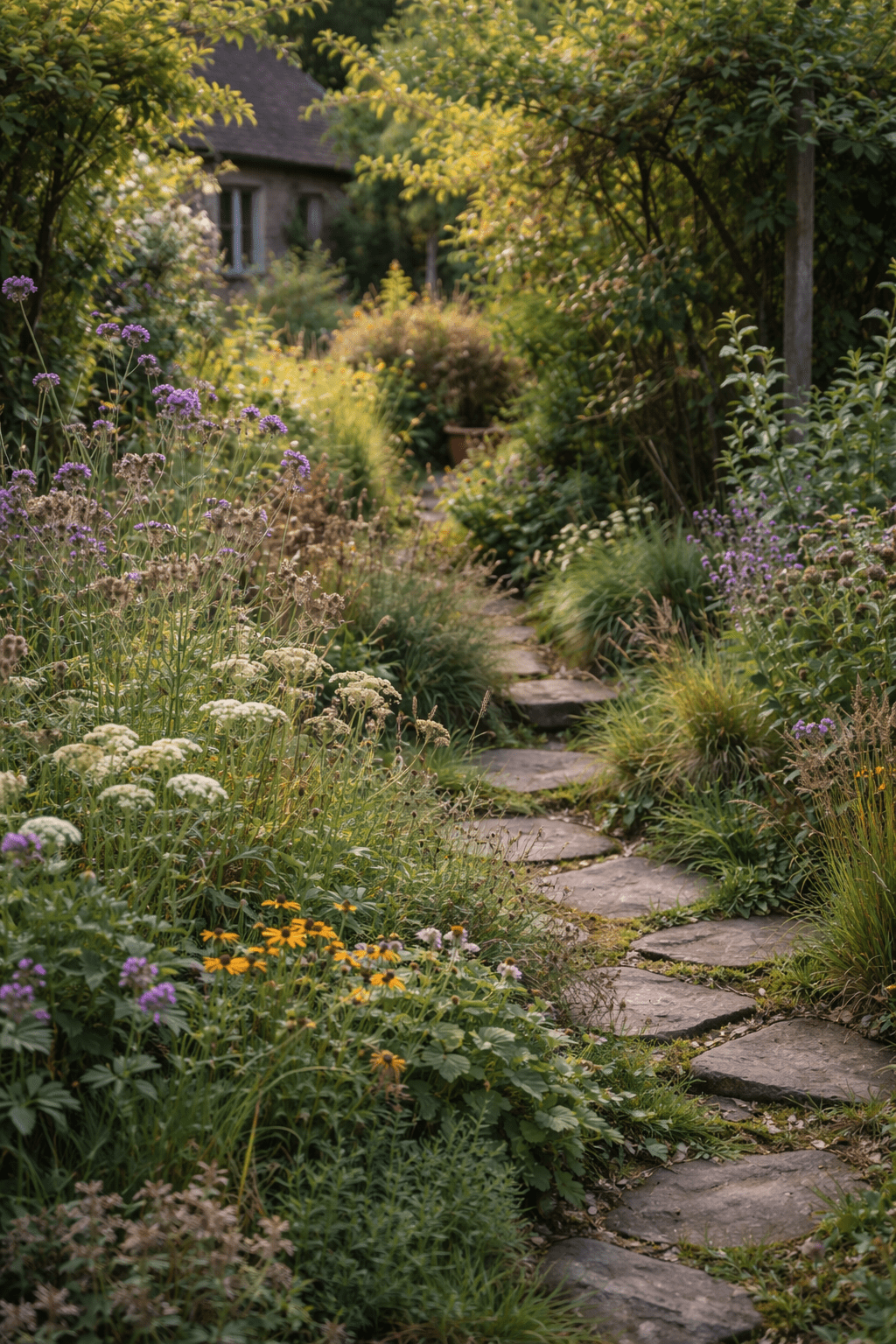
| Why Imperfect Gardens Feel More Alive There is a particular moment I notice again and again when walking into a garden — often not immediately, sometimes not even consciously — when I realise whether the space feels alive or merely maintained. It has little to do with how neat it is. It has everything to do with whether something in it appears to be happening without permission. A clipped lawn can look immaculate and still feel oddly inert. A border with uneven edges, a bit of moss creeping where it technically shouldn’t, seed heads leaning at different angles — that often feels animated, even if nothing is moving. Life, it turns out, leaves traces before it leaves spectacles. I’ve come to think that what many people call an “imperfect” garden is simply a garden where control has been applied selectively rather than universally. And that selectivity — whether deliberate or accidental — is what allows the sense of aliveness to emerge. Control, looseness, and the illusion of order Gardening culture, particularly in Britain, has long been tied to ideas of good order. Straight lines. Clear edges. Seasonal tasks completed on time. There is comfort in this, and no small amount of pride. A well-kept garden signals attentiveness, care, and competence. None of that is wrong. But taken too far, order begins to flatten a garden. Everything is resolved too quickly. Problems are removed before they can develop into relationships. The garden becomes a series of tasks rather than a place where processes can unfold. An imperfect garden retains a degree of looseness. Not chaos — that’s something else entirely — but tolerance. A tolerance for plants that self-seed. For surfaces that change texture over time. For growth that doesn’t align neatly with the plan drawn up last winter. That tolerance is not passive. It is a decision to observe first and intervene later, if at all. In practice, it often produces a garden that feels more animated precisely because it contains unresolved moments. The quiet work is happening underfoot. One of the least visible differences between a tightly controlled garden and a more relaxed one lies beneath the surface. Soil does not respond well to constant correction. Compaction, repeated disturbance, and aggressive clearing — these interrupt the networks that quietly keep a garden functioning. In gardens where a little mess is allowed to accumulate — leaf litter left beneath hedges, fallen petals left to break down, roots left undisturbed — the soil tends to hold together better. Moisture lingers. Worms remain. Fungal threads are not repeatedly severed. You don’t need to see any of this for it to influence how a garden feels. The effect shows up indirectly: plants that seem less stressed, beds that dry out more slowly, borders that hold their shape without constant input. The garden begins to carry itself. This is one reason imperfect gardens often feel calmer. They are doing less work at the surface because more work is being done invisibly below. Time made visible A perfect garden often exists in a narrow slice of time. It looks right now. But it rarely tells you what came before or what might come next. Imperfect gardens, by contrast, carry their history openly. Old pruning scars sit beside fresh growth. Self-sown plants hint at last year’s conditions. A slightly bare patch in a lawn tells you where the ground was compacted once, long ago. These details create depth. They give the garden a memory. Humans respond to this instinctively. We are not exceptionally comfortable in places that appear to have no past. A garden that shows signs of use, recovery, adjustment and return feels more honest. It doesn’t pretend to be finished. In that sense, imperfection is not a flaw but a record. What wildlife actually uses There is a persistent assumption that wildlife requires designated features: the correct box, the correct feeder, the correct corner neatly labelled as “wild.” Those things can help, but they are often less critical than structural variety. In my experience, wildlife responds less to intention and more to opportunity. Slightly untidy hedges offer nesting space. Long grass at the edge of a lawn supports insects that never venture into manicured areas. Seed heads left standing feed birds long after the gardener has forgotten them. What’s notable is how often these opportunities arise not through deliberate creation, but through restraint. By not cutting something back immediately. By not tidying a corner simply because it looks unfinished. By allowing a plant to grow beyond its expected boundary. The result is a garden that is used rather than displayed. And use, more than anything, creates the sense of life. The myth of constant intervention One of the quieter myths in gardening is that attentiveness must be constant to be effective. Good gardeners are always doing something and constantly correcting, trimming, and adjusting. In reality, much of good gardening is knowing when not to act. Plants adapt. They lean towards light, retreat from stress, and strengthen when slightly challenged. Intervening too frequently can weaken them, creating dependency rather than resilience. An imperfect garden often reflects a gardener who has stepped back enough to let those adaptations take place. This does not mean neglect. It means trust built through observation. Knowing which plants cope, which struggle, and which only appear to struggle because they are in the middle of changing. That middle state — neither failing nor thriving yet — is where a garden feels most alive. Human rhythms, written into the ground. Very few gardens are tended in ideal conditions. They are working on around jobs, illness, family commitments, weather, finances, and energy. An imperfect garden records those rhythms honestly. A border that didn’t get mulched one year. A hedge trimmed later than planned. A lawn left a little longer because life intervened. These are not failures. They are marks of a garden that exists alongside a human life rather than in opposition to it. There is something profoundly reassuring about that. A garden that accepts inconsistency tends to offer it back. It does not punish missed weeks. It responds when attention returns. This reciprocity is often what clients describe — sometimes without quite knowing how — when they say a garden feels “kind” or “forgiving.” A working gardener’s perspective From a practical standpoint, imperfect gardens are often more stable. They require fewer emergency interventions because they are not pushed to extremes. Plants are allowed to find their scale. Soils are not constantly stripped and reset. Surfaces age rather than being perpetually restored. This does not mean they are cheaper or easier in every respect. They demand patience. They require a willingness to accept outcomes that are not entirely predictable. They also require explaining — sometimes repeatedly — that not everything that looks untidy is a problem. But over time, these gardens tend to settle. Maintenance becomes lighter, more responsive, less urgent. The work shifts from control to conversation. And that shift is felt by anyone who steps into the space. The difference between messy and alive It’s worth saying that not all untidiness produces life. There is a difference between neglect and allowance. A garden overwhelmed by invasive growth or starved of basic care can feel just as lifeless as one that is over-managed. The quality that distinguishes a living imperfection is intention held lightly. Someone is paying attention, even if they are not acting all the time. Decisions are being made, even if those decisions are to wait. That balance — between presence and restraint — is subtle but visible. Why do we respond to it? The reason imperfect gardens feel more alive is that they resemble systems we recognise. Woodlands, meadows, riverbanks — none of these are tidy, yet all are coherent. They hold structure without rigidity. A garden that borrows this logic feels believable. It doesn’t ask us to admire effort; it invites us to notice process. We sense that if we returned next week or next year, it would not be identical. Something would have shifted. That promise of change is the essence of aliveness. Perfect gardens feel resolved. Imperfect gardens feel in motion. And most of us, whether we articulate it or not, prefer to spend time in places that are still becoming |
| About our writing & imagery Most articles reflect our real gardening experience and reflection. Some use AI in drafting or research, but never for voice or authority. Featured images may show our photos, original AI-generated visuals, or, where stated, credited images shared by others. All content is shaped and edited by Earthly Comforts, expressing our own views. |

