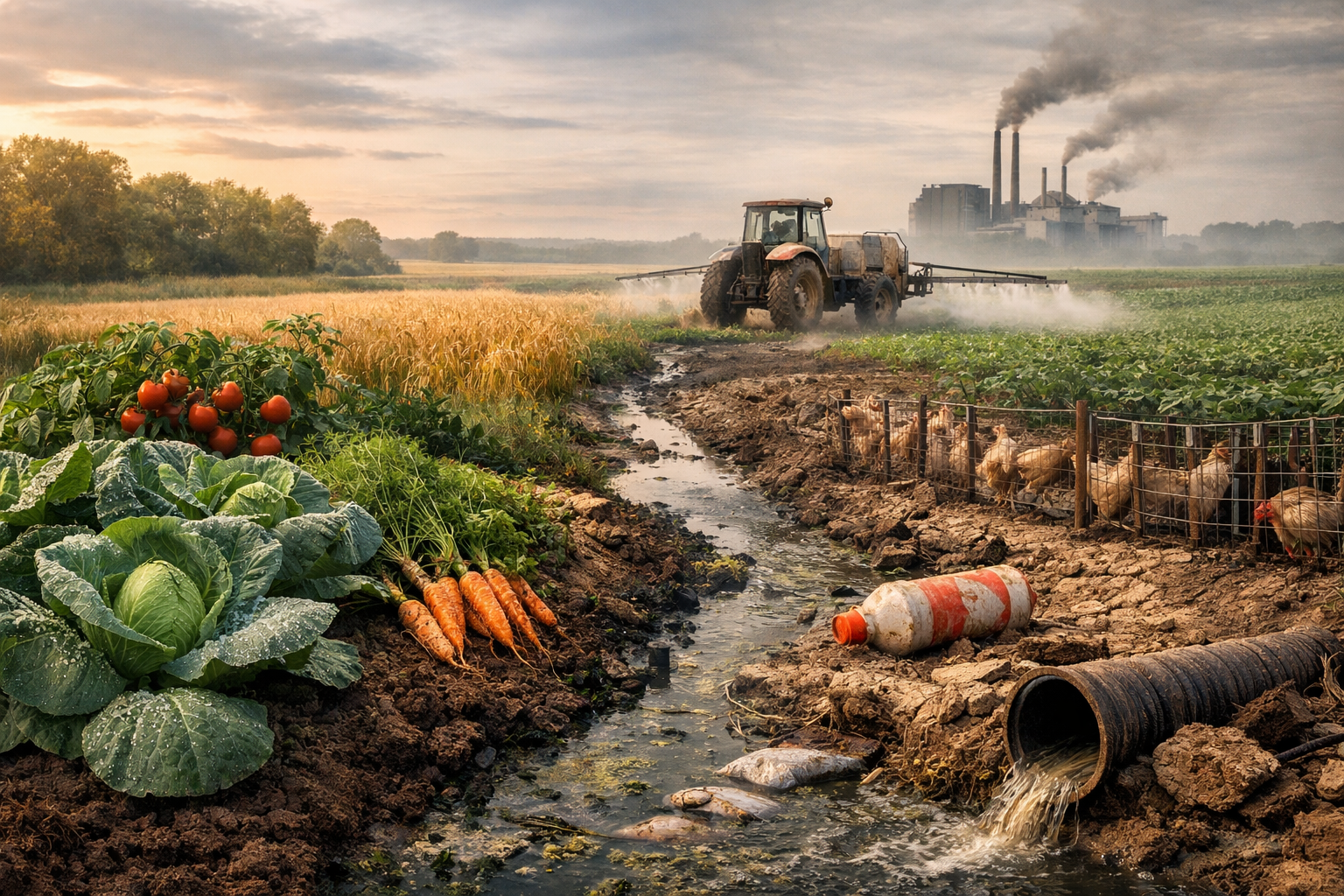
| Why “cheap” food isn’t cheap at all I spend a good part of my working life with my hands in soil. That alone changes how you think about food, not in a preachy, lentils-and-sackcloth way, but in a quieter, more inconvenient way. You start to see time. You start to notice inputs. You start to understand that nothing edible appears quickly, effortlessly, or without consequence. Which is why the phrase cheap food has always made me wince a little. It’s not that I don’t understand the appeal. I live in the same world as everyone else. I see the yellow stickers. I feel the pull of a £1 ready meal at the end of a long day. I understand budgets, fatigue, and the quiet relief of not having to think too hard about what’s for tea. I’m not immune to any of that. But when you work outdoors long enough—watching what it takes to coax life from tired ground—you start to realise that cheap food is rarely cheap. It’s simply that the bill is settled somewhere else, by someone else, often much later. Food, like gardens, always keeps its accounts. We choose whether to read them. The lie of the low price The supermarket shelf gives us a comforting illusion: a clean, orderly place where food appears detached from weather, labour, soil, and animals. Prices look tidy. Comparable. Reassuring. But that price is only the visible fragment of a much larger transaction. Cheap food works by stripping costs away from the point of sale and scattering them outward—into land, bodies, ecosystems, and future years. Soil depletion doesn’t show up on a receipt. Neither does chronic farmer debt, exhausted workers, antibiotic resistance, polluted waterways, or the slow erosion of rural skills. In gardening, we see this pattern constantly. Someone asks why we won’t just “spray something cheap” on a problem bed. They want a fast fix. What they don’t see is that the quick chemical solution usually makes the soil poorer, the pests more resilient, and the future work harder and more expensive. Cheap food follows the same logic. It solves today by borrowing heavily from tomorrow. Soil knows the truth. Soil is a ledger. It records everything. When food is grown intensively, cheaply, and repeatedly from the same land, something has to give. Organic matter drops. Microbial life thins out. Structure collapses. The soil becomes a medium rather than a living system. To compensate, we pour in fertilisers—synthetic nutrients that keep plants upright and green but do nothing to rebuild what’s been lost. It’s like feeding someone caffeine and sugar instead of meals. You get energy, not health. As a gardener, you learn quickly that soil treated this way becomes brittle. It dries out faster. Floods more readily. Needs constant intervention. The costs don’t vanish; they compound. Cheap food depends on soils that are quietly running on overdraft. And here’s the thing most people miss: restoring soil is slow. It can take years—sometimes decades—to rebuild what was stripped out in a few growing seasons. That cost doesn’t appear anywhere near the checkout. But it will be paid, one way or another. Cheap labour is still labour. Food doesn’t grow itself. Someone plants it. Someone harvests it. Someone processes, packages, and transports it. When food is cheap, labour is usually where the savings come from. Low wages. Seasonal precarity. Long hours. Minimal protection. Often, migrant workforces have little bargaining power and plenty to lose. This isn’t abstract to me. Gardening is physical work. It takes a toll on the body even when done well. Joints stiffen. Backs ache. Weather doesn’t negotiate. When food prices are pushed ever lower, labour is squeezed until it becomes invisible. The human cost is normalised. We accept it as background noise to affordable abundance, much like we’ve accepted traffic deaths as the price of mobility. But there is no such thing as costless labour. The body keeps its own records. So do communities hollowed out by work that doesn’t sustain a life. Health doesn’t balance the books either Cheap food often costs more later—in clinics, prescriptions, lost workdays, and diminished quality of life. Highly processed, calorie-dense, nutrient-thin food fills stomachs without truly feeding people. It’s not that these foods are inherently evil; it’s that they’ve become structurally dominant because they’re profitable, shelf-stable, and cheap to produce at scale. In gardens, we see a similar dynamic with plants grown for speed rather than resilience. They look impressive for a while, then collapse under stress. They require constant input to stay upright. Human bodies aren’t so different. Diets built around the cheapest calories tend to externalise costs into healthcare systems and personal suffering. Again, the price hasn’t vanished. It’s been deferred. And importantly, this isn’t about individual virtue. People don’t choose cheap food because they’re ignorant. They choose it because time, money, and energy are limited. The system is designed to make the cheapest option the most convenient one. That design choice has consequences. Convenience as a hidden cost One of the great myths of modern food is that convenience is neutral. It isn’t. Convenience requires infrastructure: packaging, transport, refrigeration, additives, energy, and waste management. Each layer adds distance between us and the origin of what we eat, and each layer has its own environmental and social cost. As a gardener, I notice how far removed many people are from seasonality. Strawberries in December don’t raise eyebrows anymore. Tomatoes are expected to taste the same year-round. Food becomes abstract, detached from weather, failure, and patience. That detachment makes it easier to accept low prices, because we no longer feel what it takes to produce something. When you’ve grown even a small amount of food yourself, pricing shifts. Not upward in a greedy sense, but outward. You start to see value beyond the pound sign. The myth of efficiency Cheap food is often defended as efficient—high yields, streamlined supply chains, economies of scale. But efficiency for whom, and over what timeframe? In gardening, the most “efficient” solution often creates the most work later. A monoculture bed is easy to plant and hard to maintain. A diverse bed takes more thought initially and far less intervention over time. Industrial food systems optimise for short-term output rather than long-term stability. They prioritise uniformity over resilience—speed over recovery. When something goes wrong—drought, disease, fuel shocks—the system proves fragile. Suddenly, food isn’t cheap at all. It’s scarce, volatile, and politically sensitive. Actual efficiency includes repair, regeneration, and the capacity to absorb shocks. Cheap food systems are often efficient only as long as nothing unexpected happens. Waste is part of the price. Another quiet cost of cheap food is waste. When food is inexpensive, it becomes disposable. Supermarkets overstock to maintain the illusion of abundance. Perfectly edible produce is rejected for cosmetic reasons. Households throw away food because replacing it feels easier than planning around it. Waste isn’t just moral failure; it’s structural. Low prices encourage a culture where loss is acceptable because the individual cost feels negligible. But waste still carries weight. Landfill methane. Wasted water. Wasted labour. Wasted soil fertility. In gardens, waste is obvious. You feel it when you compost a plant you nurtured for months. You don’t do it casually. Cheap food dulls that sensitivity. What working with land teaches you. After years of gardening, a few observations become unavoidable. First, quality reduces work. Healthy soil grows healthier plants that need less intervention. Good food satisfies more deeply. You eat less of it, waste less of it, and feel better afterwards. Second, shortcuts always charge interest. Whether it’s soil, diet, or labour, taking from the system without replenishing it leads to escalating costs. Third, context matters. Not all cheap food is equal, and not all expensive food is virtuous. Local doesn’t automatically mean better. Organic doesn’t guarantee sustainability. Labels simplify a world that resists simplification. And finally, food is never just fuel. It’s a relationship—between land and eater, producer and community, present and future. When those relationships are thinned, something essential is lost, even if shelves remain full. Rethinking value without moralising It’s tempting to turn this conversation into a lecture. I don’t want to do that. Most people are already stretched. Food decisions sit at the intersection of money, time, care, habit, and stress. Blame isn’t proper. What is useful is noticing where the actual costs land. When food seems improbably cheap, ask quietly: Who or what is paying the rest of the bill? Sometimes the answer is soil. Sometimes it’s a worker. Sometimes it’s your future self. This isn’t about purity. It’s about awareness. I don’t believe in perfect food choices. I believe in better questions. Where this leaves us As a gardener, I don’t expect everyone to grow their own food, just as I don’t expect everyone to compost, save seed, or read soil structure like a book. But I do think reconnecting—even slightly—with how food is produced changes how we value it. Cheap food isn’t cheap. It’s subsidised by damage that doesn’t appear on the label. Once you see that, the conversation shifts. It becomes less about price and more about balance—less about guilt and more about care. And care, like soil, accumulates slowly—but it pays dividends for a very long time. |
| Fact Box: The Hidden Costs Behind “Cheap” Food Food prices reflect only part of the story. The figures below highlight where many of the unseen costs of low-priced food tend to fall — on soil, workers, health systems, and the environment. Soil & Land **Around 33% of the world’s soils are moderately to highly degraded, mainly due to intensive agriculture, erosion, and loss of organic matter. (UN Food and Agriculture Organisation) **Industrial farming systems often prioritise yield over soil regeneration, leading to increased reliance on synthetic fertilisers. These inputs can boost short-term output but do not rebuild soil structure or microbial life. (FAO; European Commission Joint Research Centre) **It can take decades to restore healthy topsoil, while poor practices can degrade it in just a few growing seasons. (FAO) Labour & Economics **Globally, agricultural workers are among the lowest-paid labour groups, with high levels of seasonal insecurity and limited worker protections, particularly in fresh produce supply chains. (International Labour Organisation) **In the UK and EU, food prices are kept low partly through tight margins passed down the supply chain, often leaving farmers earning below the cost of sustainable production. (National Farmers’ Union; Sustain UK) **Migrant labour plays a critical role in food production, yet is frequently associated with long hours, physically demanding conditions, and limited bargaining power. (ILO; UK Equality and Human Rights Commission) Health Costs **Diet-related illness places a significant burden on public health systems. In the UK, poor diet is one of the leading contributors to preventable disease, including Type 2 diabetes, cardiovascular disease, and obesity. (Public Health England; NHS England) **Highly processed foods are often cheaper per calorie but lower in fibre and micronutrients, contributing to long-term health costs not reflected in their retail price. (British Nutrition Foundation; World Health Organisation) **The NHS spends billions of pounds annually treating diet-related conditions — costs borne collectively rather than at the till. (NHS England) Environment & Climate **Food systems account for approximately one-third of global greenhouse gas emissions, including farming, processing, transport, packaging, and waste. (Intergovernmental Panel on Climate Change) **Intensive agriculture is a major contributor to water pollution, particularly through nitrate and phosphate runoff, which affects rivers and coastal ecosystems. (UK Environment Agency; European Environment Agency) **Food waste alone contributes around 8–10% of global greenhouse gas emissions, despite being entirely avoidable. (UN Environment Programme) Food Waste **UK households throw away millions of tonnes of edible food each year, much of it linked to over-purchasing and the low perceived value of food. (WRAP UK) *8Lower food prices are consistently associated with higher waste rates, as replacement feels cheaper than preservation. (WRAP; FAO) A Note on Context Cheap food does not arise from a single cause, nor does responsibility sit with individual consumers. Low prices are the outcome of system design, shaped by policy, supply chains, labour markets, and cultural expectations around convenience and abundance. The figures above don’t argue for perfection — only for clearer sight of where costs land when they don’t appear on the receipt. |
| About our writing & imagery Most articles reflect our real gardening experience and reflection. Some use AI in drafting or research, but never for voice or authority. Featured images may show our photos, original AI-generated visuals, or, where stated, credited images shared by others. All content is shaped and edited by Earthly Comforts, expressing our own views. |


Interesting post, Rory. I find it amazing what we accept, and yet don’t have any understanding about how things work.
LikeLiked by 1 person
Ha yes Eugenia, the food acceptance is astonishing these days, and l often think if people really knew, would they be so accepting then?
LikeLiked by 1 person
I would think most would, but then some don’t care.
LikeLiked by 1 person