| Part 9 |
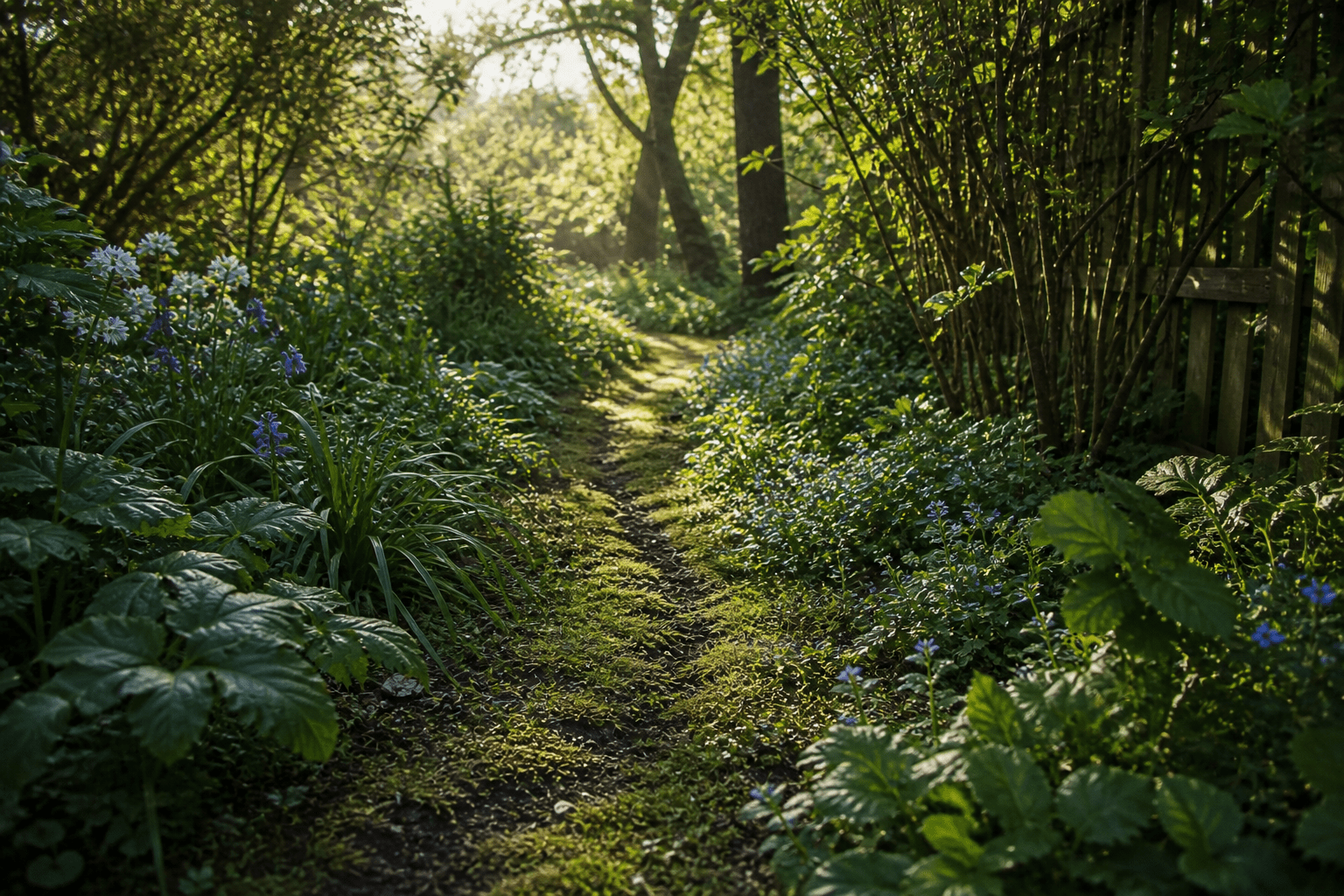
| By the time you have begun to accept that the garden is shaped as much by what happens unseen as by what is actively maintained, you realise it is not solely defined by human use. Instead, unseen processes and changes suggest independent activity, highlighting a central argument: the garden is influenced by patterns and routes that exist beyond your direct involvement and become evident through repetition. It isn’t a formal path, not laid or marked, yet it acts like one. Grass is slightly flattened without foot traffic, plantings have narrow lines where growth is disturbed, and subtle tracks follow boundaries uninterrupted. These signs form routes that are used repeatedly, following the same line with a precision that suggests familiarity. At first, these traces can be dismissed as incidental. A single disturbance may be attributed to a one-off movement, a brief passage through the space that leaves little to indicate it will happen again. But over time, the pattern establishes itself. The same line is used, the same areas are affected, and the route becomes more defined, not because it has been created, but because it has been followed consistently. The garden, in this sense, is being navigated according to a logic that is not your own. The explanation is straightforward. Wildlife moves through gardens as part of larger routes beyond any single space. A garden is a segment in a broader network, and its paths are sections of larger routes. Foxes, hedgehogs, and others follow lines of least resistance, most cover, or directness, reusing established lines. What’s less obvious is how these routes interact with maintained space. Planting follows intentions, paths guide movement, boundaries define structure. The non-human paths cross intentions, align only where convenient, and ignore them when necessary. A border may be crossed at its narrowest, a fence used as a guide, and seemingly undisturbed areas reveal use over time. This does not disrupt the garden’s function in any significant way, but it introduces a parallel system of movement alongside the one you have created. You maintain the visible paths, ensuring they are clear, defined, and usable, while other routes continue to be used without requiring the same level of maintenance. They are reinforced not by construction, but by repetition, and their persistence depends on conditions that extend beyond the immediate space. This requires a subtle shift in perception. The garden is no longer just a contained space but part of a partly visible network. Your boundaries aren’t always followed, and your routes are not the only ones. This is clear when you anticipate where new paths will form, recognising conditions that make certain lines more likely. A consistent pattern appears with time. Routes follow edges to cover or connect protected points. Open spaces are crossed quickly; sheltered areas are used more. Obstacles redirect rather than prevent movement, often in predictable ways. The garden is read as terrain shaped by unseen priorities. Clients are often only partly aware of this. They may see disturbed areas or worn lines, but they seldom link them to broader movement. The garden is still seen mainly by its visible features, treating these paths as minor irregularities rather than evidence of a larger system. There are occasions where this awareness becomes more pronounced, particularly when movement is observed directly or when the signs become too consistent to ignore. At that point, the garden is understood differently, not as a closed space, but as one that is shared. This does not change its fundamental maintenance, but it does alter how certain elements are approached. Openings may be left in boundaries to allow for movement, planting may be adjusted to accommodate established routes, and the presence of these paths may be accepted rather than corrected. This isn’t always deliberate but reflects recognition that the garden isn’t solely defined by chosen actions. Other users are present—expressed in the patterns they leave. The paths not yours aren’t imposed like created paths, but shape use just as much. Over time, this becomes part of how the garden is read and understood. You begin to see not just the arrangement of plants and structures, but the lines of movement that pass through them, connecting one part of the space to another in ways that are not immediately obvious. The garden reveals itself as something more than a collection of features, becoming a point of intersection within a wider network of activity instead. As with the patterns in the grass and the processes of decay, these paths reinforce the idea that the garden operates at multiple levels, some of which are not immediately visible or fully controlled. The presence of these routes does not diminish the role of maintenance or design, but it does place them within a broader context in which the space is influenced by factors that extend beyond its boundaries. Once this is recognised, it becomes difficult to view the garden as entirely your own. It is shaped by your actions, certainly, but it is also shaped by movement that does not rely on your presence and by patterns that are established independently of your intention. The paths that are not yours do not require permission, and they do not need to be acknowledged to exist. They are simply part of how the space is used, whether you see them or not. |
| About our writing & imagery Most articles reflect our real gardening experience and reflection. Some use AI in drafting or research, but never for voice or authority. Featured images may show our photos, original AI-generated visuals, or, where stated, credited images shared by others. All content is shaped and edited by Earthly Comforts, expressing our own views. |

