| Part 11 |
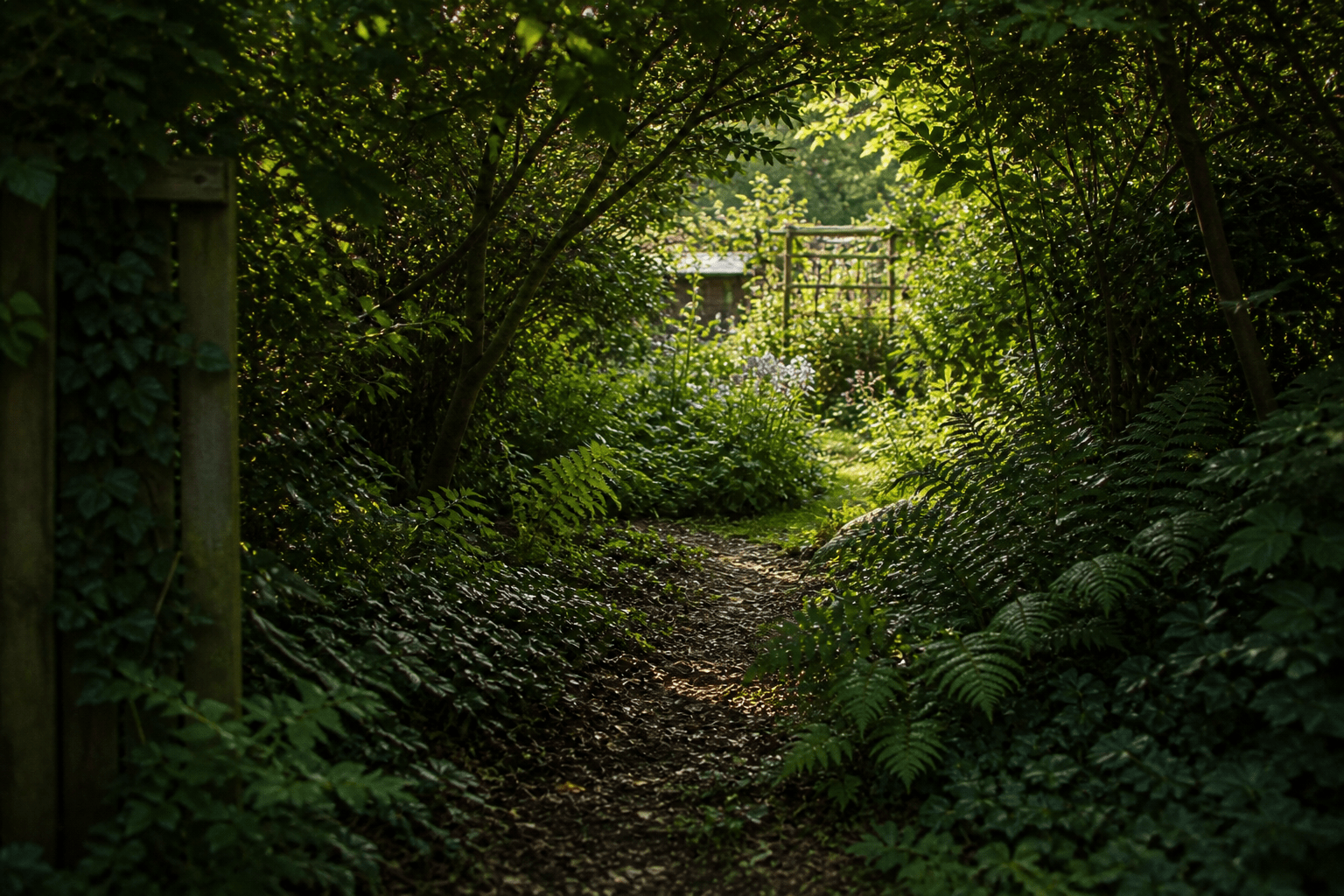
| Once it becomes clear that the garden does not present itself in a single, fixed way, and that even light can alter how a space is read without changing anything within it, attention turns to the decisions that shape what is revealed and what is not. These decisions are not always deliberate in the sense of being formally planned, but they are consistent enough to form a pattern. Certain areas of a garden are developed, refined, and maintained to a level that reflects their visibility, while others are left less defined, less immediate, and, in some cases, less frequently observed. This distinction does not usually present itself as a clear division, but it becomes evident over time. A garden may appear complete when viewed from its primary vantage points, the areas closest to the house or most often used, carrying a level of attention that reinforces their role as the visible centre of the space. Beyond this, there are often sections that are not neglected but are not subject to the same degree of control. Planting may be denser, access less direct, and maintenance less frequent, not because these areas are unimportant, but because they are not intended to be read in the same way. Paths play a role in this, though not always in an obvious sense. Formal routes guide movement through the garden. They establish a sequence of spaces meant to be experienced in a particular order. What lies beyond those routes is not necessarily hidden. It is not always encountered unless there is a reason to move away from the defined structure. Over time, this creates areas that are known but not regularly seen. These exist within the garden without forming part of its immediate presentation. Working within these spaces requires a different kind of awareness. The conditions are often less consistent, shaped by a combination of reduced intervention and the influence of surrounding planting. Light is more variable, airflow is less predictable, and the ground may hold moisture differently from the more exposed areas of the garden. These are not extreme differences, but they are enough to shift how the space behaves and, consequently, how it is approached. Clients will often refer to these areas in indirect terms. They may describe them as quieter parts of the garden or as spaces left more natural, without necessarily defining what that means in practical terms. There is usually an understanding that these sections do not require the same level of attention and that their value lies in their difference rather than in their refinement. This does not imply neglect, but it does introduce a level of separation between what is actively managed and what is allowed to remain more independent. The reasons for this are varied, but they tend to converge around a common theme. Not everything within the garden needs to be visible at all times, and not every part of the space needs to be resolved into a clear, maintained form. There is a willingness in these areas to allow the garden to operate with greater autonomy, even if that autonomy is not explicitly acknowledged. This becomes more apparent when these spaces are revisited after a period of time. The changes that have taken place are often more pronounced. This is not because they are fundamentally different from those occurring elsewhere, but because they have not been moderated to the same extent. Growth may be more layered, with plants extending into one another in ways not permitted in more controlled areas. The ground may show signs of activity that have been left undisturbed. The overall structure may feel less defined, not suggesting disorder but reflecting a different set of priorities. There is also a perceptual shift that accompanies this. Moving into a part of the garden that is less frequently observed changes how the space is experienced, not because it is separate, but because it has not been continuously adjusted to align with expectation. The eye does not move through it as easily, and the usual reference points are less clear. This requires a more deliberate engagement, a slowing of movement and attention that is not always present in more familiar areas. From a practical perspective, these spaces often require intervention. The nature of that intervention differs. The aim is not always to bring them into alignment with the rest of the garden, but to maintain their viability without removing the qualities that distinguish them. This can involve selective pruning, the removal of material that has become excessive, or the introduction of structure where needed. Always, these actions are adjustments rather than corrections. The presence of these areas suggests that the garden is not intended to be fully resolved. There is an acceptance, whether conscious or not, that some parts of the space will remain less defined, and that this lack of definition contributes to the overall character of the garden. It introduces variation not just in appearance but also in experience, allowing different parts of the space to operate under slightly different conditions. This does not alter the fundamental understanding that the garden is an active system. But it does add another layer to how that system is managed. The decision to leave certain areas less visible or less controlled is not simply a matter of convenience. It reflects an understanding, however implicit, that the garden does not need to be fully observed to function. In some cases, it may function more effectively when it is not. Over time, this becomes part of how the garden is read. You begin to recognise not just what is present, but what is withheld, and how that affects the overall balance of the space. The visible areas are supported by those that are less so, not in a structural sense, but in the way they contribute to the continuity of the system. The garden is not divided into separate parts, but it does contain areas with varying degrees of exposure. Once this is recognised, it becomes more difficult to treat the garden as an entirely open space. It is not hidden deliberately, but it is not fully revealed either. There are always sections that exist just beyond immediate attention, shaped by conditions that are not constantly observed and by decisions that allow them to remain that way. And in that, the garden moves further from the idea of a space that can be fully known at any one time. It remains manageable, and its structure is still defined by the work carried out within it, but it is no longer entirely visible in a single view. It extends beyond what is immediately seen, not because it is concealed, but because it is not always brought into focus. |
| About our writing & imagery Most articles reflect our real gardening experience and reflection. Some use AI in drafting or research, but never for voice or authority. Featured images may show our photos, original AI-generated visuals, or, where stated, credited images shared by others. All content is shaped and edited by Earthly Comforts, expressing our own views. |

