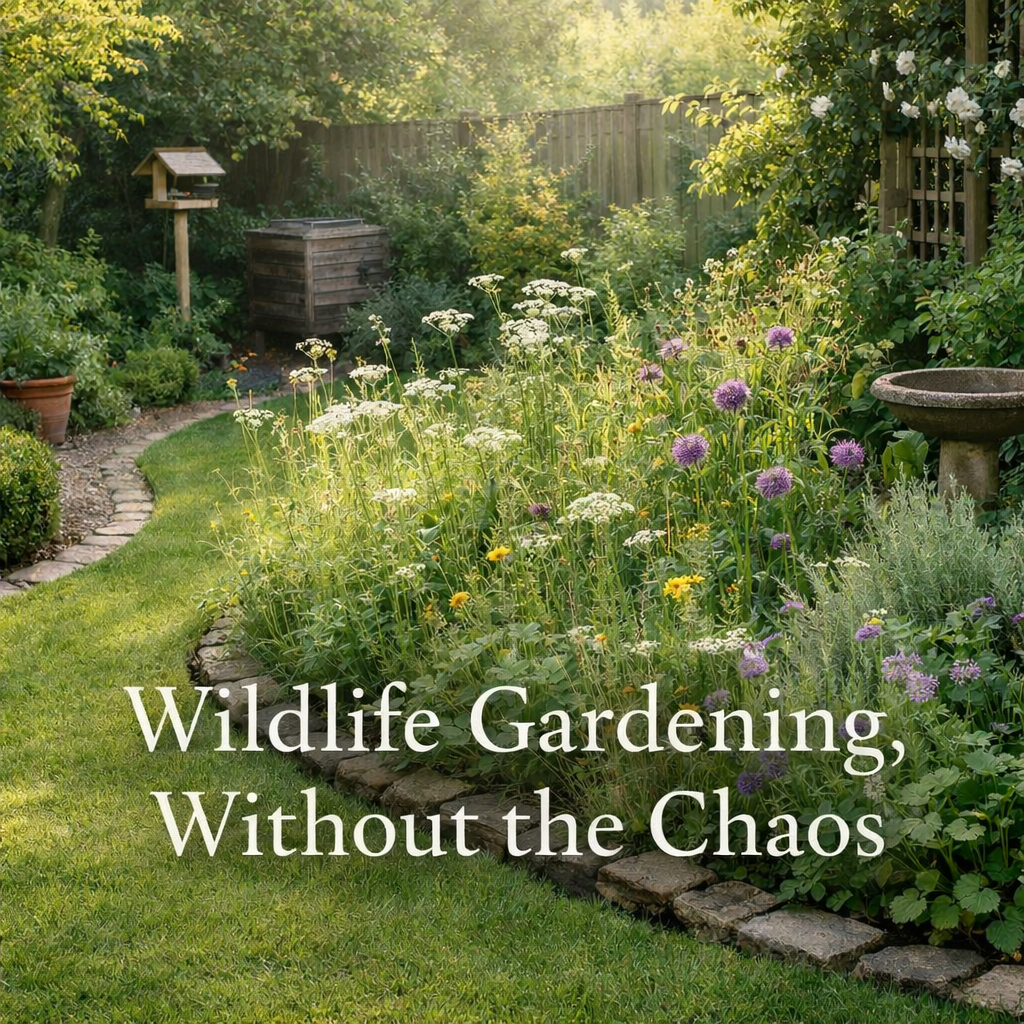
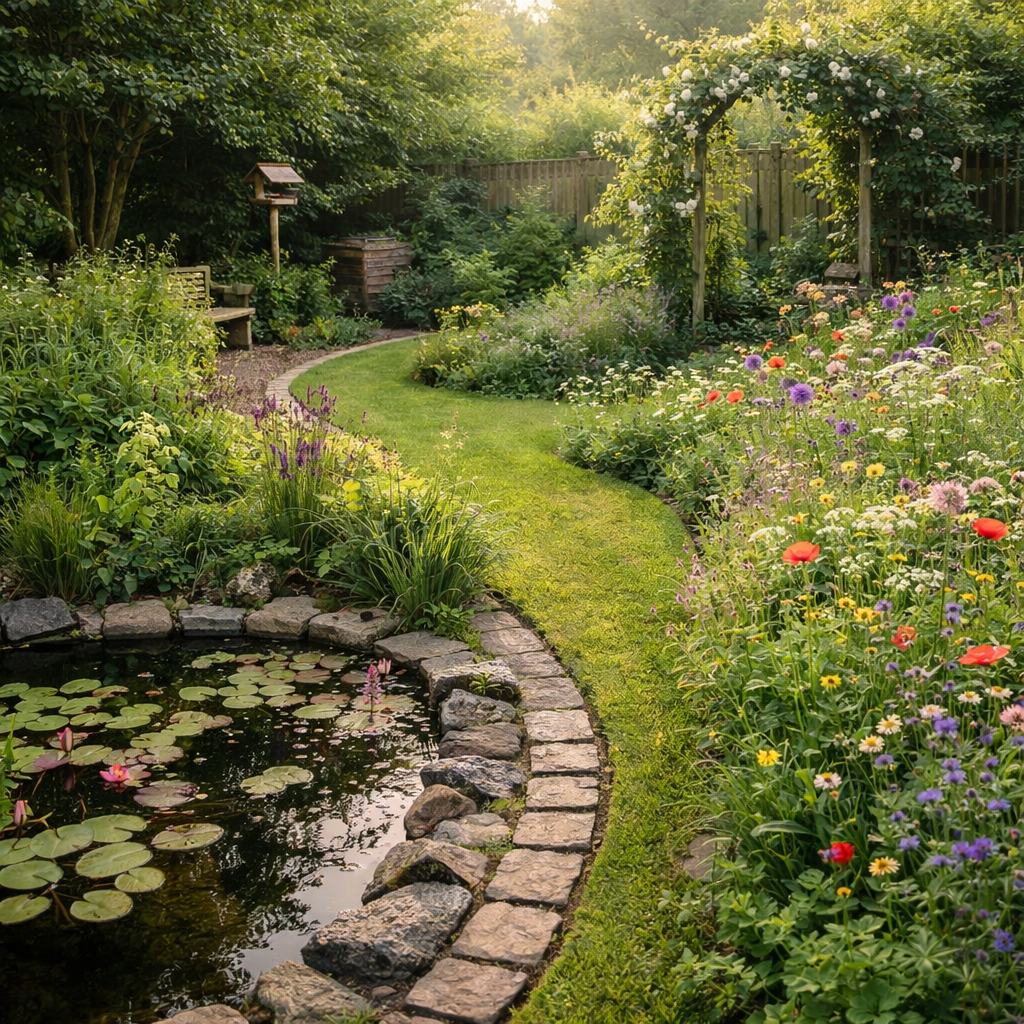
| Neat Edges, Wild Centres The strongest reactions people have to wildlife gardening rarely stem from concerns about insects or birds. Instead, it’s triggered by the concept of edges—the clear distinction between managed and wild areas. Edges are where people look first. The line where the lawn meets the border. The point where the path gives way to planting. The place the eye uses to decide, almost instantly, whether a garden is being looked after or quietly slipping its moorings. I learned this by standing with clients as they gesture at long grass or a bustling border. “I don’t mind it being natural,” they’ll say, “just not… abandoned.” They rarely mean the plants themselves. They mean the uncertainty. Most people don’t react against wildness itself—they respond to a lack of definition. When garden boundaries blur, intent becomes unclear, and discomfort follows. The main challenge for wildlife gardeners is to signal intent through visible boundaries. The irony is that wildlife often thrives best when that intent is visible. What edges actually do An edge is not just a line. It’s a signal. In gardens, edges show where movement and change are allowed or stopped. They guide footsteps and sightlines—punctuation for the space. Wildlife also favors boundaries—where grass meets hedge, planting thickens, or leaf litter gathers. But for wildlife to thrive and people to feel secure, the boundary must be firm. A crisp, maintained edge creates stability. It reassures both the gardener and the wildlife by making the margin clear and predictable. When everything is vague, everything feels temporary. The myth of uniform wildness One of the quieter myths that’s crept into modern gardening is the idea that wildness must be evenly distributed. That if you allow nature in one place, you must allow it everywhere. That selective care is somehow dishonest. Uniformly wild gardens often become disturbed: maintenance is unpredictable, creating unstable conditions. Wildlife doesn’t benefit from that kind of rhythm. It prefers predictability, even if that predictability includes regular cutting—provided it happens in the same places, at roughly the same times. Neat edges are core to this approach. They let you declare—visibly and consistently—where wildness is allowed and where it is not. This visible decision is central to effective wildlife gardening. Centres are where patience lives. The center of a border or meadow is where time slows. Plants complete cycles. Seed heads stand. Insects overwinter. Soil life flourishes without interruption. This is where wildlife support actually happens—not in the gesture of letting things grow, but in the decision to leave them alone long enough to matter. Patience is difficult when a garden looks messy. People act from anxiety, not necessity. A clean edge buys you time. It reassures you that nothing is running away. Working gardens, not statements Most of the gardens I work in are not ideological projects. They are places where people live, pass through, sit, and occasionally worry about what the neighbours think. They have bins, sheds, washing lines, and the odd awkward corner that never quite behaves. In those settings, neat edges are not an aesthetic luxury; they are practical infrastructure. They keep paths clear. They stop planting and collapse into the circulation space. They reduce the sense that maintenance is an endless, losing battle. If wild, unmanaged areas are framed with intentional, neat edges, they signal care, not neglect. The key to successful wildlife gardening is not just tolerance of wildness, but clear, sustained definition around it. I’ve seen small strips of long growth support more visible wildlife than larger chaotic spaces because they’re left undisturbed year after year. Consistency matters more than scale. When edges disappear Edges erode: lawns blur into borders, paths narrow, plants sprawl. Gradually, the garden feels unresolved. This is often when people decide that wildlife gardening “doesn’t work for them,” when in reality what’s failed is not the principle, but the framing. Reinstating an edge at that point can feel drastic, even cruel. Yet it is usually the act that restores balance. Once the line is back, the rest of the garden often settles again—plants included. It’s a reminder that structure is not the enemy of life. It is one of its conditions. Edges as acts of care There is something quietly humane about maintaining edges. It is repetitive, deliberate work. It requires you to return to the same place, notice the same line, and keep it where you decided it should be. In doing so, you are making a promise to the rest of the garden: this is held, so that you can be free. Wildlife benefits from that promise. So do the people who live alongside it. The long view Gardens change slowly when they are allowed to. The most successful wildlife-friendly spaces I know are not dramatic from one year to the next. They deepen rather than expand. Their edges remain familiar; their centres become richer. This is not accidental. It is the result of repeated, modest acts of maintenance that hold space open for complexity to develop. Neat edges, wild centers: this is not just a compromise. It is the main partnership that makes wildlife gardening work—clarity at the margins sustains richness at the core. |
| About our writing & imagery Most articles reflect our real gardening experience and reflection. Some use AI in drafting or research, but never for voice or authority. Featured images may show our photos, original AI-generated visuals, or, where stated, credited images shared by others. All content is shaped and edited by Earthly Comforts, expressing our own views. |

