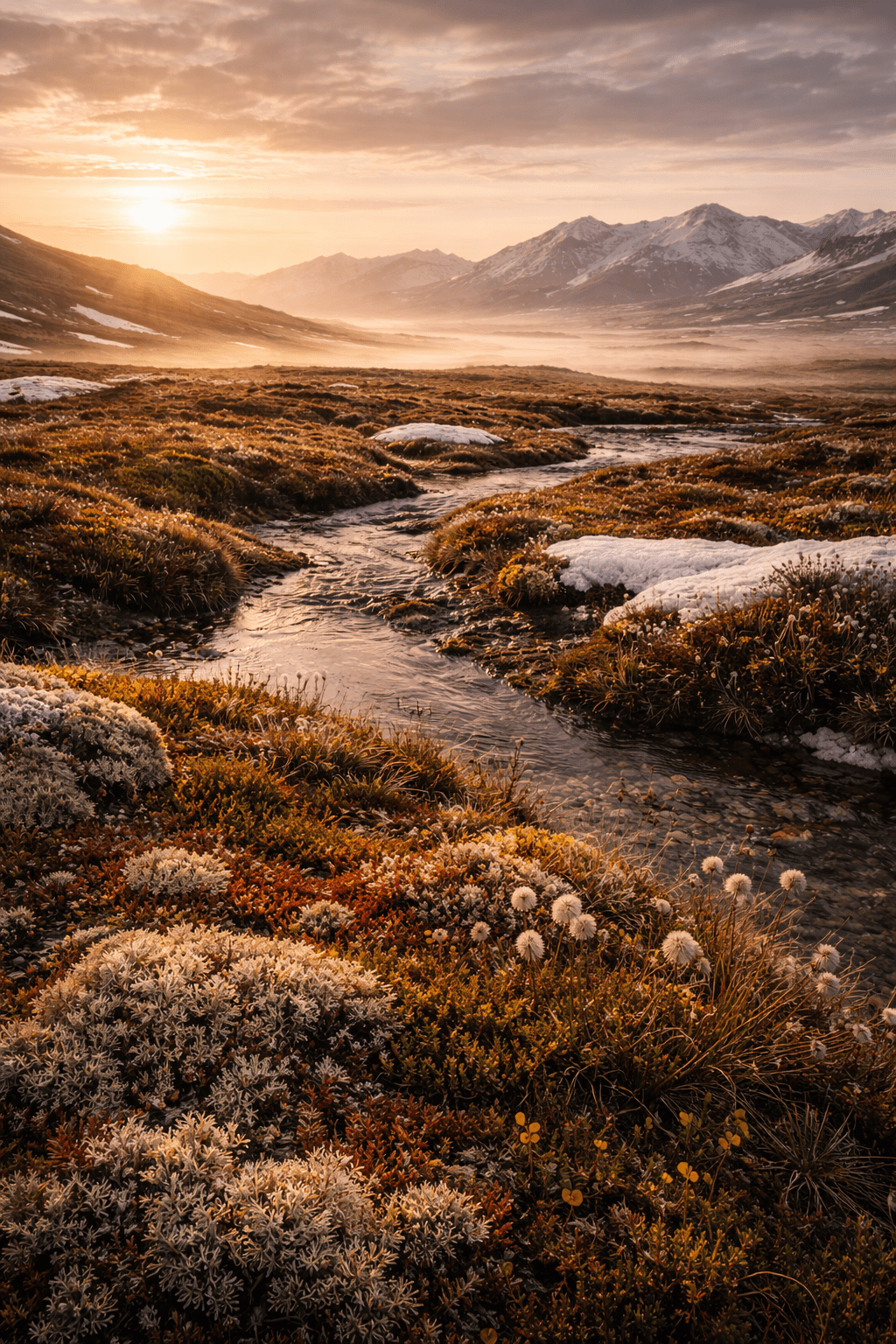
| Episode 6 Tundra: Cold, Time, and Locked Futures The tundra does not announce itself. There are no dramatic silhouettes, no towering forms, no obvious signs of power. It lies low, spread thinly across the margins of continents, easily dismissed as empty space between more interesting places. That dismissal is a mistake. What defines the tundra is not what grows there, but what is held there. Beneath the surface lies soil that has accumulated organic matter for thousands of years, locked in place by cold. Growth is slow, cautious, and close to the ground. Nothing here is in a hurry, because speed would be fatal. This is not a landscape designed for recovery. It is a landscape designed for continuity. A common assumption is that all ecosystems rebound if pressure is removed. The tundra complicates that idea. Recovery here is not about regrowth, but about preservation. Once frozen ground thaws, it does not simply refreeze and return to its previous state. The chemistry changes. Drainage shifts. Carbon that was safely stored becomes active again. What follows is not a collapse in the cinematic sense, but an irreversible transition. Gardening offers a small but telling parallel. Anyone who has overworked soil at the wrong time knows the feeling: structure collapses, waterlogging follows, and what once supported life becomes hostile to it. You can stop digging, but the damage does not undo itself quickly. Some thresholds, once crossed, remain crossed. The tundra operates almost entirely on thresholds. Temperature, moisture, timing — move any one too far, and the system reorganises into something else. Shrubs advance. Drainage alters. Ground subsides. None of this happens dramatically. It happens quietly, then all at once. There is a temptation to frame tundra change as an opportunity — new land, new growth, new access. This reflects a deeply ingrained bias toward expansion. But the tundra is not unused land. It is land performing a planetary function. It regulates climate not through productivity, but through restraint. It holds carbon precisely because it resists rapid cycling. After control, the tundra becomes one of the clearest tests of whether restraint arrives in time. Unlike forests or grasslands, it cannot absorb repeated disturbance and recover later. There is no flexible middle ground. The system either remains intact or it does not. What makes this uncomfortable is that intention is irrelevant here. You can care deeply and still cause damage. You can withdraw and still face consequences. The tundra reminds us that some systems are not responsive to management as we expect. They respond only to limits. For a gardener, this is a sobering lesson. Not all damage announces itself. Not all recovery is possible. Knowing when to stop is sometimes the most skilled act available. The tundra does not need improvement. It needs time. And time, once lost, is the one resource that cannot be restored. |
| About our writing & imagery Many of our articles are written by us, drawing on real experience, reflection, and practical work in gardens and places we know. Some pieces are developed with the assistance of AI, used as a drafting and research tool rather than a voice or authority. Featured images may include our own photography, original AI-generated imagery, or—where noted—images kindly shared by other creators and credited accordingly (for example, via Pixabay). All content is shaped, edited, and published by Earthly Comforts, and the views expressed are our own. |

