| The Parts of a Place That Only Exist at Certain Times of Day |
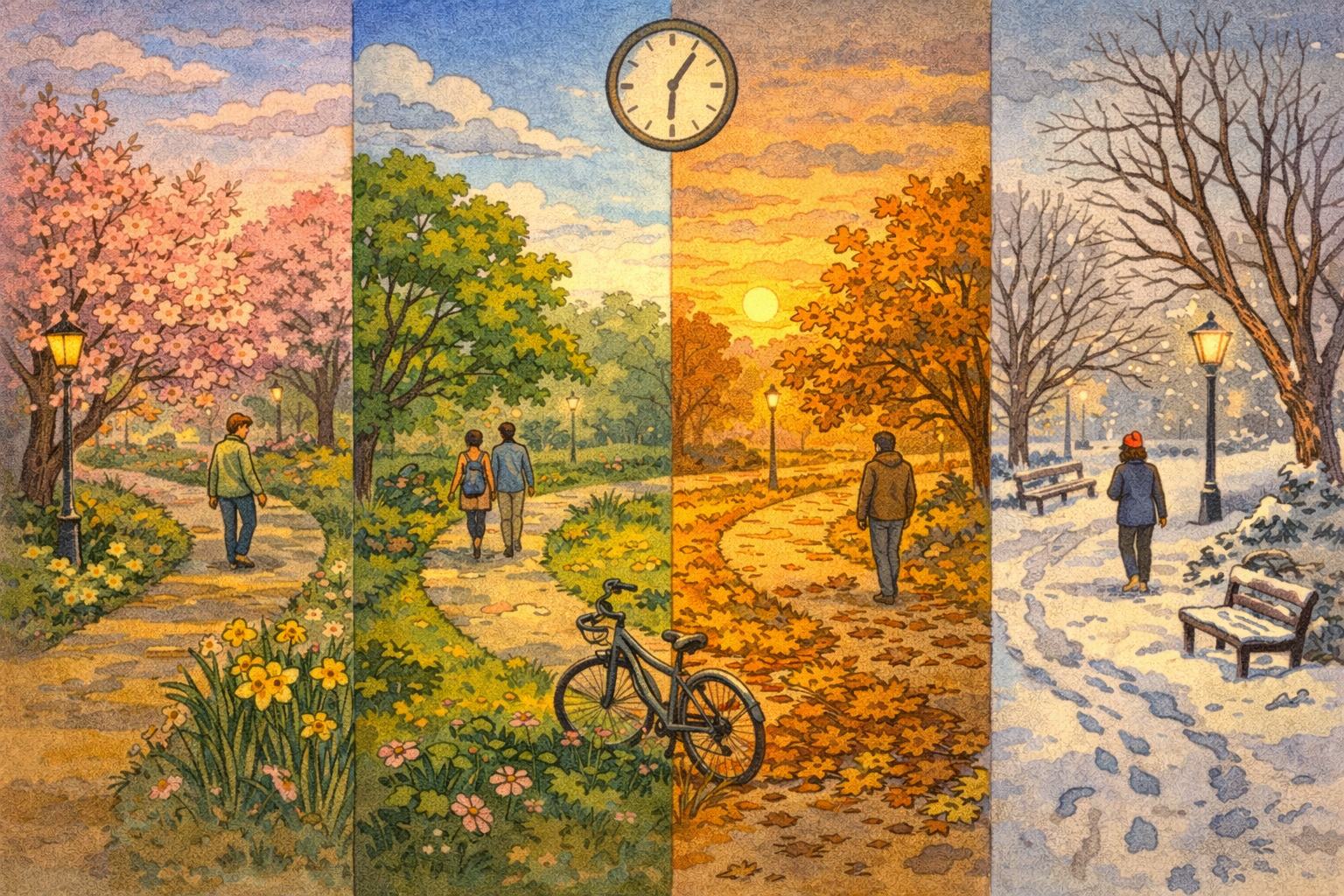
| Some places don’t exist all the time. Or rather, they exist physically, but not perceptually. They only come into being under particular conditions — a certain angle of light, a lull in noise, the absence or presence of people. I miss that window, and the place slips back into anonymity. I didn’t understand this until I started working outdoors for long stretches, arriving early and leaving late, seeing the same ground at different hours. A garden at eight in the morning is not the same garden at four in the afternoon. It isn’t just light that changes. Behaviour does too. Sound. Purpose. Even scale. Towns work the same way. Some paths only feel like paths at dawn, when nobody else is using them. At midday, they’re corridors. In the evening, they’re thresholds. A bench that feels exposed in full daylight becomes a refuge at dusk. A street that seems dull during working hours softens once shops close and windows light up unevenly. We tend to think of places as fixed. In reality, they are conditional. One of the myths worth challenging is that familiarity equals knowledge. You can walk the same street for years and only know one version of it. The version that aligns with your schedule. Everything outside that timeframe remains theoretical. Gardening quickly trains you out of this assumption. Plants reveal different information at different times. Leaves hold moisture in the morning that’s gone by afternoon. Soil smells change as the day warms. Pests appear at hours you never see if you only visit at lunchtime. To understand a place properly, you have to meet it under more than one set of conditions. I’ve noticed that early morning versions of places are often the most honest. They haven’t been tidied yet. They haven’t adjusted themselves for use. You see what’s left behind rather than what’s arranged. Late evening versions are different again — softer, quieter, more forgiving. Details emerge because the noise has dropped away. There’s a practical lesson here about judgment. Assessing a place at a single moment gives you a partial truth. You might mistake calm for emptiness, or busyness for vitality. Only time reveals rhythm. This matters when decisions are made quickly. A space dismissed as uninviting might be lively at another hour. A garden labelled low-use might be misaligned with the day’s heat or light. Without temporal context, we misread places. I’ve also noticed that people attach different meanings to the exact location depending on when they encounter it. A street walk on the way to work carries an obligation. The same street walked home carries release. The physical environment hasn’t changed, but the emotional load has. Gardening has taught me to work with these shifts rather than against them. Some tasks are better done early, when attention is sharp, and disturbance is minimal. Others benefit from afternoon warmth. Knowing when to do something is as important as knowing how. The same applies to noticing. There are details you will never see if you only pass through places at speed, during peak hours, under functional pressure. Slowing down isn’t always possible, but varying your timing often is. A slight schedule change can reopen perception. This isn’t about romanticising dawn or dusk. It’s about recognising that time is part of place. Ignoring it flattens experience. Including it restores depth. I’ve come to think of towns as layered rather than mapped. Different versions stack on top of each other, activated by clocks rather than coordinates. To know a place well is not to memorise it, but to encounter it repeatedly under different conditions. There’s a humility in this. You accept that your understanding will always be partial. That there are versions of places you may never meet. But you also gain curiosity. A sense that familiarity doesn’t exhaust possibility. The parts of a place that only exist at certain times of day aren’t hidden. They’re simply conditional. They ask for patience rather than discovery. And once you start noticing them, time stops being a backdrop and becomes part of the landscape itself. |
| About our writing & imagery Most articles reflect our real gardening experience and reflection. Some use AI in drafting or research, but never for voice or authority. Featured images may show our photos, original AI-generated visuals, or, where stated, credited images shared by others. All content is shaped and edited by Earthly Comforts, expressing our own views. |

