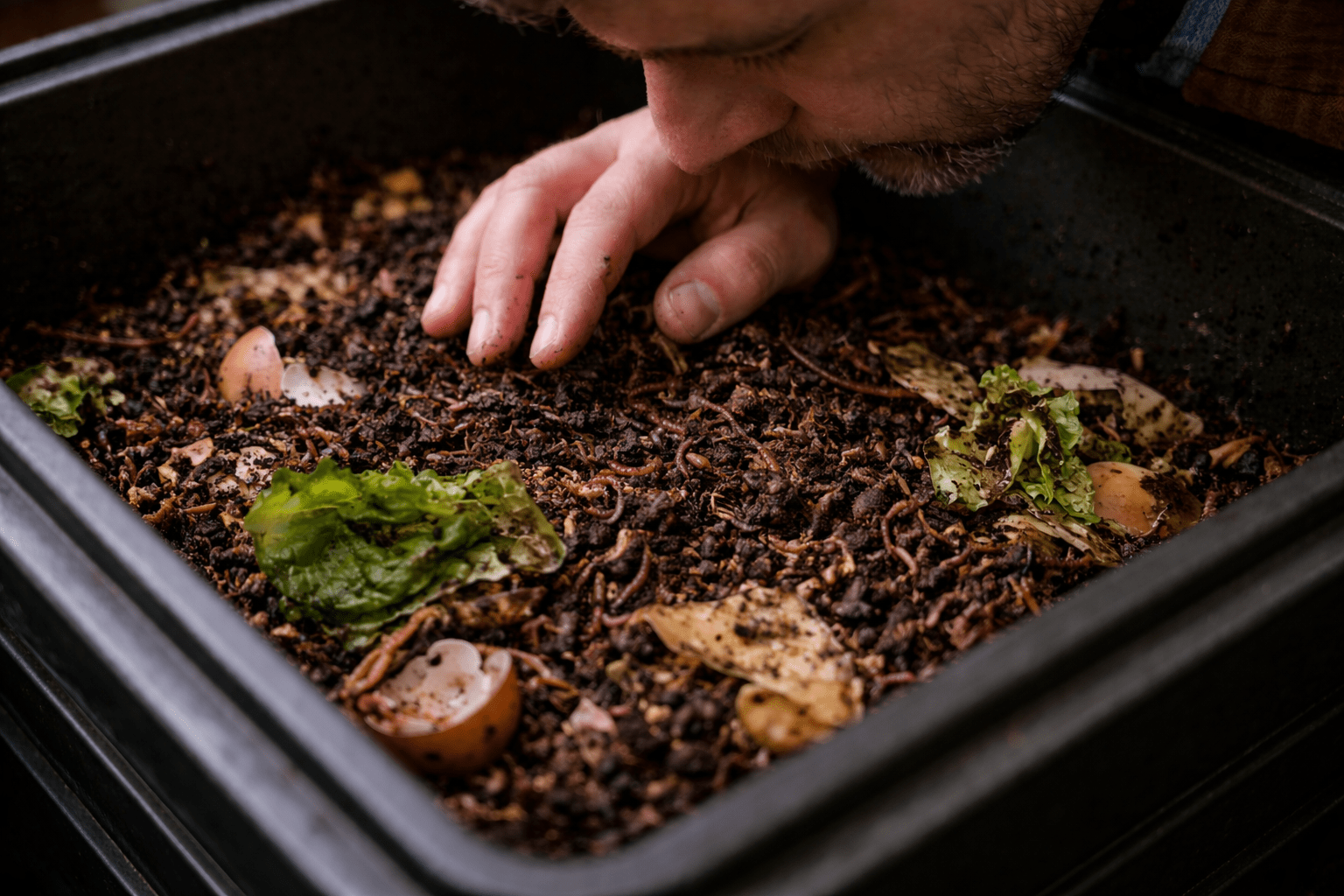
| Reading the Bin Most problems in a worm farm announce themselves quietly. They don’t arrive as crises; they drift in as small changes that are easy to miss if you’re looking for the wrong things. Reading a bin is less about inspection than attention, and attention of a particular kind — patient, sensory, and unhurried. People often begin by looking, when smell is usually the better guide. A healthy worm farm doesn’t smell of much at all. There’s a damp, earthy neutrality to it, closer to leaf mould than compost heap. When an odour appears, the instinct is to label it as a failure immediately. In practice, smell is information, not judgment. A brief sour note after feeding, or a slightly sweet fermentation, often settles on its own as microbes rebalance. Panic intervention at this stage tends to prolong the problem rather than solve it. Persistent, sharp, or sulphurous smells are different — but learning that difference takes time, not rules. Texture tells a similar story. Bedding that collapses into a slick mass is rarely a feeding issue on its own; it’s usually a moisture problem expressing itself physically. Dry, dusty material suggests the opposite. Worms respond to these conditions long before we do, shifting their position, tightening into clusters, or retreating into narrow bands where conditions suit them. Watching where worms choose to be is more revealing than almost anything else. They are not evenly distributed because conditions are not even, and that unevenness is often functional rather than flawed. There’s a tendency to search for visual reassurance — busy worms, visible castings, food disappearing on schedule. But worm farms don’t perform for observers. A bin can look static for weeks and be doing exactly what it should. Activity first occurs at the microbial scale. The worms follow. When people expect immediate visual feedback, they’re often responding to impatience rather than evidence. Reading the bin well means accepting long stretches where nothing seems to change. Sound is rarely discussed, perhaps because it feels implausible, but silence matters. A worm farm should not hiss, fizz, or bubble audibly. These are signs of active fermentation rather than decomposition, and they usually accompany the formation of anaerobic pockets in overly wet or compacted material. Again, this isn’t about policing perfection. Temporary fizzing after feeding can occur. The skill lies in noticing whether it resolves on its own or intensifies over time. Systems that are allowed to self-correct often do. One of the hardest lessons is learning when not to respond. Not every deviation needs correction. Worm farms fluctuate naturally with temperature, feeding patterns, and season. Intervening at every wobble flattens those rhythms and makes the bin harder to read in the long run. If you’re always adjusting, you never see what the system does on its own. Reading requires stillness as much as observation. There’s also the question of presence. Many people open their bins with a checklist in mind: worms present, food breaking down, no obvious problems. Over time, that checklist fades, and something subtler takes its place. You notice whether the bin feels settled. Whether the smell is familiar. Whether the texture holds together without compacting. These impressions are difficult to quantify, but they’re often more accurate than measurements. Experienced keepers trust them not because they’re vague, but because they’re cumulative. It’s worth acknowledging that learning to read a bin involves mistakes. You will misinterpret signals. You will intervene when you shouldn’t, or wait when action is needed. Worm farming offers very little immediate feedback, which makes it an unforgiving teacher at first. But over time, patterns emerge. You remember what happened last winter, or after that particular feeding, or during a hot spell. The bin becomes legible through repetition. Reading a worm farm is not about vigilance. It’s about familiarity. The goal isn’t to catch problems early so much as to recognise normality when you see it. Once you know what your bin looks, smells, and feels like when it’s healthy, everything else becomes easier to interpret. Until then, restraint is often the most reliable response. In the end, a well-read worm farm doesn’t need much management. It asks to be noticed, not corrected. The information is there, if you’re willing to slow down enough to receive it. |
| About our writing & imagery Many of our articles are written by us, drawing on real experience, reflection, and practical work in gardens and places we know. Some pieces are developed with the assistance of AI, used as drafting and research tools rather than as a voice or authority. Featured images may include our own photography, original AI-generated imagery, or—where noted—images kindly shared by other creators and credited accordingly (for example, via Pixabay). All content is shaped, edited, and published by Earthly Comforts, and the views expressed are our own. |

