| A 5-Part Series |
| A curated exploration of Malaysia’s most iconic, curious, and ecologically important insects |
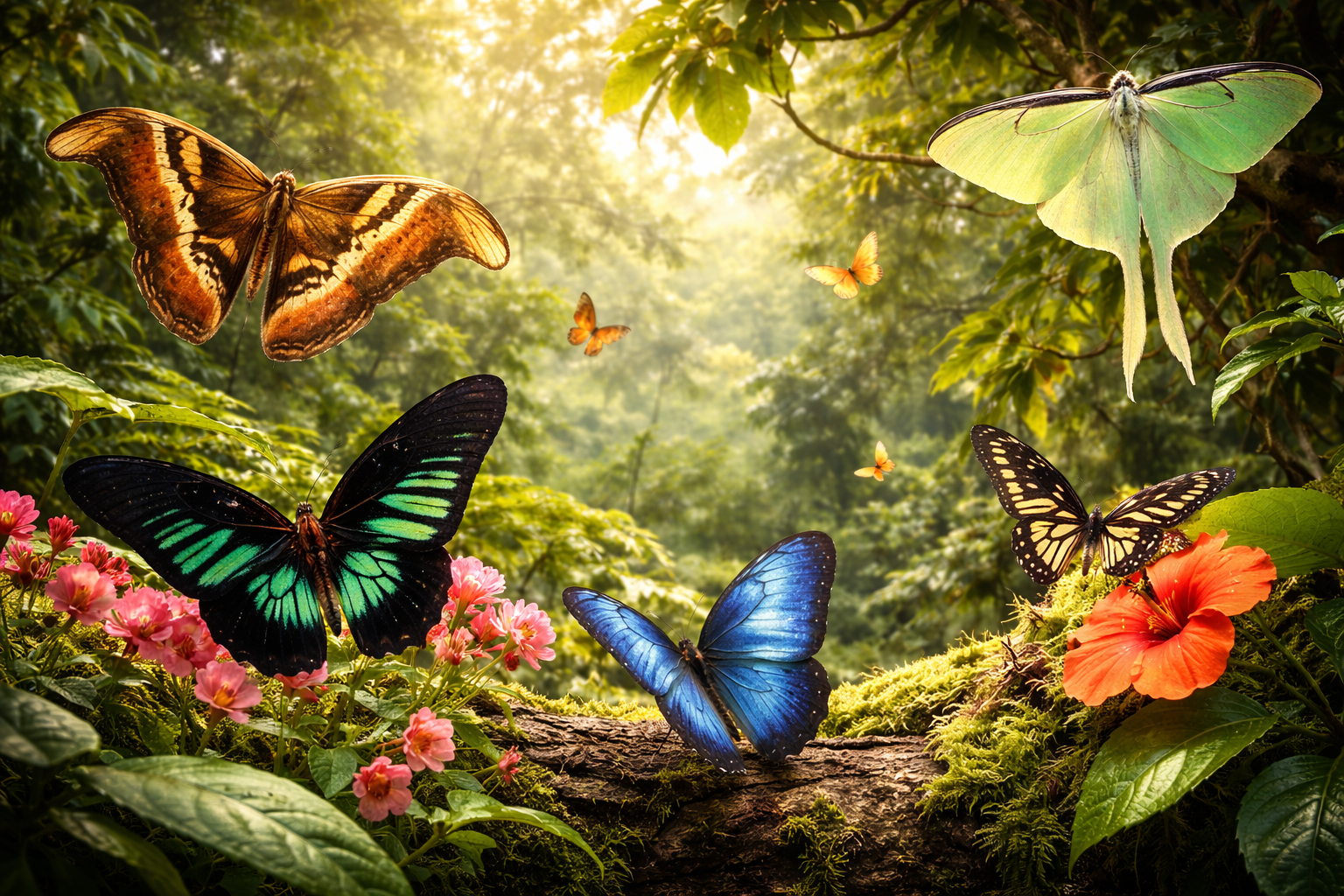
| Part 2 Butterflies & Moths: Constant Colour, Constant Motion In Malaysia, butterflies and moths exist without interruption. There is no seasonal pause, no brief window of emergence followed by absence. Instead, colour, movement, and reproduction continue throughout the year, shaped by rainfall cycles rather than temperature. The forests do not wait for spring, and neither do their insects. Variation replaces seasonality, creating a landscape where change is subtle but constant. Birdwing butterflies dominate attention through scale and presence. Their large wings move slowly and deliberately through forest clearings, river corridors, and canopy gaps. These are not fragile insects blown about by chance. Their flight is controlled and economical, adapted to dense vegetation where careless movement wastes energy. Watching a birdwing cross a clearing feels less like witnessing speed and more like observing confidence. Rajah Brooke’s birdwing, Malaysia’s most recognisable butterfly, exemplifies this balance. It glides far more than it flaps, conserving effort while covering distance. Its continued presence depends on intact forest corridors and specific host plants, making it more than a visual icon. Where this butterfly thrives, ecological connections remain functional. Where it disappears, fragmentation has already begun. Elsewhere in the forest, flashes of iridescent blue cut through shaded paths. Morphos and their close relatives rely on light and angle rather than camouflage alone. Their wings alternate between brilliant colour and near invisibility depending on movement, confusing predators and disrupting pursuit. The forest briefly lights up, then returns to green shadow. Swallowtail butterflies occupy transitional spaces. They patrol the edges between forest and farmland, riverbanks and roadsides, gardens and jungle. Strong flyers, they link habitats separated by human activity, carrying pollen and genetic material across gaps that might otherwise isolate plant populations. Their routes trace invisible lines of connection across altered landscapes. As daylight fades, moths take over the work of movement and exchange. Atlas moths bring scale to the night. Among the largest moths on Earth, their wings mimic dried leaves with astonishing accuracy. When resting, they vanish into the forest floor, indistinguishable from debris. Their adult lives are brief and focused, with no feeding stage — all stored energy is spent on reproduction and dispersal. Pale luna moth relatives appear almost suddenly, drawn to light or moonlit clearings. Their presence is fleeting. They mate, lay eggs, and disappear, compressing an entire life cycle into a matter of days. Despite their short adult lives, their larvae contribute significantly to forest food webs and nutrient flow. In Malaysia, butterflies and moths are not symbols of passing seasons. They are constant participants in a landscape that never fully rests, maintaining motion, colour, and connection in an environment built on continuity rather than pause. |
| About our writing & imagery Many of our articles are written by us, drawing on real experience, reflection, and practical work in gardens and places we know. Some pieces are developed with the assistance of AI as a drafting and research tool. Featured images may include our own photography, original AI-generated imagery, or—where noted—images kindly shared by other creators and credited accordingly (for example, via Pixabay). All content is shaped, edited, and published by Earthly Comforts, and the views expressed are our own. |

