| A 5-Part Series |
| A curated exploration of Malaysia’s most iconic, curious, and ecologically important insects |
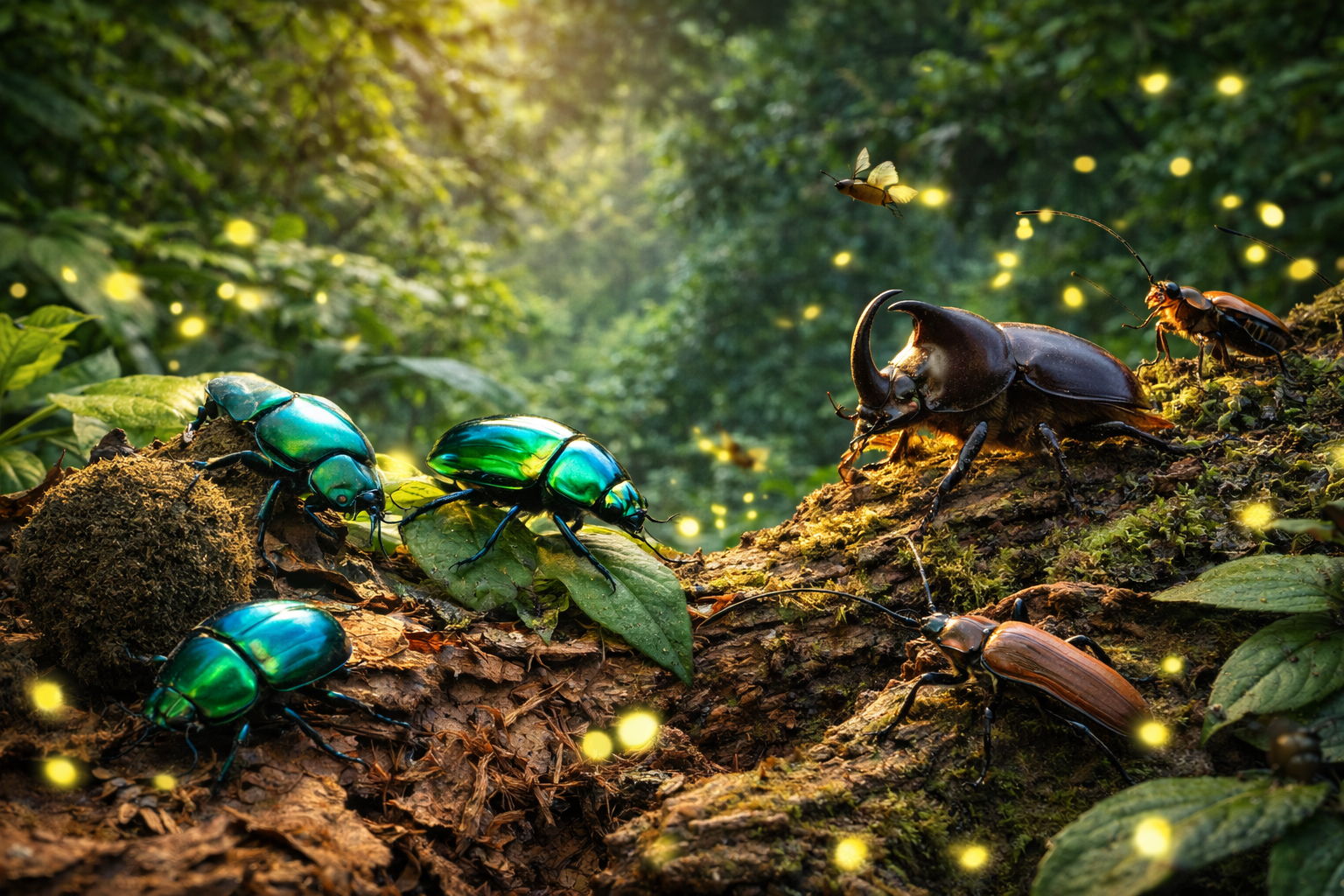
| Part 3 Beetles: Armour, Weight, and Persistence Beetles thrive in Malaysia’s heat and moisture. Few insect groups are as adaptable or numerous, and their diversity reflects the demands of a rainforest that never slows. From forest floor to canopy gaps, beetles occupy nearly every available niche. Their roles are practical and essential, ranging from recycling organic material to regulating populations and transmitting information in environments with limited visibility. Scarab beetles are among the most important recyclers. They process dung, fallen leaves, and decaying plant matter at extraordinary speed. In tropical systems, organic waste accumulates continuously. Without rapid breakdown, nutrients would remain locked in dead material, slowing plant growth and disrupting food chains. Scarabs prevent this bottleneck, keeping nutrients in circulation and soils active. In rainforests, delay is not neutral — it creates imbalance. Jewel beetles operate in brighter, more exposed spaces. Their metallic greens, blues, and bronzes are not simply decorative. These reflective surfaces help manage heat and light, deflecting intense sunlight and reducing overheating. This adaptation allows jewel beetles to work along forest edges, in canopy gaps, and in areas disturbed by fallen trees, where exposure would overwhelm less specialised insects. Rhinoceros beetles bring scale and strength into the system. Their heavy bodies and horned heads are not designed for combat with predators but for competition among themselves. Males use their horns to lift and displace rivals during mating contests. These beetles invest enormous energy into short reproductive windows, timing their activity to periods when conditions are optimal. Their lifecycle reflects precision rather than endurance. Longhorn beetles are closely tied to wood and time. Their larvae spend years tunnelling through dead trees and fallen branches. These tunnels allow fungi, bacteria, and moisture to penetrate wood that would otherwise resist decay. Longhorn beetles accelerate decomposition from the inside out, ensuring that dead trees return to the soil rather than remaining inert obstacles on the forest floor. Click beetles introduce movement and sound as survival tools. When threatened, they snap their bodies against the ground, launching themselves into the air. This sudden movement can startle predators and provide escape without relying on wings—an advantage in dense vegetation where flight paths are limited, and ambush is common. Fireflies complete the picture with light. Their bioluminescence is highly specific, functioning as a communication system rather than decoration. In dense, humid forests where sound and scent disperse poorly, light becomes the most reliable signal. Each species uses distinct flashing patterns to identify mates and defend territory, turning darkness into a navigable space. In Malaysia, beetles are not background insects. They are engineers of continuity, keeping energy, nutrients, and information flowing through a system that never truly pauses. |
| About our writing & imagery Many of our articles are written by us, drawing on real experience, reflection, and practical work in gardens and places we know. Some pieces are developed with the assistance of AI as a drafting and research tool. Featured images may include our own photography, original AI-generated imagery, or—where noted—images kindly shared by other creators and credited accordingly (for example, via Pixabay). All content is shaped, edited, and published by Earthly Comforts, and the views expressed are our own. |

