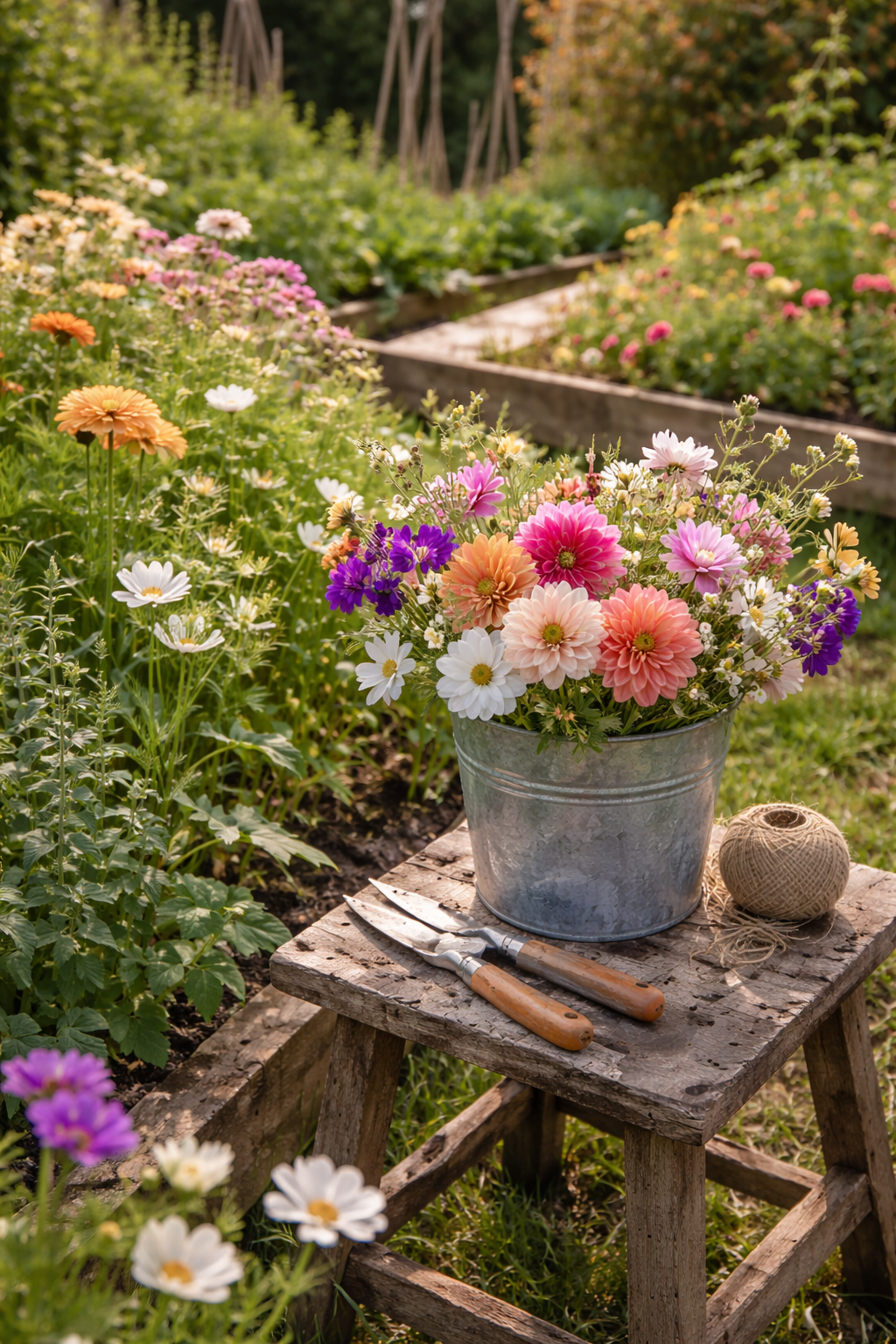
| There is a quiet pleasure in cutting flowers you have grown yourself. Not the grand, armful harvest for a wedding or the theatrical abundance you see in glossy magazines—though that has its place—but the simple act of stepping outside, scissors in hand, and returning with something freshly cut for the table. For many gardeners, growing flowers for cutting feels like a separate discipline. Something organised, perhaps commercial, requiring rows, netting, rotation plans and early-morning harvest schedules. And yes, there is a professional world of cut flower production that is precise and demanding. But at a domestic scale, it is far easier than most people imagine. You do not need a field. You do not need a greenhouse. You do not need regimented beds lined with string. You need a little space, a willingness to cut, and a slight shift in how you see flowers. |
| A Different Relationship With Plants One reason people hesitate to grow cutting flowers is emotional. We are trained to preserve blooms, not remove them. Cutting feels like diminishing. Yet many flowering plants respond to cutting not with decline but with renewed energy. They have evolved to set seed after pollination. When we remove the bloom before it matures, we interrupt that process. The plant often responds by producing more. Sweet peas are the classic example. Pick them regularly, and they keep coming. Leave them to form pods, and they slow. Dahlias behave similarly: the more you cut, the more they push out fresh stems. The assumption that cutting harms the display can be gently challenged. In many cases, cutting is the engine of the display. You Don’t Need a Separate Plot It is easy to overcomplicate the idea of a “cut flower garden”. In truth, many of the best cutting flowers can be woven into existing borders. Cosmos will rise lightly between perennials. Zinnias sit happily in sunny pockets. Scabious threads itself through without dominating. Even shrubs—hydrangeas, roses, forsythia in spring—offer stems suitable for vases without compromising the overall garden. You do not need regimented rows unless you enjoy that aesthetic. A few square metres of well-prepared soil, decent light, and steady feeding are enough to produce bouquets throughout the season. Containers, too, can carry cutting flowers. Dwarf dahlias, compact cosmos varieties, and even snapdragons will perform in deep pots with good compost and regular watering. The barrier is often conceptual rather than physical. Annuals: The Gentle Workhorses If you are beginning, annual flowers are the most forgiving route. They grow quickly from seed. They flower generously. They are untroubled by the knowledge that their life is brief. Cosmos, cornflowers, ammi, nigella, and calendula—all offer cut-worthy stems with minimal fuss. There is a rhythm to sowing annuals that feels almost agricultural. Sow in spring. Transplant once sturdy. Cut steadily through summer. The simplicity is part of their charm. There is no long-term commitment. Each year you can adjust colours, try new varieties, respond to what worked and what didn’t. And if something fails? You begin again next year. Perennials That Earn Their Place Perennials bring depth to cutting arrangements and stability to the garden. Peonies, once established, offer a brief but extraordinary harvest. Alchemilla provides frothy green filler for weeks. Achillea delivers flat-topped colour in steady succession. Echinacea holds form beautifully in a vase. Shrubs, too, are underused in home-cut arrangements. Foliage from pittosporum or eucalyptus adds structure. Early blossom from flowering currant can transform a simple jug into something quietly elegant. Growing for cutting shifts attention from showiness to utility. You begin to notice stem length, branching habit, and vase life. And in noticing those qualities, you start to understand plants differently. Soil and Sunlight Still Matter There is no magic exemption for cutting flowers. They require the same fundamentals as any other plant: decent soil, sufficient light, and consistent watering in dry spells. If the soil is hungry, the stems will be short and weak. If the site is shaded, flowering will be sparse. If watering is erratic, blooms may abort early. Improving soil with compost before planting makes an immediate difference. Supporting taller varieties with unobtrusive stakes prevents wind damage. Feeding lightly during peak growth encourages stronger stems. None of this is complex. It is simply attentive gardening applied with a new purpose. The Practicalities of Cutting Cutting flowers well is an art in itself. Morning is often best when stems are fully hydrated. Use clean, sharp secateurs or scissors. Remove lower leaves before placing stems in water. Change the water regularly. These small acts noticeably extend vase life. There is also a subtle skill in cutting at the right stage. Some flowers—like dahlias—are best cut when fully open, as they do not continue to bloom in water. Others—like tulips or lilies—can be taken slightly earlier. You learn through practice. You observe how long each variety holds. You adjust. And gradually, the house becomes punctuated by small, shifting arrangements that reflect the garden outside. A Gentle Reframing One common belief is that growing cut flowers is indulgent. Decorative rather than productive. I find that view curious. Flowers feed pollinators. They improve biodiversity. They offer mental restoration. They connect indoor and outdoor spaces. Bringing them inside does not diminish their value; it extends it. There is also something grounding about arranging what you have grown. It slows you down. It sharpens observation. It encourages gratitude for imperfection—curved stems, uneven heights, petals marked by weather. Cut flowers are not about perfection. They are about participation. Trends and the Return to the Garden In recent years, there has been a renewed interest in homegrown flowers. Partly economic, partly aesthetic, partly cultural. The appeal of seasonal, locally grown blooms has risen as awareness of imported, chemically treated flowers has grown. But beyond trends, the appeal feels older. Growing flowers for cutting restores a cyclical awareness. You notice when sweet peas fade and dahlias begin. You anticipate the first cosmos. You watch the buds form with a sense of future intention. It encourages succession sowing—small batches at intervals—to prolong harvest. It invites experimentation with colour palettes and combinations. And unlike many gardening ambitions, it does not require scale. A handful of well-grown stems can transform a room. It Really Is That Simple You do not need acres. You do not need specialist infrastructure. You need light, soil improved with compost, a few packets of seed or young plants, and the courage to cut. Start small. Grow what you enjoy looking at. Cut regularly. Notice what thrives. Adjust next year. The idea that cutting flowers is complicated belongs to a different scale of production. At home, it is one of the most straightforward, generous forms of gardening. The first time you place a small jug of your own flowers on the kitchen table, the effort feels modest and the return disproportionate. It is easy. You have to begin. |
| About our writing & imagery Most articles reflect our real gardening experience and reflection. Some use AI in drafting or research, but never for voice or authority. Featured images may show our photos, original AI-generated visuals, or, where stated, credited images shared by others. All content is shaped and edited by Earthly Comforts, expressing our own views. |

