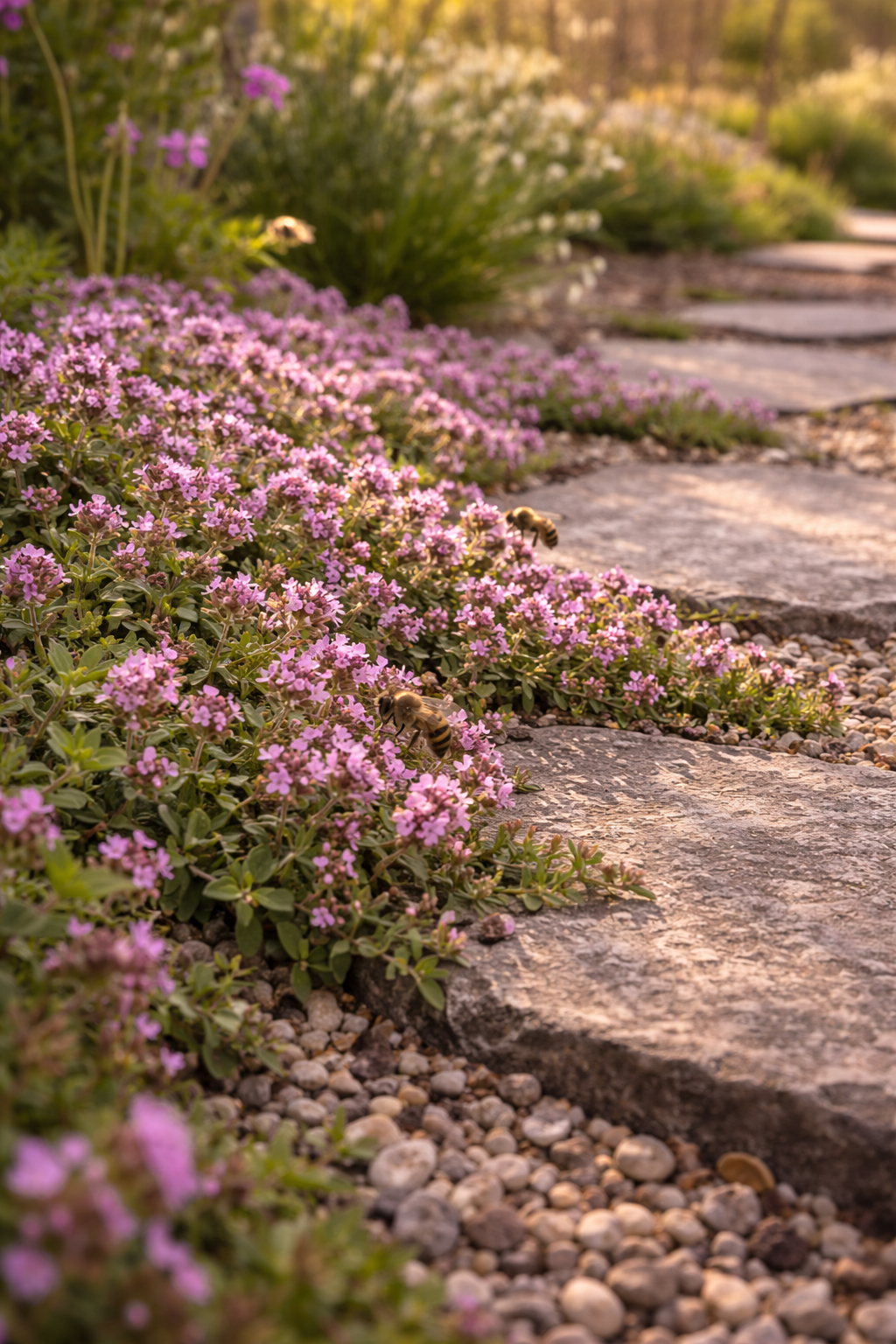
| Creeping Red Thyme — The Quiet Carpet That Earns Its Place Some plants shout for attention in a garden, and some settle in and become part of the fabric of the place. Creeping red thyme belongs firmly to the latter group. It does not tower, it does not dominate, and it rarely features in glossy garden centre displays. Yet once established, it becomes one of those plants that quietly change the atmosphere of a space. You notice it not because it demands to be noticed, but because suddenly the ground seems softer, more alive, more inhabited. In a garden culture that often leans heavily on height, spectacle and seasonal drama, creeping thyme works at ground level. It spreads slowly, forming a low, aromatic mat of tiny leaves, punctuated in early summer by small pink-red flowers that hover just above the foliage like a fine haze of colour. The plant rarely exceeds a few centimetres in height, yet its effect is surprisingly powerful. It is one of those plants that reveals the difference between gardening as decoration and gardening as ecology. And in many British gardens, it is remarkably underused. |
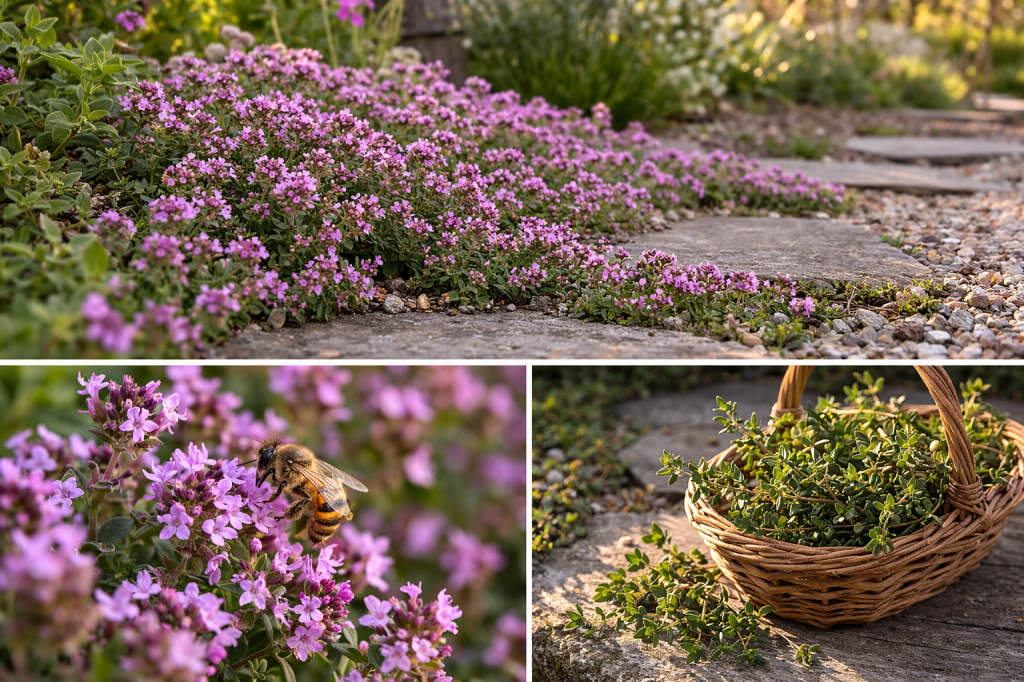
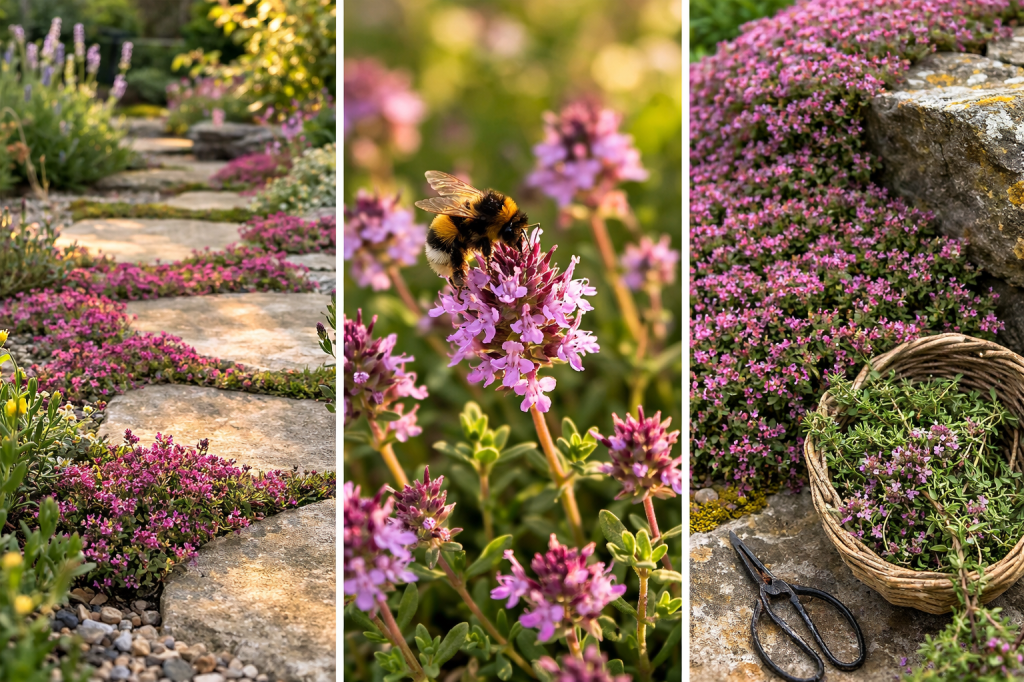
| A Plant That Works With the Garden, Not Against It One of the things that appeals to working gardeners about creeping red thyme is its temperament. It does not behave like a pampered plant. In fact, it tends to thrive precisely where many other plants struggle. Sunny edges of paths. Gaps between paving stones. Shallow gravel beds. Dry banks with thin, poor soil. These are places where lawn grasses sulk and moss tries to move in. They are transitional areas of the garden—neither flowerbed nor pathway, neither wild nor formal. Creeping thyme sits comfortably in these spaces because it evolved to tolerate a degree of hardship. Native thyme species originate from dry, sun-baked regions of southern Europe and the Mediterranean. Their instinct is not to luxuriate in rich soil but to anchor themselves in gritty ground where drainage is quick, and competition is limited. When we place them in the British garden, they carry that instinct with them. The trick, therefore, is not to improve the soil endlessly but to respect what the plant is adapted to. If anything, our climate presents the opposite challenge. In the UK, we rarely struggle with drought for long, but we often struggle with excess moisture. Heavy clay soils and damp winters can quickly turn a well-meaning planting into something the plant finds intolerable. Thyme does not like wet feet. It is not a dramatic protest. It simply fades. That is why creeping thyme works particularly well in places where drainage is naturally sharp: gravel paths, dry walls, raised beds, rockeries, and the narrow joints between paving stones where rainwater slips away quickly. Those small pockets of soil, often dismissed as awkward gaps, are precisely the places where creeping thyme can shine. The Ground-Level Garden Garden design often focuses on vertical structure: trees for height, shrubs for bulk, perennials for seasonal movement. But there is a layer beneath all of this that quietly shapes the whole garden — the ground layer. Bare soil is rarely attractive for long. It invites weeds, dries unevenly, and visually fragments the space. Many gardeners turn automatically to bark mulch or gravel to solve this, but living groundcovers offer something richer. Creeping red thyme belongs to this category of living surface. Instead of leaving spaces between stepping stones empty, thyme can soften them. Instead of allowing gravel beds to look stark, it weaves through them. Instead of relying on moss in shady cracks, it provides a sun-loving alternative in brighter places. And unlike many groundcovers, it does not form a suffocating monoculture. The foliage is fine and open, allowing small insects to move freely through it. The plant spreads slowly enough that it rarely overwhelms neighbouring plants. In fact, one of its most pleasing qualities is the way it knits things together without ever becoming oppressive. When creeping thyme fills a gap, the garden looks less engineered and more settled. The Moment of Flower For much of the year, creeping thyme is modest. Then early summer arrives, and something shifts. Tiny flower spikes rise just above the foliage, and the entire carpet blushes pink-red. It is not a dramatic explosion of colour like a rose border or a cottage garden bed, but a softer transformation. The flowers appear like a fine mist across the plant’s surface. From a distance, the effect is subtle. Up close, it becomes something quite different. The flowers are magnets for bees. Honeybees, solitary bees, hoverflies and small pollinating insects appear in numbers far greater than the scale of the plant would suggest. The sound of them becomes part of the garden’s experience. If you pause beside a patch of thyme in bloom on a warm June afternoon, you will hear the quiet, constant hum of activity. It is one of the most convincing reminders that even small plants can support meaningful ecological life. In many ways, creeping thyme is a type of pollinator planting often overlooked. It does not rely on large flowers or bright colours. It provides a reliable source of nectar across a wide surface area. And because the flowers are so small and numerous, pollinators can move easily from one to the next without expending much energy. Fragrance Underfoot One of the small pleasures of creeping thyme is the scent. Unlike many ornamental plants, whose fragrance is confined to their flowers, thyme releases its aroma from its leaves. A light brush of the hand, a passing footstep, or even the warmth of the sun can release the familiar herbal scent. This quality makes it particularly suited to paths and stepping areas. Gardeners have long planted thyme between paving stones specifically so that the scent is released as people walk across it. It is one of those sensory details that changes how a garden feels. Not because the fragrance is overwhelming — it is anything but — but because it appears unexpectedly. You step across a path, and suddenly the air carries a faint herbal note. Moments like this are small but powerful. They remind us that gardens are not purely visual spaces. Edible, But Not Demanding Creeping red thyme is also edible, though its role in the kitchen is somewhat different from the upright culinary thyme commonly grown in herb gardens. The flavour is milder, sometimes slightly sweeter, and the leaves are much smaller. It is perfectly usable in cooking — scattered over roasted vegetables, infused in oils, or used sparingly in savoury dishes — but its real strength lies in its dual role. You are not planting a herb bed that demands harvesting. You are planting a groundcover that is also edible. This distinction matters because it changes the way the plant is used. Instead of cultivating it solely for the kitchen, you let it grow naturally in the garden and harvest an occasional sprig when needed. It becomes part of the landscape first, and a herb second. Evergreen Presence In the depths of winter, the British garden often retreats. Many herbaceous plants disappear below ground, leaving beds bare and skeletal. Creeping red thyme, however, holds its place. The foliage remains through winter, though often darker and more compact. Frost can sometimes tint the leaves with subtle bronze tones, adding another layer of seasonal interest. It is not a dramatic winter colour, but it is something. And sometimes that is enough. A patch of thyme still holding its shape beneath a pale winter sky has a quiet resilience about it. Practical Observations From Working Gardens Years of practical gardening change the way one sees plants. You begin to notice not just how they look in photographs, but also how they behave in real places, with real soil, real weather, and real neglect. Creeping red thyme reveals several things once you have lived with it in gardens for a while. The first is that soil preparation matters less than drainage. Gardeners sometimes assume herbs need rich soil because they are productive plants, but thyme often performs better in leaner ground. Adding grit to heavy clay soils can make a significant difference. Raised beds or slightly elevated planting pockets can also help water move away from the roots. The second observation concerns watering. Newly planted thyme benefits from occasional watering while it establishes, but once settled, it prefers restraint. In the UK’s climate, the greater danger is usually overwatering rather than drought. Allowing the plant to adapt to slightly drier conditions strengthens its resilience. A third point becomes apparent after flowering. Light trimming once the bloom fades encourages the plant to grow more densely. Without this occasional tidy, creeping thyme can become slightly woody in the centre. A gentle shear — nothing severe — often refreshes the plant and helps it maintain its carpet-like appearance. Finally, patience is required. Creeping thyme spreads gradually rather than racing across the ground. Gardeners who expect immediate coverage may feel disappointed at first. Yet the slower pace is part of its charm. It settles in gradually, filling spaces without overwhelming them. A Plant That Challenges the Lawn One of the quiet myths of British gardening is that a lawn must always dominate open ground. Yet many gardens contain awkward sunny patches where grass never truly thrives — thin soils beside paths, narrow strips along driveways, dry banks or heavily trodden corners. Creeping thyme can offer an alternative in some of these places. It will never replace a full lawn for heavy use. Children playing football or constant foot traffic will eventually damage it. But for light-stepping areas and decorative groundcover, it often performs better than struggling turf. There is also a broader question here. Why do we insist that every piece of ground behave like a lawn? The uniform green carpet of grass is a relatively modern expectation in British gardens. Earlier landscapes were often far more varied, with thyme lawns, chamomile lawns and other low herbs forming scented walking surfaces. Creeping thyme quietly reconnects us to that older idea of groundcover. A garden does not have to be entirely grass to feel coherent. The Quiet Magic of Resilience Gardening inevitably teaches patience and humility. Plants rarely perform exactly as expected. Weather changes, soils vary, and every garden contains its own microclimates. Creeping red thyme embodies a kind of resilience that suits this uncertainty. It tolerates drought once established. It copes with poor soil. It withstands moderate foot traffic. It supports pollinators. It remains evergreen. Yet it never appears aggressive or domineering. There is something quietly reassuring about a plant that asks for little and gives back steadily. On a warm summer afternoon when the thyme is in bloom, and bees drift lazily across the surface of the flowers, it becomes clear why gardeners have valued plants like this for centuries. Not because they are spectacular. But because they endure. Closing Thoughts In many gardens, the most memorable plants are not always the tallest or the brightest. Sometimes they are the ones that settle quietly into the spaces between other things. Creeping red thyme belongs to that category. It does not dominate borders or demand centre stage. Instead, it works patiently at ground level, softening edges, feeding pollinators and releasing fragrance underfoot. Over time, these small contributions accumulate. A path feels more alive. A gravel bed becomes more natural. A gap between stones fills with something living rather than empty soil. And that, in many ways, is what good gardening often comes down to. Not grand gestures. But thoughtful details that make the garden feel complete. |
| About our writing & imagery Most articles reflect our real gardening experience and reflection. Some use AI in drafting or research, but never for voice or authority. Featured images may show our photos, original AI-generated visuals, or, where stated, credited images shared by others. All content is shaped and edited by Earthly Comforts, expressing our own views. |


It’s beautiful, like a delicate carpet.
LikeLike
Morning Eugenia, very much so – apologies for the delay in responding, no comments now appear for me in the side directory.
LikeLike