| Part 17 |
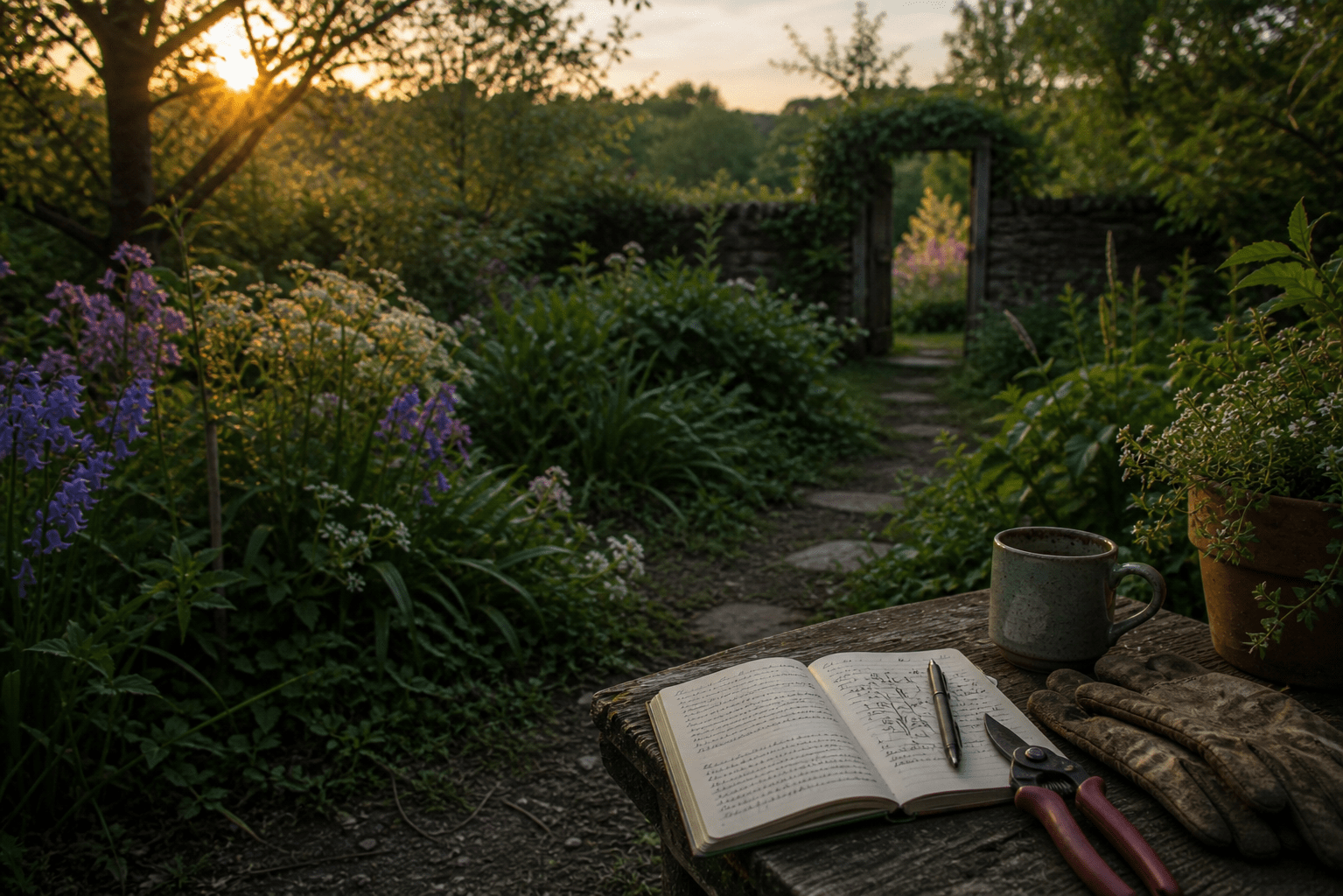
| By the time the garden is understood as something that operates beyond what is immediately seen and is not entirely shaped by what is done within it, there is a gradual shift in how the work itself is approached. This shift is not defined by any single realisation, nor does it present itself as a clear change in method, but it becomes evident over time in the way decisions are made and in what is no longer pursued with the same level of insistence. Much of what has been observed suggests that the garden is not a system that can be fully directed, but rather one that responds, adjusts, and continues in accordance with conditions that are not always visible or fully under control. Patterns form without intention, movement passes through the space without being seen, and elements establish themselves in ways that resist easy alteration. Alongside this, there are areas that hold the space without requiring intervention, and habits that persist beyond their original context. Taken together, these observations begin to reshape the role of the gardener, not by reducing it, but by redefining its limits. The first change often comes from what is no longer forced. There are areas where repeated attempts to establish a particular result are gradually set aside, not because the outcome is impossible, but because the conditions do not support it in a way that justifies continued effort. This is not a matter of abandoning the space, but of recognising that the approach itself may not align with what is present. The work shifts from trying to impose a solution to understanding what the space can sustain without resistance. This adjustment is not immediate. It develops through repetition: trying the same method and seeing the same outcome. At some point, it becomes clear the pattern is not incidental. Then, changing direction is less about trying something new and more about responding to evidence. The garden does not need correction in these cases. It needs to be read more accurately. There is also a change in how time is considered. Early in the process, there is often an expectation that results will follow within a certain period and that interventions will produce visible outcomes that can be measured against the intended outcomes. Over time, this expectation becomes less rigid. The garden follows cycles that rarely match the pace of maintenance. The effects of actions may not show until later, when conditions have changed. This shift does not slow the work, but it changes how progress is understood. Patience, in this context, is not a passive state, but an active recognition of how the system functions. It involves allowing processes to unfold without constant adjustment, observing how the space responds, and intervening where necessary without disrupting what is already working. This is not a reduction in effort but a refinement, directing attention to what can be influenced effectively rather than to what resists change. Unseen activity also drives this shift. The garden is used in ways beyond what can be observed. This changes how decisions about intervention are made. Decisions rely not only on what is seen, but on what might be happening out of view. This does not require constant adaptation, but it does shape how actions are taken, especially if they can affect ongoing, hidden activity. Similarly, the recognition that not all areas of the garden are intended to be fully visible alters how those spaces are treated. The focus is no longer on aligning every part of the garden with a single standard, but on maintaining a balance between what is actively managed and what is allowed to develop with a degree of independence. This does not create a division within the space, but it does introduce variation in how different areas are approached. Over time, these adjustments lead to a more measured form of engagement with the garden. The work remains consistent, but it becomes less reactive, less driven to address every irregularity as it arises. There is a greater emphasis on understanding patterns, on recognising when a change is part of a broader process rather than an isolated issue, and on determining whether intervention is necessary or simply habitual. This does not mean the garden develops without guidance. The gardener still shapes the space, maintains structure, and ensures it functions as intended. But observation and response define the role more than direction alone. The garden is not fixed in a form. It is guided in ways that fit its conditions. There is also a change in how success is understood. It is no longer measured solely by how closely the garden aligns with an initial plan, but by how well it functions as a system. A space that supports consistent growth, that accommodates movement, and that maintains its structure over time is no less successful because it does not conform exactly to a predefined design. In some cases, it may be more so, as it reflects a balance between intention and response that is more sustainable in the long term. This shift in understanding—that a garden cannot be fully controlled but must be engaged with as a dynamic system—is the result of repeated observation and recognising what can and cannot be directed. Instead of rejecting existing methods, this approach adjusts them to fit a broader, more adaptive perspective. And within this adjustment, the role of the gardener becomes more closely aligned with the garden itself. The work is no longer defined solely by what is done, but by how it is done, and by the extent to which it reflects an understanding of the processes that are already in motion. The garden is not something brought into being through effort alone, but something shaped through a combination of action and observation. Once this is recognised, the distinction between working on the garden and working with it becomes less pronounced. The two are not separate, but part of the same process, each informing the other in ways that are not always immediately visible. The garden continues, and the work within it continues, not as an attempt to fix it into a final state, but as an ongoing engagement with something that does not settle into one. |
| About our writing & imagery Most articles reflect our real gardening experience and reflection. Some use AI in drafting or research, but never for voice or authority. Featured images may show our photos, original AI-generated visuals, or, where stated, credited images shared by others. All content is shaped and edited by Earthly Comforts, expressing our own views. |

