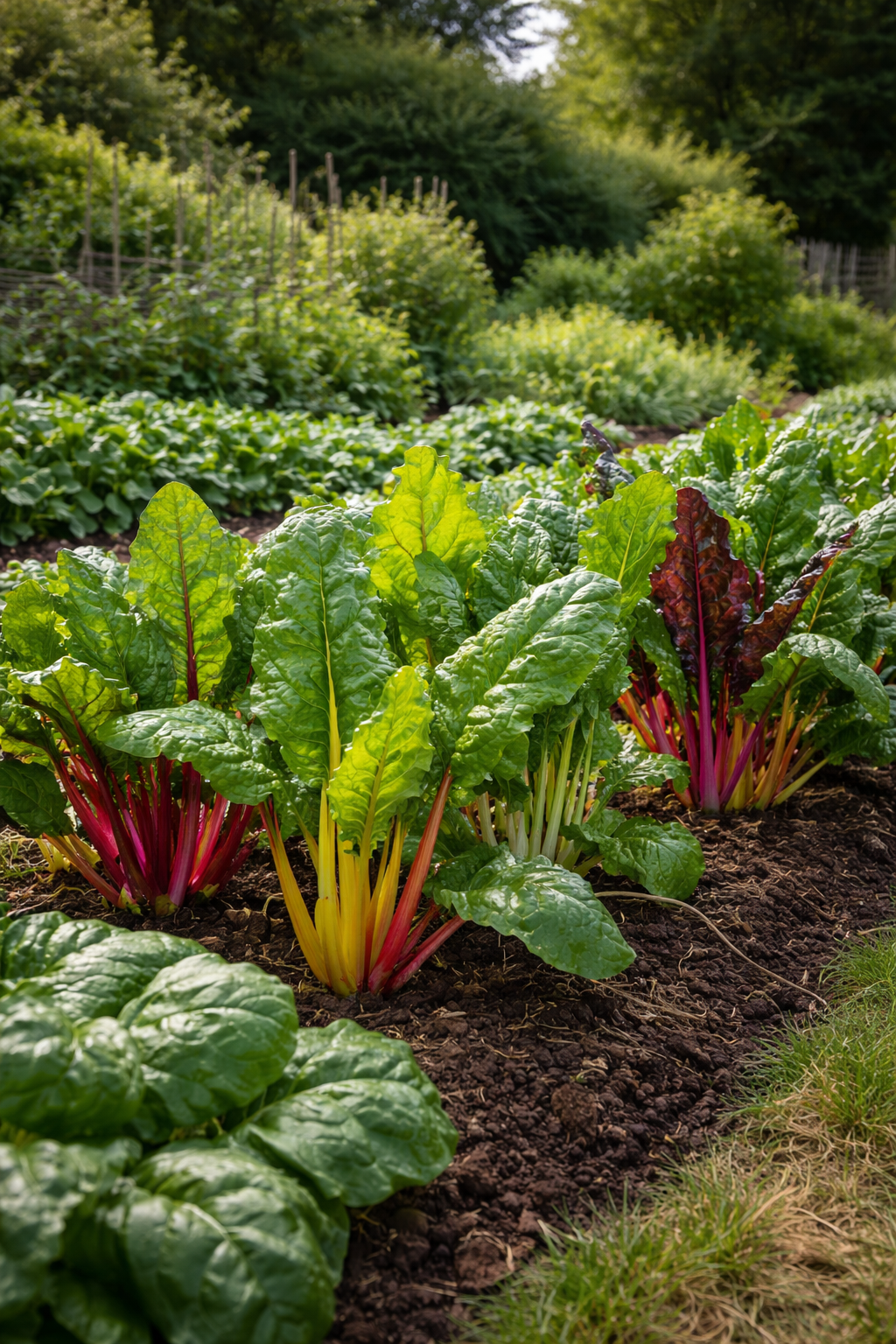
| The Vegetable That Refuses to Hurry |
| If onions are clerical and orderly, chard is something else entirely. It does not rush, it does not sulk easily, and it does not collapse at the first inconvenience. It simply persists. There are vegetables that feel seasonal — peas in early summer, tomatoes in late August, and brassicas in winter. Chard stretches across those boundaries. It can begin in spring, carry on through autumn, and in a mild winter, stand there quietly as if nothing has changed. In our gardens near the coast, where frost is rarely theatrical, I have cut chard leaves in January that were sown the previous April. Few crops offer that sort of patience. And yet, despite its generosity, chard is often misunderstood. It is treated either as a decorative novelty — all coloured stems and optimism — or as a utilitarian leaf for soups. In truth, it sits somewhere more grounded: ornamental enough to belong in a border, practical enough to earn its space in a kitchen garden. Transitioning from how chard fits into our gardens, it’s helpful to understand the nature of growing it: this is less about cleverness and more about rhythm. |
| A Plant With Two Personalities Chard is essentially a beet that forgot to make a root. That is the simplest way of thinking about it. It shares the same family traits — thickened leaf stems, bold veins, a tolerance for cooler temperatures — but instead of swelling underground, it directs its energy into foliage. This dual nature matters. It means chard appreciates many of the same soil conditions as beetroot, yet it behaves more like a leaf crop in harvest and maintenance. There are two types worth considering: broad-stemmed Swiss chard, often with white or vivid ribs, and narrower-stemmed perpetual spinach, which is more versatile in the kitchen. Both varieties are worthwhile. The fashionable varieties — ‘Bright Lights’, with its carnival of yellow, pink and orange stems — are undeniably striking. They have their place, particularly in mixed beds where food and ornament overlap. But I have found that the quieter green-and-white strains are often tougher and longer-lived. The brightly coloured stems can be slightly more prone to weather damage and, occasionally, to bolting in erratic springs. That is not a criticism. It is a reminder that beauty sometimes carries trade-offs. Soil: Steady, Not Excessive Chard is forgiving, but it has preferences. It likes fertile soil, yet not freshly manured ground. Too much nitrogen produces vast leaves that look impressive but can become coarse and susceptible to slug damage. What it wants is well-structured soil that holds moisture without becoming waterlogged. In our Kent clay, this means incorporating compost in autumn and allowing winter rain to settle it. By spring, the bed has a softness without being unstable. Chard roots travel deeper than lettuce but shallower than parsnips. It needs soil that offers both anchorage and drainage. One practical observation: chard dislikes sudden drought more than many people realise. While it is hardy against cold, it can become bitter and tough if repeatedly stressed by dry spells. A deep, occasional watering in summer — rather than daily sprinkling — encourages more resilient growth. If the leaves begin to lose their sheen or develop a slight leathery feel, it is often not the feeding they require, but steadier moisture. Sowing: Direct and Unfussy Chard can be sown directly from April onwards once the soil has warmed. It does not demand heat as beans or courgettes do, but it does respond to light and lengthening days. The seed itself is actually a cluster — what looks like a single seed often produces several seedlings. This is worth remembering. If sown too thickly, you will have a small forest on your hands. I sow in shallow drills, perhaps 2–3 cm deep, spaced generously. Once the seedlings appear and have formed a few true leaves, I thin them to around 25–30 cm apart for broad-stemmed varieties. It feels extravagant. It is not. Crowded chard produces smaller, thinner stems and encourages mildew in damp summers. Give it space and air, and it becomes architectural. Perpetual spinach can be grown slightly closer, though even then, I prefer not to crowd it. Airflow is one of the simplest forms of disease prevention, and it costs nothing. A Crop That Rewards Restraint One of the most common mistakes with chard is either harvesting too aggressively or not harvesting at all. It thrives on a steady rhythm. Pick outer leaves regularly, leaving the central crown intact. Do not strip the plant bare in one enthusiastic afternoon. That interrupts its natural pattern and can stress it into bolting, especially in late spring. If left untouched for weeks, the leaves become overly large and fibrous; stems thicken beyond tenderness. The balance is simple but requires attentiveness: frequent, moderate picking. This is not a vegetable for feast-and-famine harvesting. It is a vegetable for continuity. Varieties Worth Knowing There are wide varieties available, but a few stand out in practice. ‘Bright Lights’ is perhaps the most recognisable. Its multicoloured stems can transform an otherwise green bed into something almost painterly. It works well in mixed planting schemes where aesthetics matter. ‘Fordhook Giant’ is a classic white-stemmed variety — reliable, robust and less prone to bolting. Its leaves are broad and forgiving in cooking. ‘Lucullus’ offers tender stems and a good balance between flavour and resilience. It is not flamboyant, but it is dependable. Perpetual spinach, often sold simply under that name, deserves serious consideration. It produces narrower leaves but continues cropping for an astonishing length of time. In some gardens, it behaves almost as a short-lived perennial. Each variety carries subtle differences. Over time, you begin to favour one not for fashion, but for how it suits your soil and kitchen. Bolting: Not Always a Failure Chard will bolt — send up a flowering stem — particularly in hot, erratic springs or if stressed by drought. Many gardeners treat this as a total failure. I do not. Yes, once it commits to flowering, leaf production declines. But the early flower stems are edible and rather pleasant, with a texture somewhere between asparagus and young broccoli. And the flowers themselves attract large numbers of pollinators. In smaller gardens, where space is limited, you may not wish to allow bolting. In larger or more relaxed settings, allowing one or two plants to flower can bring unexpected life into the bed. We sometimes expect vegetables to behave like obedient servants. Chard reminds us that it is, after all, a plant. Wintering and Longevity In milder parts of the UK, chard can overwinter with minimal protection. Leaves may tatter in frost, but the crown often survives. A light mulch around the base — not over the crown — can help moderate temperature swings. In harsher winters, plants may collapse entirely. In those years, I treated it as an annual and started again in spring. There is no great drama in this. The key is not to cling too tightly to permanence. Chard is generous but not immortal. Pests and Problems Compared to brassicas or carrots, chard is relatively trouble-free. Slugs can be a problem in wet springs, particularly on young seedlings. Flea beetle may pepper leaves, though rarely to a catastrophic effect. Leaf miner occasionally tunnels through foliage. If spotted early, affected leaves can simply be removed. More often than not, problems arise from poor spacing or erratic watering rather than pests. Yellowing leaves are frequently a sign of inconsistent moisture rather than nutrient deficiency. The simplest solutions are often cultural rather than chemical. Growing Chard Beyond the Vegetable Patch One of chard’s quiet virtues is its ability to bridge ornamental and edible spaces. In mixed borders, especially in more naturalistic planting schemes, it can hold its own among grasses and perennials. The coloured varieties, in particular, look at home beside late-summer flowers. Their stems catch low sunlight in a way that feels deliberate rather than accidental. In smaller town gardens, where space is shared between utility and aesthetics, this matters. A plant that feeds you and looks composed while doing so earns its keep. Three Observations From Practice First: chard thrives on consistency more than intensity. Regular watering, moderate feeding, steady harvesting — not extremes Second: generous spacing transforms both health and flavour. A crowded chard bed never quite achieves its potential. Third: do not underestimate the power of perpetual spinach. It lacks glamour but often outperforms the showier strains in longevity. These principles—consistency, spacing, recognising reliable varieties—are the main lessons chard teaches through careful observation each season. Why It Endures Chard tolerates wind, cool nights, imperfect soil, and missed watering without collapsing under scrutiny. It also carries a certain humility. It is rarely the centrepiece of a meal, yet without it, winter kitchens feel emptier. It is sautéed quietly with garlic, folded into soups, and stirred into stews. It does not demand applause. Perhaps that is why I return to it every year. In summary: Sow chard in spring, nurture it without overcomplicating, harvest steadily, and you gain months of reliable greens—steadiness is chard’s true gift. There are vegetables that thrill. Chard endures. And sometimes, in a garden, endurance is the greater virtue. |
| About our writing & imagery Most articles reflect our real gardening experience and reflection. Some use AI in drafting or research, but never for voice or authority. Featured images may show our photos, original AI-generated visuals, or, where stated, credited images shared by others. All content is shaped and edited by Earthly Comforts, expressing our own views. |

