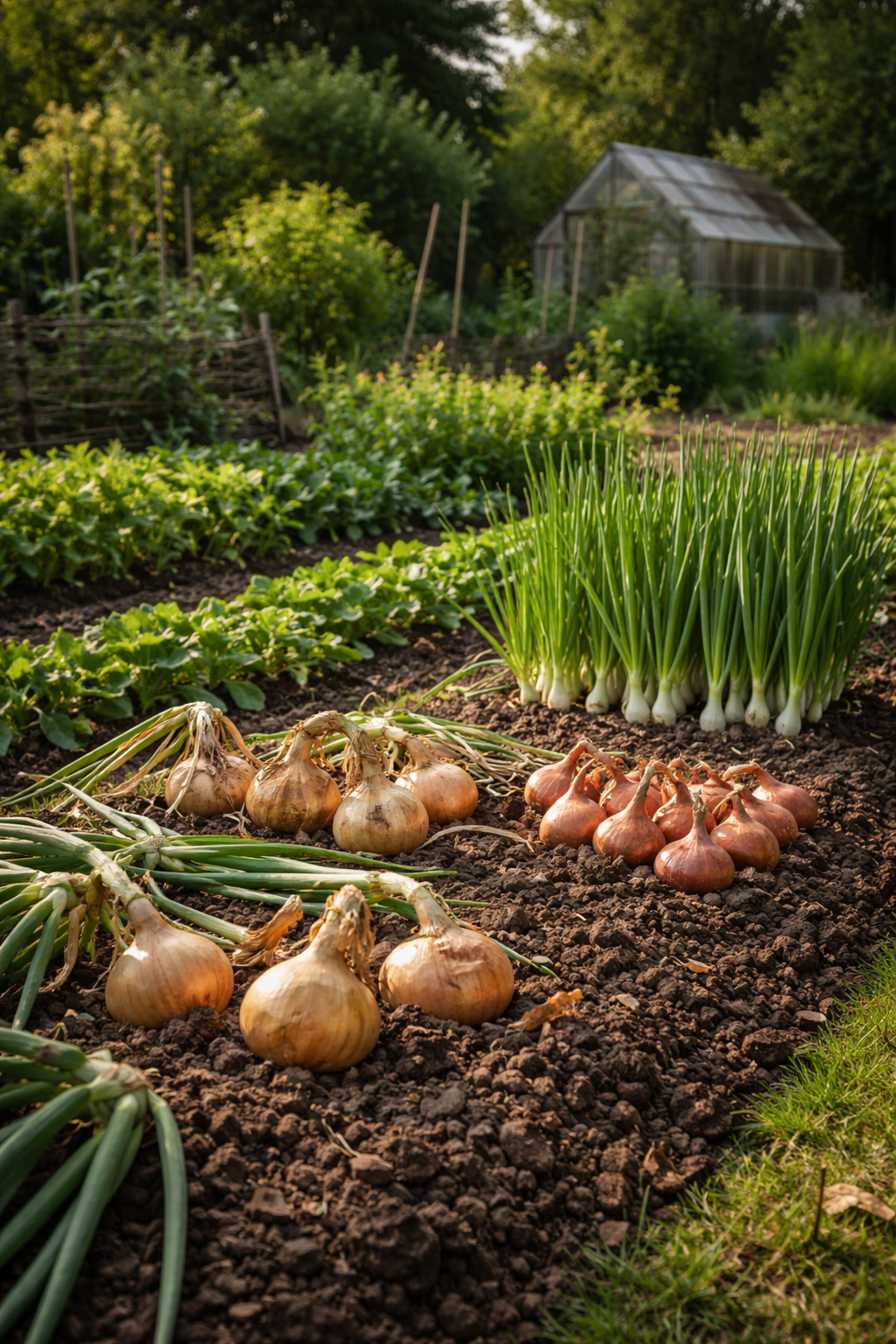
| Onions in Their Quiet Company |
| There are vegetables that feel industrious and theatrical — pumpkins sprawling, runner beans climbing, courgettes thrusting themselves forward as if they invented abundance. And then there are the alliums: onions, shallots and spring onions, which go about their business without display. They do not shout for attention. They are, in their way, clerical. Orderly. Almost monastic. And yet we rely on them for almost everything. Growing them well is less about trickery than about temperament. They ask for patience, consistency and a certain respect for time. They are simple, yes — but not simplistic. The difference matters. What follows is not a set of instructions so much as a working gardener’s reflections on what truly makes onions thrive in a British garden, particularly in our damp and changeable corner of Kent. |
| The Ground Before the Bulb If I have learned one thing, it’s that onions dislike surprises underground. They want steadiness and firm, well-drained soil—not rich, freshly manured beds like pumpkins. Too much nitrogen means more leaves and smaller bulbs. You get impressive greens but disappointing bulbs. The best onions I grow are in soil that was well-fed the year before. This runs against trends that urge constant additions every spring. For onions, less is often more. I aim for a bed improved with autumn compost, settled by rain and frost. By planting time, the soil’s structure is well-suited to onions. If the bed feels spongy, I have likely gone too far. The key takeaway: restraint creates optimal onion ground. This is particularly important with shallots. Shallots are less forgiving of loose, overly rich ground. They want a tidy start. Plant them into soft, unstable soil, and they will swell unevenly, sometimes even rot where water lingers. And that brings me to drainage. In Kent, our springs can be deceptively wet. Onions dislike sitting with cold water at their base. It invites rot and fungal mischief. A slightly raised bed — not theatrical, just an inch or two — makes a real difference in heavier ground. You are not lifting them to the sky; you are simply keeping their shoulders dry. Sets, Seeds and the Myth of Convenience Most gardeners use sets. I do too. Sets are small, dormant bulbs planted in spring or autumn for overwintering varieties. They are convenient, quick, and reliable. But they are not perfect. It’s assumed that sets are easier and better. I question that. Set a bolt—send up a flower stalk—especially if spring alternates between cold and warm. Sets are already partially grown and biologically ready before planting. Seed-grown onions are steadier but slower and require more work early on. However, they rarely bolt. When I have time, seed-grown bulbs keep better and seem more settled in their place. That said, life does not always allow for perfection. Sets are excellent for consistency and speed. If you use them, choose firm, small sets, as larger ones are more likely to bolt. That is not superstition; it is biology. Spring onions are usually sown from seed. They’re fast and forgiving, responding well to warmth and light. They are perhaps the most democratic option. Timing Is a Quiet Discipline Onions are governed by day length. They swell when the days reach a certain duration. No amount of feeding or coaxing will override this. That knowledge should calm us. In southern England, maincrop onions are usually planted in March or early April. Plant them too early into cold, waterlogged soil, and they sulk. Plant them too late, and they lack the long days needed for full bulbing. With shallots, I favour planting in March when the soil is workable but not claggy. Press them into firm soil so that only the tip shows. They dislike being buried deeply; they also dislike wobbling in loose earth. Sow spring onions every three weeks from March for a continuous harvest. This avoids surplus and shortage. The key takeaway: steady sowing ensures an ongoing supply and prevents feast-or-famine. This steady sowing suits the temperament of the plant and, frankly, the temperament of the gardener. Water: Less Drama Than You Think Onions don’t need constant feeding or watering. The key is moderation. The takeaway: extreme care is unnecessary. In the early stages, as they establish leaves, they benefit from consistent moisture. Not saturation — simply regularity. If spring is dry, I water deeply but infrequently, encouraging roots to travel downward rather than linger at the surface. Once bulbing begins, I reduce watering unless conditions are very dry. Excess water late in the season dilutes flavour and can reduce storage quality. It also encourages soft growth. Shallots in particular reward restraint. They develop a more concentrated flavour in slightly drier conditions. A shallot grown in overwatered soil tastes oddly bland — all size, no character. Spring onions are the exception. Because we harvest them young, they benefit from more consistent moisture. A dry spell can toughen them quickly. The essential principle: balanced care leads to healthier onions. Neither excess nor neglect is needed. Spacing and the Virtue of Air Crowded onions compete poorly. Their modest roots and wide, hollow leaves need airflow. Too-close onions make smaller bulbs and risk mildew. Space maincrop onions 10–15 cm apart in rows 25–30 cm apart. Shallots are slightly wider. It feels generous at first, almost wasteful, but the space fills invisibly below ground. Good spacing is about plant health. Air moving through leaves dries moisture and reduces disease, which is especially important in damp summers. And here is another quiet truth: onions dislike being fussed over once planted. Constant weeding with a hoe, which disturbs their shallow roots, can set them back. I weed carefully by hand when young, then allow the foliage to shade the soil. A thin mulch of compost — applied sparingly and not against the neck — can suppress weeds without encouraging rot. Feeding Without Indulgence Onions are moderate feeders. A light dressing of balanced organic fertiliser in early spring is sufficient in most gardens. High-nitrogen feeds create lush, floppy tops that are prone to disease and produce poor bulbs. We often equate green growth with success. With onions, that is misleading. Thick, dark green leaves can hide a mediocre bulb. Aim for consistent, moderate onion growth. The main approach: support steadiness, not excess, in foliage or bulbs. If the soil is very poor, a small amount of sulphate of potash can support bulb development. But I would caution against chasing perfection through products. Soil structure and timing matter more. Shallots: The Understated Aristocrat Shallots deserve their own paragraph, if not a small chapel. They multiply rather than simply swell. One planted bulb becomes a cluster. Their flavour is more nuanced, their storage is often better, and their culinary uses are quieter but deeper. They are less tolerant of wet winters. Overwintered shallots in heavy soil are a gamble. In lighter soil, autumn planting can yield strong early crops, but spring planting is safer in much of the UK. I have found that gently loosening soil around developing clusters — without disturbing roots — can help them expand evenly. Not lifting, simply easing the surface crust. It is a small intervention, but one that seems to prevent misshapen bulbs. Shallots are more sensitive to onion fly. A simple horticultural fleece barrier early on can make the difference between success and frustration. I do not leave fleece on permanently; airflow is still important. But for the vulnerable early weeks, it is protective without being oppressive.e. Spring Onions: Fleeting but Worth It Spring onions occupy a different space in the garden calendar. They are not stored. They are eaten fresh, often within hours of lifting. For spring onions, fertility matters less than tenderness. Sow thinly, but don’t over-thin. Clusters lifted together have charm. Firm soil yields stable, tender spring onions. The key point: avoid planting in loose soil for strong results. I sow in shallow drills and firm the soil with the rake. Once established, spring onions need little except water in dry spells and some weeding. They tolerate partial summer shade, making them useful for beds between crops. The Question of Topping and Bending There is an old practice of bending onion tops to encourage ripening. I do not subscribe to it. Onions know when they are ready. When the neck softens, and the tops fall naturally, that is the moment. Forcing them interrupts the final movement of nutrients into the bulb and can compromise storage. Similarly, do not be tempted to peel back the soil to expose bulbs prematurely. Some gardeners do this in the hope of larger bulbs. In my experience, it does little but increase the risk of sunscald and disease. Trust the plant’s rhythm—onions signal readiness. Takeaway: Avoid unnecessary intervention as plants know their timing. Harvest and Curing: Where Many Go Wrong Harvesting is not merely pulling from the ground. It is a process of drying, firming and patience. Lift onions on a dry day if possible. Allow them to sit on the soil surface for a few days, turning gently if rain threatens. The outer skins tighten and dry. After harvesting, onions need 2 to 3 weeks of curing in a cool, dry place. The key takeaway: curing the patient means longer storage and less spoilage. Shallots follow the same principle but often dry faster. Spring onions, of course, bypass this entirely. They go straight from the soil to the kitchen. Storage and Selection Once cured, store onions in a cool, dry, well-ventilated place. Not in plastic. Not in damp sheds. I hang some in plaits. Others lay in shallow crates. The key is airflow. Save the best bulbs for future planting. Over time, this practice improves your onions for your garden. Key takeaway: selection shapes onions that are better adapted year by year. A Note on Failure Onions are not immune to difficulty. Onion white rot, rust, and fly damage — these are real challenges. Crop rotation helps, though in small gardens it is imperfect. Good hygiene, removal of infected debris, and avoiding overwatering reduce risk. But sometimes a season is simply poor. A cold, erratic spring can lead to bolting beyond your control. A wet summer can encourage mildew. In those years, it is worth remembering that onions have been grown in Britain for centuries without perfection. We are not managing a laboratory. We are tending a living system. Why Grow Them at All? You can buy onions cheaply. Shallots too. Spring onions arrive in neat supermarket bundles. So why bother? Because flavour shifts when you grow your own. A shallot pulled in August carries a sweetness that shop-bought bulbs rarely match. A spring onion lifted minutes before slicing tastes alive. Even a humble brown onion grown in your own soil seems denser, more purposeful. There is also something steadying about a bed of onions. They occupy space for months without drama. They teach patience. They remind us that not all progress is visible. In our own gardens around Sandwich, I often look across a bed of onions in June and think: nothing much is happening. And yet beneath the soil, something deliberate and structured is unfolding. That, to me, is the quiet satisfaction of growing them well. Three Things That Matter More Than You Think First: firmness of soil. It is astonishing how often this is overlooked. Onions root best in ground that has been gently compacted — not hard, simply settled. Second: moderation in feeding. Excess fertility weakens more than it strengthens. Third: patience at harvest. Curing is not optional. These are not glamorous insights. They are small, cumulative habits. Growing onions, shallots and spring onions is not about spectacle. It is about consistency, restraint and trust in natural timing. They are modest crops that reward attentiveness rather than innovation. In an era that often celebrates complexity, I find comfort in their simplicity. Plant them well. Keep them steady. Harvest them when ready. Dry them properly. And then, months later, slice into one in the kitchen and recognise that the quiet discipline of spring has carried you through to winter. |
| About our writing & imagery Most articles reflect our real gardening experience and reflection. Some use AI in drafting or research, but never for voice or authority. Featured images may show our photos, original AI-generated visuals, or, where stated, credited images shared by others. All content is shaped and edited by Earthly Comforts, expressing our own views. |

