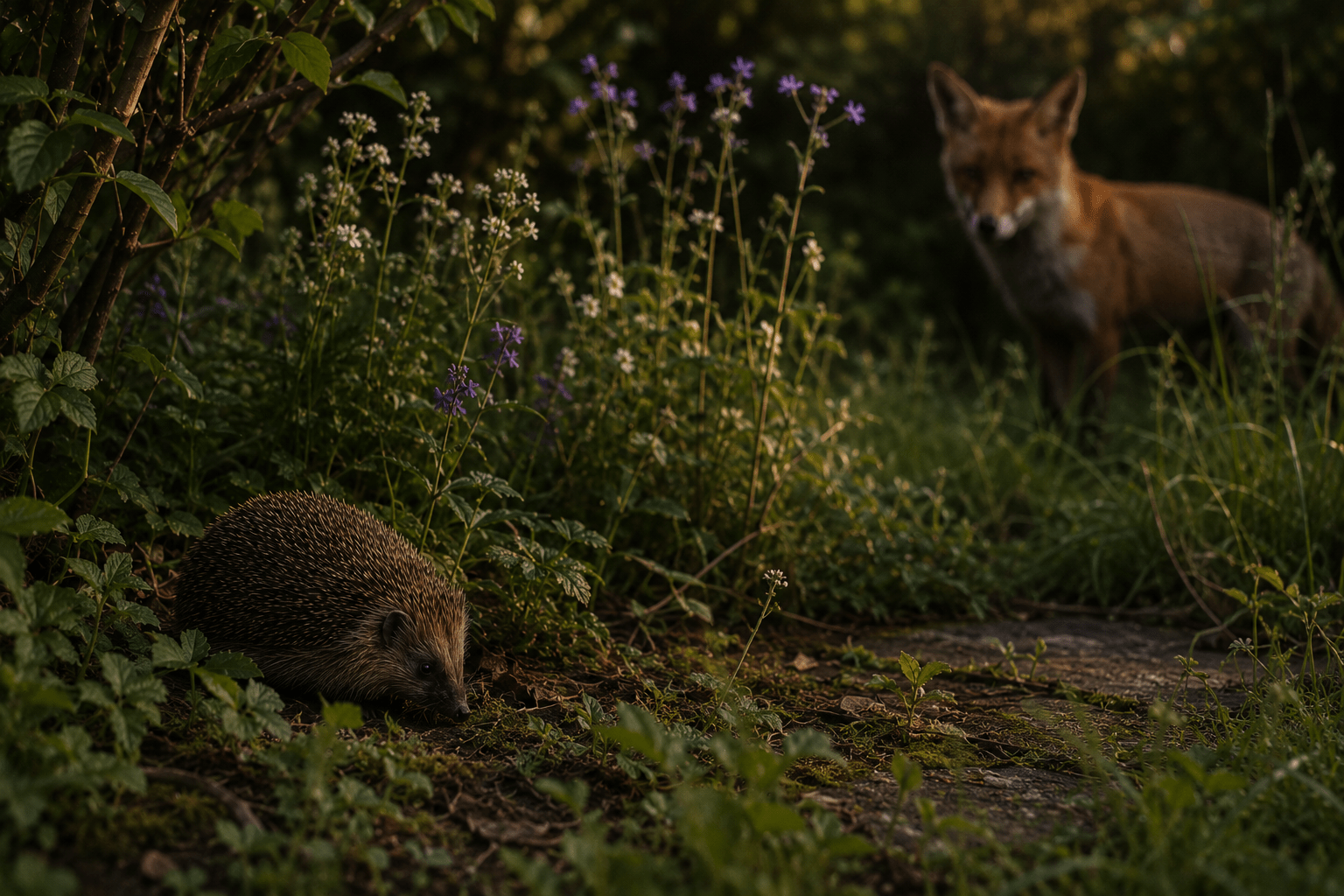
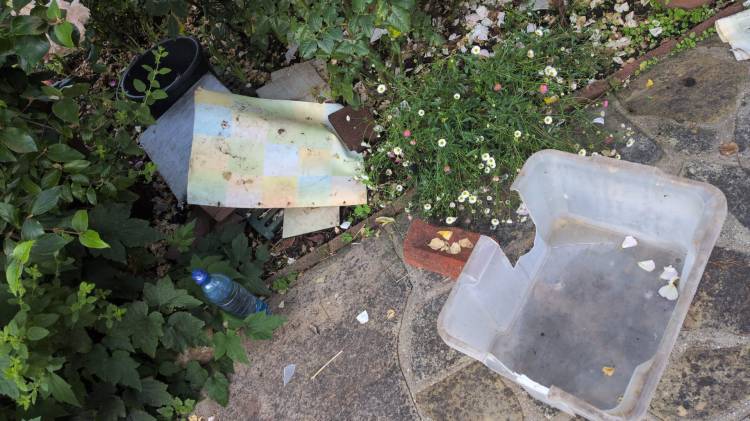
Fox damage to a client’s hedgehog feeding station.
| There is something quietly satisfying about knowing hedgehogs are visiting a garden. Unlike many forms of wildlife, hedgehogs seem to arrive with very little fuss. They do not sing from the tops of trees or announce themselves with bright plumage. Most gardeners discover them indirectly. A half-empty food bowl in the morning. A narrow path through long grass. Small footprints in damp soil. Occasionally, if one is fortunate, one may hear the unmistakable rustling sound of a hedgehog moving through leaves on a warm summer evening. Over the years, I have met many clients who have developed a real affection for their visiting hedgehogs. Some provide feeding stations. Others install dedicated hedgehog houses. A few have gone much further, creating entire sections of their gardens specifically to support wildlife. Then, quite often, another visitor arrives. The fox. For some people, this comes as an unwelcome surprise. They have carefully established a feeding station for hedgehogs, only to discover that a fox has apparently dismantled the entire arrangement overnight. Food bowls are overturned. Plastic containers are dragged across patios. Bricks are moved. Shelters are investigated. The evidence is usually scattered across the garden like the aftermath of a small burglary. The natural reaction is often to ask how to get rid of the fox. In reality, that is rarely the best question. A fox is simply doing what a fox has evolved to do. It is responding to an opportunity. Food has appeared in a predictable location, and an intelligent, adaptable animal has figured out where to find it. From the fox’s perspective, there is no mystery here at all. The challenge for gardeners is not eliminating foxes. It is designing feeding stations and shelters that work despite their presence. That distinction matters. Understanding the real problem One of the most common assumptions I encounter is that foxes represent a major threat to adult hedgehogs. While foxes can certainly attack young, injured, or vulnerable hedgehogs, healthy adults are not particularly easy prey. A fully-grown hedgehog is an awkward, spiny package that requires considerable effort to tackle. Most foxes would much rather investigate an exposed bowl of food than wrestle with an adult hedgehog. In many cases, the fox is not interested in the hedgehog at all. It is interesting that the meal is being provided. This changes the conversation considerably. If the objective is to protect hedgehogs, the focus should be on safeguarding feeding stations and nesting areas rather than attempting to exclude foxes from the wider garden. Gardens are increasingly important wildlife habitats precisely because they support multiple species. Foxes, hedgehogs, birds, insects and small mammals are all attempting to navigate the same fragmented landscape. The goal is coexistence rather than exclusion. Why feeding stations fail Most failed feeding stations share similar characteristics. They are convenient for the gardener. Food is placed in an open dish or inside a lightweight container. The structure sits on a patio or pathway, making it easy to access and clean. A brick or decorative stone may be added as an afterthought to prevent movement. Unfortunately, what is convenient for a gardener is often equally convenient for a fox. A determined fox possesses impressive strength and persistence. Lightweight covers can be lifted. Plastic containers can be dragged. Loose bricks can be shifted surprisingly easily. Once the animal learns that food is inside a structure, it becomes motivated to investigate repeatedly. Many gardeners interpret this behaviour as aggression. Most of the time, it is simply curiosity reinforced by reward. The fox returned because the previous visit was successful. Designing for behaviour Good wildlife gardening often begins with understanding behaviour rather than fighting it. Hedgehogs and foxes occupy the same environment but move through it differently. A hedgehog is comfortable navigating narrow tunnels, confined passages and dense vegetation. It spends much of its life squeezing beneath shrubs, moving through gaps and following sheltered routes. A fox prefers open access. It can investigate confined spaces, but it generally favours approaches that allow rapid movement and visibility. This difference provides the foundation for effective feeding station design. A well-designed feeding station is not a fortress. It does not need steel doors or elaborate mechanisms. It simply needs to exploit the fact that hedgehogs and foxes move differently through the landscape. A narrow entrance tunnel, positioned ahead of the feeding chamber, immediately changes the dynamic. Food placed at the rear of the structure becomes difficult for a fox to reach. The hedgehog, meanwhile, continues to access it without difficulty. Good design often succeeds where deterrents fail. The importance of weight Another lesson learned through practical gardening is that weight matters. Gardeners frequently underestimate the physical capabilities of foxes. A loose brick may look substantial to us, but it offers little resistance to an animal accustomed to scavenging, digging and exploring urban environments. When I construct wildlife shelters, I often think less about what the structure looks like and more about how it behaves during the night. Could it be tipped over? Could it be dragged? Could it be lifted? Would it survive repeated investigation? Heavy paving slabs remain one of the simplest and most effective solutions available. A substantial slab placed atop a feeding station dramatically reduces the likelihood of disturbance. Another layer beneath the structure can help prevent digging and shifting. It is not sophisticated. It is simply practical. Shelter should not smell like dinner. One mistake I occasionally see involves combining feeding and nesting functions. Gardeners place food directly beside a hedgehog house or, in some cases, inside it. The intention is entirely understandable. We naturally want to make life easier for wildlife. Yet from a security perspective, this approach creates problems. Food attracts attention. The more attractive a feeding location becomes, the more likely it is to be investigated by other animals. A hedgehog house should ideally remain a quiet, unobtrusive place. It should smell of leaves, soil and nesting material rather than regular meals. Separating feeding areas from nesting sites reduces unnecessary disturbance and helps maintain the security of the shelter itself. Working with the garden One of the advantages of gardening is that plants can become part of the solution. A feeding station positioned on open paving is visible and exposed. The same structure tucked beneath shrubs feels entirely different. Dense planting creates natural barriers. It narrows access routes and reduces visibility. It encourages hedgehogs while making investigation more difficult for larger visitors. This is one of the reasons mature gardens often support wildlife so effectively. Complexity creates opportunities. The best wildlife spaces rarely look engineered. They feel as though they emerged naturally from the landscape. The myth of total fox-proofing Perhaps the biggest misconception surrounding wildlife feeding stations is the idea that anything can be made completely fox-proof. In truth, foxes are remarkably adaptable animals. A sufficiently determined fox can investigate almost anything. Absolute exclusion is rarely achievable and often unnecessary. The objective should be to reduce opportunities rather than to pursue perfection. If a fox occasionally walks through the garden, that is not a failure. If a fox investigates a feeding station and cannot access the food, that is success. Wildlife gardening is not about creating sealed environments. It is about gently influencing outcomes. There is an important difference. A broader reflection The older I become, the more I find myself appreciating wildlife as a lesson in perspective. Many gardening challenges arise because we view nature as a collection of separate categories. We decide that one creature belongs and another does not. The hedgehog becomes the welcome guest. The fox becomes the unwanted visitor. Yet from an ecological standpoint, both are simply participants in the same system. The fox is not trying to ruin anyone’s wildlife project. It is responding to opportunities in an increasingly fragmented landscape where food sources can be unpredictable. Understanding this does not mean allowing foxes unrestricted access to feeding stations. It means approaching the problem with some sympathy. Good wildlife gardening often involves creating conditions that allow different species to coexist without unnecessary conflict. That is a more subtle objective than simply keeping one animal out. Living alongside wildlife The most successful wildlife gardens I encounter are rarely the neatest. They tend to contain layers of vegetation, hidden corners, fallen leaves and places where nature is allowed a little more freedom than conventional gardening wisdom might recommend. In these gardens, hedgehogs often thrive because the environment offers more than food. It provides shelter, routes, nesting opportunities and relative safety. A feeding station is only one small part of that picture. Protecting hedgehogs ultimately involves thinking about the wider garden as habitat rather than decoration. When feeding stations are thoughtfully designed, shelters are properly positioned, and the surrounding landscape remains welcoming, hedgehogs generally find ways to coexist with the other creatures sharing the same space. Including foxes. The result is not a wildlife garden free from disturbance. It is something more interesting than that. It is a garden that reflects the realities of nature itself: complex, occasionally untidy, endlessly adaptive, and always capable of surprising us. |
| About our writing & imagery Most articles reflect our real gardening experience and reflection. Some use AI in drafting or research, but never for voice or authority. Featured images may show our photos, original AI-generated visuals, or, where stated, credited images shared by others. All content is shaped and edited by Earthly Comforts, expressing our own views. |

