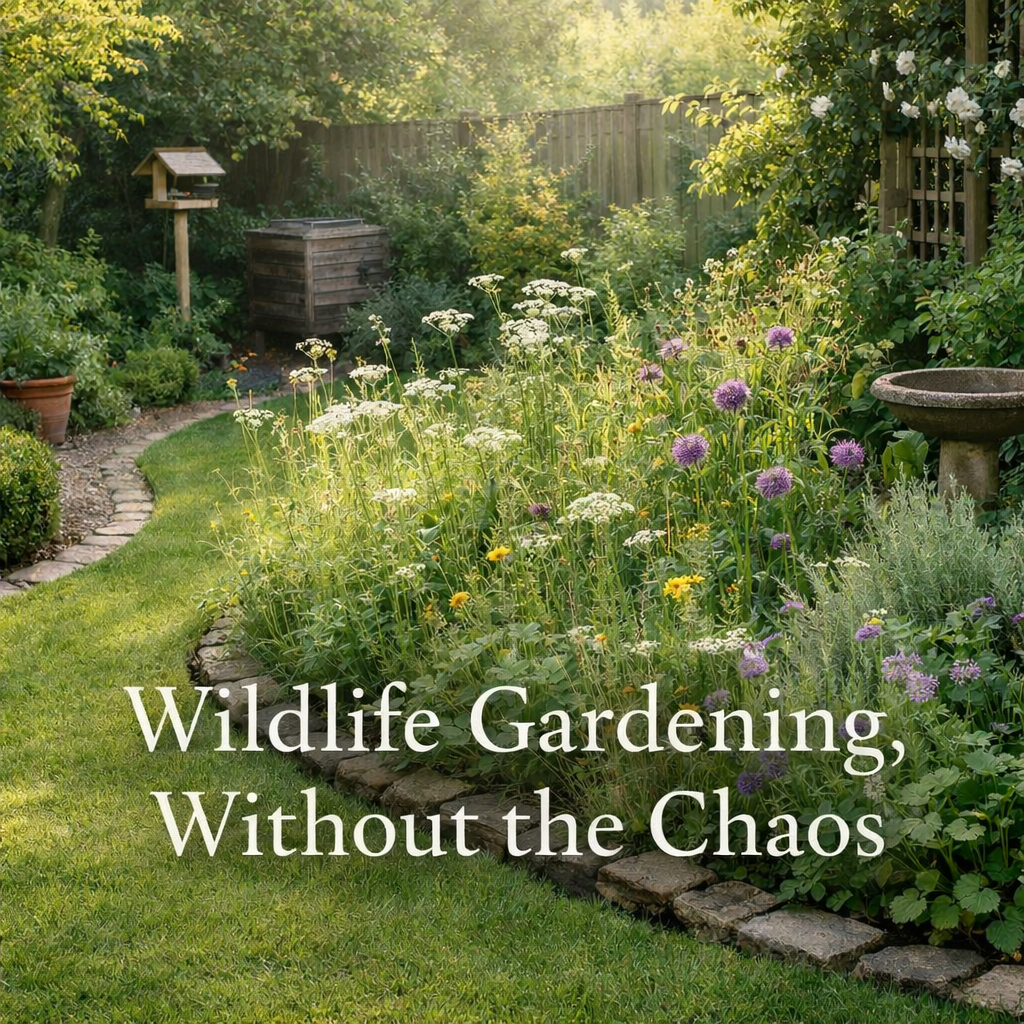
| What “Rewilding” Actually Means in a Town Garden The word rewilding tends to arrive in town gardens carrying more weight than it can realistically support. It comes freighted with images of large landscapes and sweeping reversals: rivers returned to old courses, animals reintroduced at scale, human presence deliberately reduced. When that same word is applied to a small, bounded space between fences, it can feel either aspirational or faintly absurd, depending on the context and the expectations attached to it. Most people are not opposed to the idea of rewilding itself. What unsettles them is what they believe it demands: a loss of control, a loss of order, and often a loss of neighbourly ease. There is a lingering assumption that once rewilding begins, the correct response is to step back entirely and allow the garden to proceed without further interference. For many, that feels less like care and more like abandonment. That discomfort is not ignorance. It is an accurate reading of the limits of a town garden. A garden in an urban or suburban setting is not a blank canvas. It is already shaped by roads, drainage systems, buildings, light pollution, pets, and constant human movement. It cannot return to a pre-human state, because it has never existed outside one. The question, then, is not whether rewilding is possible, but what the term can reasonably mean at this scale. One difficulty lies in the use of borrowed language. Concepts developed for landscapes measured in hectares are often imported directly into domestic spaces without being resized. In large-scale ecology, rewilding frequently involves removing barriers and allowing systems to reorganise themselves with minimal ongoing intervention. In a town garden, removing barriers usually just means growth continues until it meets the next fence. That is not rewilding. It is expansion without context. When people attempt to apply large-scale ideas without adaptation, disappointment often follows. The garden becomes harder to live with rather than richer in life. Diversity narrows instead of widening. Confidence ebbs, and the initial enthusiasm quietly gives way to frustration. What fails in those moments is not the instinct to support nature, but the assumption that non-intervention is synonymous with care. Town gardens are, by definition, edited spaces. Soil has been moved and compacted, levels adjusted, species introduced and excluded. Water is directed. Light is filtered. Even the decision to mow or not mow is an act of selection. Pretending otherwise creates confusion rather than freedom. True rewilding, even at the landscape scale, is not about doing nothing. It is about intervening differently. In a town garden, that distinction matters enormously, because the absence of management rarely produces richness. More often, it produces dominance. This is where the difference between wildness and neglect becomes important. There is a persistent belief that wildness must look chaotic in order to be authentic, that a living system should appear unruly if it is to be taken seriously. In reality, many healthy ecosystems are structured, layered, and surprisingly consistent. They are not random; they are patterned. Neglect, by contrast, is unpredictable. It leads to sudden collapses, uneven growth, and the gradual loss of variety as a small number of robust species take hold. Intervention then arrives abruptly, driven by irritation rather than observation. Wildness develops slowly. Neglect accelerates failure. If rewilding is to mean anything useful in a town garden, it is not the abandonment of control but its softening. It is a shift in emphasis rather than a disappearance of intent. At the garden scale, rewilding is less about letting go entirely and more about allowing processes to complete. Plants are permitted to flower fully and set seed. Leaves are allowed to fall and remain where they land, at least for a time. Insects are given the chance to overwinter. Soil organisms are not constantly exposed or reset. These changes are modest, but together they create continuity, which is what wildlife responds to most reliably. One of the most effective adjustments people make when they begin thinking in this way is not so much about what they do, but how often they do it. Borders are cut back once rather than repeatedly. Grass is left longer in defined areas. Tidying is delayed, and clearing becomes selective rather than comprehensive. Structure remains, but the rhythm changes. Wildlife responds strongly to rhythm. Predictable disturbance allows species to adapt and settle. Random disturbance forces retreat. Rewilding, in this sense, becomes a matter of choosing fewer moments to intervene and choosing them with greater care. Succession is another area where scale matters. In unmanaged spaces, succession moves quickly and decisively, with woody growth taking over, light levels dropping, and diversity narrowing. In a town garden, allowing succession to proceed unchecked usually means losing the openness that supports insects, birds, and smaller mammals. Preventing succession entirely, however, creates a different kind of stagnation. A rewilded town garden allows succession to occur in pockets and then gently redirects it. Shrubs are thinned rather than removed. Self-seeders are given time to establish before being edited. Change is acknowledged and guided rather than resisted outright. This kind of gardening demands attention rather than intensity. There is also a social reality that cannot be ignored. Town gardens exist within communities, not in isolation. Sightlines, boundaries, pests, and noise all matter. Ignoring this does not make it disappear; it simply shifts tension outward. Successful wildlife gardening recognises these pressures and works within them, finding ways to support life without provoking unnecessary conflict. For this reason, visible care matters. Paths are maintained. Edges are held. Entry points remain clear. These signals reassure people that what they are seeing is deliberate, not accidental. Wildlife benefits from deliberate systems far more than from ambiguity. Rewilding in a town garden is not an act of retreat. It is an assumption of responsibility. It requires noticing what is arriving, what is disappearing, what is beginning to dominate, and what is failing to establish. It requires decisions about when to intervene and when to wait. This is not passive gardening; it is attentive gardening. If the word rewilding continues to feel unwieldy, it can help to reframe the question entirely. Instead of asking how wild a garden can be allowed to become, it is often more useful to ask how much life it can support without losing balance. That question invites observation rather than ideology and sits more comfortably within the realities of small, shared spaces. A rewilded town garden does not announce itself loudly. It looks settled rather than theatrical. Edges are clear, centres are richer, and change happens gradually. Wildlife appears not because it is being lured, but because conditions suit it. The garden feels lived in by people and other species alike, without either overwhelming the other. Throughout this series, the same principle keeps surfacing. Wildlife thrives not where humans vanish, but where care becomes quieter and more consistent. Rewilding, in a town garden, is not about undoing human presence. It is about softening it: intervening less often, timing actions better, and allowing life to develop within a structure that can hold it. That is not a lesser form of rewilding. It is the true path—one uniquely suited to the realities of town gardens, and the only way lasting abundance will ever take root here. |

| About our writing & imagery Most articles reflect our real gardening experience and reflection. Some use AI in drafting or research, but never for voice or authority. Featured images may show our photos, original AI-generated visuals, or, where stated, credited images shared by others. All content is shaped and edited by Earthly Comforts, expressing our own views. |

