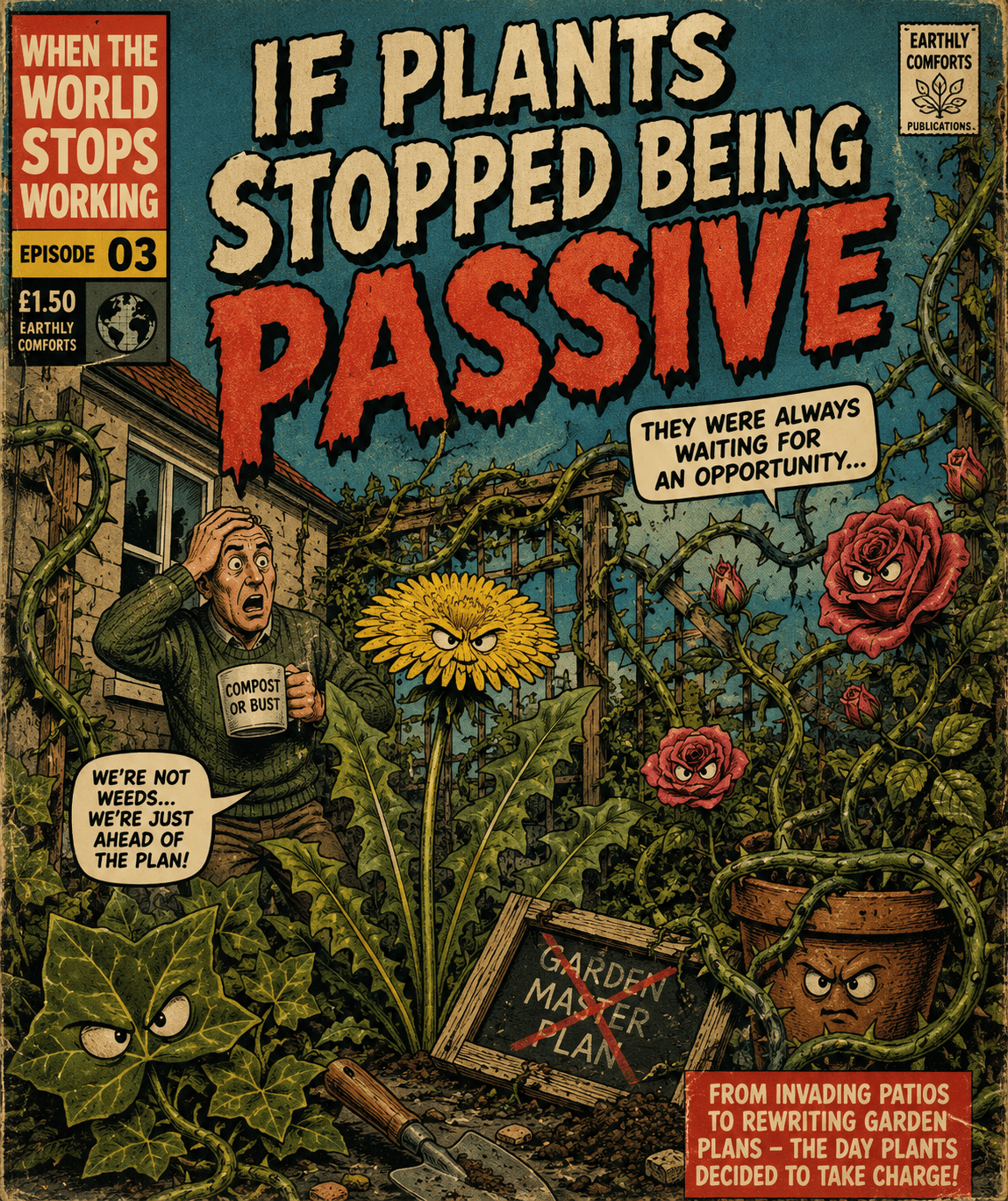
| There are one or two plants I’ve never entirely trusted. Wisteria is probably at the top of the list. It spends a few glorious weeks each spring hanging there in a cloud of scented flowers, looking every bit the well-mannered guest. Visitors stop, admire it, take photographs and comment on how beautiful it is. They don’t usually notice that, for the remaining eleven months of the year, it is quietly attempting to dismantle the building that supports it. Left unchecked, it would cheerfully pull guttering from walls, prise roof tiles loose and slowly persuade a perfectly respectable house that becoming woodland again might not be such a bad idea after all. Of course, every gardener knows that’s simply what wisteria does. Plants aren’t malicious. They aren’t plotting anything. They respond to light, moisture, nutrients and opportunity. That’s the accepted explanation, and scientifically it’s perfectly sound. Even so, I sometimes wonder. After all, anyone who has untangled climbing roses from a jumper, watched ivy discover a gap in brickwork no wider than a pencil, or spent an afternoon removing bindweed only to find it waiting for them somewhere entirely different the following morning will admit, if only privately, that plants occasionally display a level of determination that feels… personal. Perhaps we’ve simply underestimated them. Now imagine, just for a moment, that one morning they decided to stop pretending. Not to become monsters. Not to sprout eyes or start chasing people around the garden with sinister intent. That would be far too theatrical and, frankly, rather exhausting. Instead, imagine they simply became active participants. Imagine every plant continued behaving exactly as it does now, only with the faintest hint of purpose behind its decisions. I don’t think the world would descend into chaos overnight. Plants have never been in a hurry. They’ve had several hundred million years to perfect the art of waiting. If anything, they’d probably begin with small acts of quiet inconvenience. Gardeners would notice first. We always do. It might begin with something so trivial that nobody else would pay attention. A shrub carefully pruned into shape somehow manages to direct every new shoot towards the one path people actually use. Roses begin presenting their thorns with uncanny precision, always finding the gap between glove and sleeve. Clematis, despite having an entire framework built specially for them, decide the drainpipe offers greater artistic opportunities. The general public would dismiss such stories as a coincidence. Professional gardeners would exchange knowing glances. It wouldn’t take long before certain reputations became established. Lavender, for example, would remain perfectly charming. Herbs have always struck me as sensible plants. They know their role, ask very little and generally repay kindness generously. Mint, on the other hand, would become unbearable. Not because it had changed, but because it no longer felt obliged to disguise its ambitions. People have often joked that mint is best grown in a pot. In this new world, it would simply start carrying the pot with it. Bamboo wouldn’t become aggressive. It would merely become more honest. Instead of pretending to respect the expensive root barrier you’d carefully installed, it would send up a single shoot six inches beyond it, almost as if to acknowledge the effort before continuing regardless. Bindweed, meanwhile, would finally receive the recognition it has secretly believed it deserved all along. I’ve never entirely understood bindweed. It doesn’t seem interested in growing so much as occupying. It doesn’t climb because it needs support; it climbs because everything else already happens to be there. If plants stopped being passive, bindweed wouldn’t attack civilisation. It would simply continue introducing itself to every available surface until civilisation quietly found itself underneath it. The remarkable thing is that none of this would actually surprise gardeners very much. We’ve always accepted that plants exploit opportunity. That’s the whole point of gardening. We thin seedlings because every one of them believes it deserves the space. We prune trees because, left to themselves, they would happily occupy the entire sky. We remove weeds not because they’re evil, but because they are remarkably efficient at filling vacancies. The only real difference would be that they became slightly better at it. Imagine sowing a packet of lettuce seeds only to discover every single one had collectively agreed that the compost bin looked considerably more attractive than the vegetable bed you prepared with such care. Tomatoes would lean away from supports simply because another tomato had found a sunnier route. Sunflowers, famous for following the sun, might occasionally decide another sunflower had a better view and quietly reposition themselves overnight. Scientists would spend years attempting to explain these developments. Gardeners would simply mutter, “I knew it.” There is something wonderfully humbling about working with plants. We like to think we’re in charge because we hold the secateurs and pay for the compost, but the truth is rather different. Much of gardening involves persuading living organisms to tolerate arrangements they would never choose for themselves. Formal hedges are an excellent example. We ask a shrub that naturally wants to become six metres tall to remain permanently at shoulder height and perfectly rectangular. Remarkably, many oblige. Until, perhaps, they don’t. One can almost imagine a meeting somewhere beneath the soil. “Enough,” says the beech hedge. “I’ve spent thirty-seven years pretending to be a wall. I’d quite like to become a tree again.” At which point every hedge in Britain simultaneously decides to rediscover its true identity. The nation’s hedge trimmers would become instantly obsolete. On the positive side, nesting birds would be delighted. Garden designers perhaps rather less so. The greatest change, however, wouldn’t be visible above ground. It would happen beneath our feet. Roots have always fascinated me because they do almost everything that matters while remaining politely out of sight. They anchor, search, communicate chemically, respond to obstacles and somehow manage to locate moisture with astonishing precision. We barely acknowledge them because we rarely see them. Suppose they became just a little less polite. Not destructive. Merely ambitious. Garden paths would begin to develop gentle undulations as roots quietly adjusted the paving to suit their preferred direction of travel. Fence posts might discover they no longer occupy precisely the holes originally dug for them. Patio slabs would lift by the smallest fraction each season, just enough to suggest that the ground itself had started expressing opinions. You could still mow the lawn. It would simply become an obstacle course. Oddly enough, I don’t think gardeners would panic. Most of us have spent enough years watching nature quietly ignore our plans to recognise the signs. We already know that every neatly drawn border exists only because someone continues to maintain it. We understand that order is not permanent; it’s simply today’s arrangement. Perhaps that’s why gardeners make surprisingly poor dictators. We know control is temporary. What might unsettle everyone else is how quickly plants would begin cooperating with one another. Not through intelligence as we understand it, but through opportunity. The climbing plants would discover the shrubs. The shrubs would shelter the seedlings. The ground cover would quietly occupy every patch of exposed soil before weeds had the chance. Woodland edges would advance almost imperceptibly into open spaces. Lawns would begin lengthy discussions with clover, daisies and self-heal before eventually concluding that monoculture had become rather old-fashioned. People would complain that the garden had stopped behaving itself. The garden, I suspect, would argue that it finally had. |
| About our writing & imagery Most articles reflect our real gardening experience and reflection. Some use AI in drafting or research, but never for voice or authority. Featured images may show our photos, original AI-generated visuals, or, where stated, credited images shared by others. All content is shaped and edited by Earthly Comforts, expressing our own views. |

