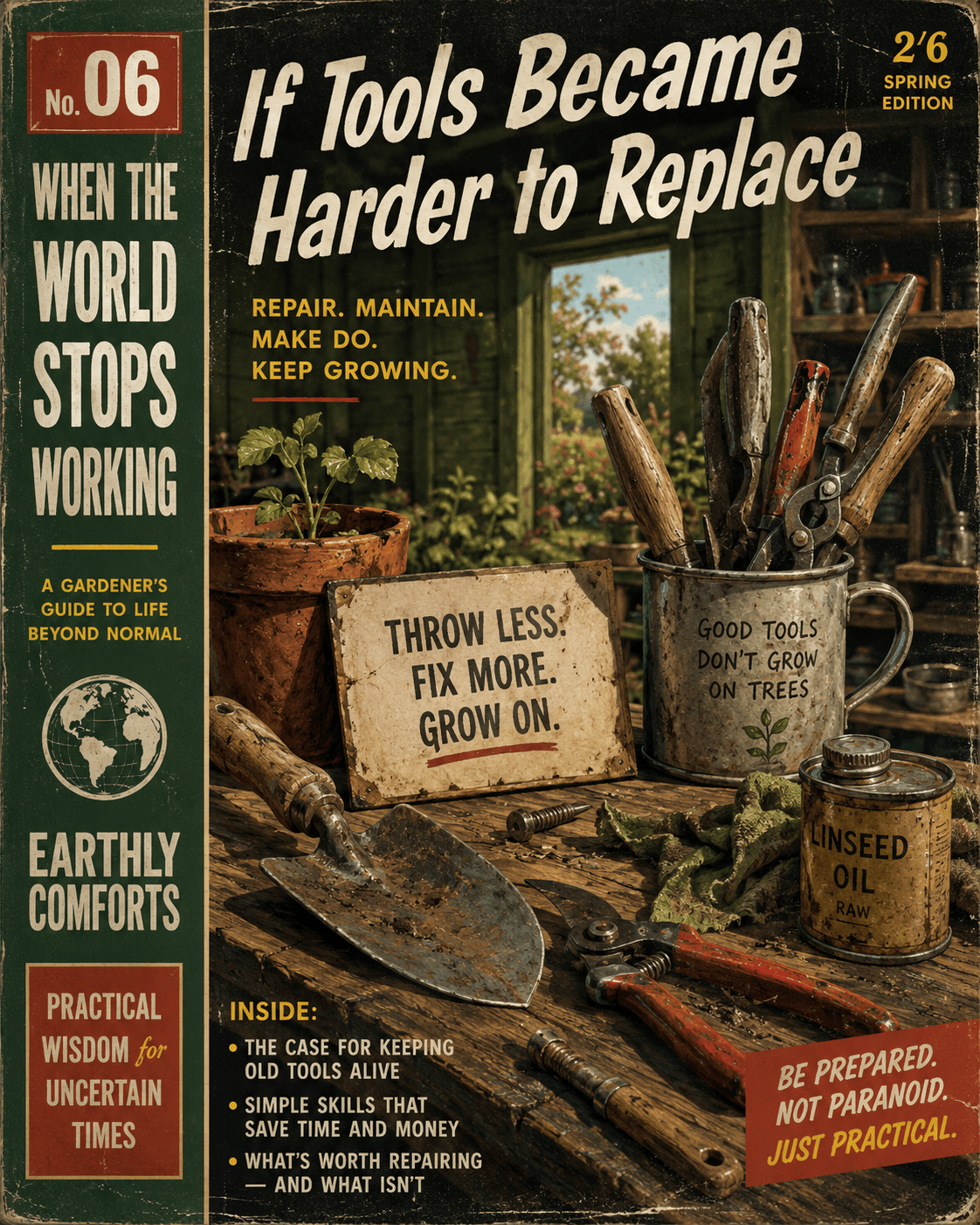
| There is an old spade leaning against the wall in our workshop that probably should have retired years ago. The handle has been replaced once, the blade has been sharpened so many times that it bears only a passing resemblance to the tool that originally left the factory, and if you look closely, there is a weld just above the socket where it snapped one particularly enthusiastic afternoon while attempting to persuade a stubborn tree root that it no longer belonged where it was. It isn’t an especially valuable tool. In fact, if you saw it at a car boot sale, you would probably walk straight past it. Yet if someone offered me a brand-new replacement tomorrow, I’d still hesitate before swapping it. That old spade has dug hundreds of planting holes, edged more lawns than I care to remember and, on at least one memorable occasion, doubled as an emergency lever, walking stick and wasp deterrent within the space of twenty minutes. Tools, rather like gardeners, acquire character through misuse. It struck me the other day that we’ve become rather accustomed to assuming replacements will always be available. If a pair of secateurs finally gives up after years of faithful service, another pair can usually be ordered before the kettle has boiled. If a rake loses a tine or a fork bends beyond redemption, there is always another waiting somewhere on a shelf, still smelling faintly of cardboard packaging and unrealistically optimistic marketing. We’ve quietly accepted that tools are temporary. I wonder what would happen if they weren’t. Not because every factory suddenly closed or civilisation collapsed overnight. That feels a little too dramatic, even for this series. Instead, imagine something far more inconvenient. Imagine replacement tools becoming steadily harder to find. Not impossible, just uncertain enough that every broken handle prompted the same question. “Can this be repaired?” I suspect gardeners would notice the change long before anyone else. We have an odd relationship with tools. We complain about them constantly, blame them for our own mistakes with surprising enthusiasm, and yet become strangely attached to the very implements that have spent years blistering our hands. Ask any gardener about their favourite trowel, and you’ll rarely hear, “The new one.” It’ll usually be, “The one I’ve had for years.” There’s a reason for that. New tools are still learning you. Old tools already know how you work. The handle sits naturally in your hand because your hand has gradually shaped it. The cutting edge bites at exactly the angle you’ve unconsciously taught yourself to use. Even the scratches tell a story, though admittedly some of those stories involve language unsuitable for publication and roots that should probably have remained where nature intended. If replacements became scarce, our attitude would change remarkably quickly. Garden centres would still display rows of gleaming equipment, but every empty hook on the shelf would become just a little more noticeable. Deliveries might be delayed. Certain models would quietly disappear. Suddenly, gardeners who had previously regarded sharpening as something other people did would begin eyeing a whetstone with fresh respect. There would almost certainly be that one neighbour who announced he had been sharpening his own tools for years. There always is. He’d spend the next decade reminding everyone. The interesting thing is that tools rarely fail without warning. They grumble first. Wooden handles dry and loosen. Metal develops tiny fractures that only reveal themselves when you’re halfway through a job you’d hoped to finish before lunch. Springs lose their enthusiasm. Hinges become reluctant. The signs are usually there, but modern life has encouraged us to ignore them because replacement has become easier than maintenance. Suppose that the calculation changed. I have a feeling workshops across the country would begin filling with forgotten skills. Handles would be sanded rather than discarded. Rust would become something to remove rather than tolerate. Files, oils and sharpening stones would quietly reclaim the importance they once held before disposable convenience arrived, carrying special introductory offers. Oddly enough, I don’t think gardeners would resent it for very long. There’s something deeply satisfying about restoring a good tool. It reminds you that quality was never meant to be temporary. Somewhere along the line, we convinced ourselves that replacing things was progress, when in reality it often meant we’d simply forgotten how to look after them. Mind you, not every tool would respond kindly. Tape measures, for example, seem to possess an inbuilt determination to self-destruct at the precise moment you’re trying to prove you measured something correctly the first time. I have never entirely trusted retractable mechanisms. They spend years pretending everything is perfectly under control before suddenly deciding that springs are merely optional suggestions. Garden hose fittings would undoubtedly form a support group. Plastic watering cans would continue cracking in exactly the place least convenient for waterproof footwear. Wheelbarrow tyres, sensing that replacements had become difficult to obtain, would almost certainly begin puncturing themselves purely to keep morale low. You may think I’m exaggerating. You’ve clearly never owned a wheelbarrow. There would, however, be an unexpected consequence. People would slow down. When every tool has the potential to become irreplaceable, you stop treating it as disposable. You don’t leave secateurs lying on the lawn because you know exactly what happens next. They vanish. Not permanently, of course. They merely enter whatever curious dimension that also stores tape measures, ten-millimetre sockets, and the labels you were absolutely certain you left beside the seed trays. Some mysteries, I suspect, are beyond scientific explanation. Others are simply sheds. A curious respect would begin creeping back into gardening. Apprentices would spend more time learning how to sharpen blades than browsing catalogues promising revolutionary ergonomic improvements. Handles would be oiled during winter evenings instead of replaced in spring. People might even discover that cleaning tools after use extends their working life by a remarkable degree, a revelation that would astonish manufacturers and grandfathers alike. The older generation would probably enjoy this far more than they admitted. Most of them have been quietly telling us to look after our tools for decades. We nodded politely before wandering off to buy another spade because the old one had become “a bit worn”. It would be mildly embarrassing to discover they were right all along, although I suspect they’d avoid saying “I told you so.” Not because they lacked the opportunity. Because they’d enjoy watching us work it out for ourselves. There is another side to all this, though, and it’s one that becomes increasingly relevant the longer you spend working outdoors. Good tools don’t merely make gardening easier; they make it safer. A sharp pair of secateurs is less likely to slip than a blunt one. A sound ash handle is far less inclined to snap unexpectedly than one that’s quietly rotting from the inside. Maintenance has never been about polishing equipment for appearances. It’s about trusting what you’re holding when you’re tired, distracted or trying to finish before the rain arrives. That trust is earned. Perhaps that’s why I keep returning to that old spade in the workshop. It isn’t perfect. It probably never was. But I know exactly what it can do and, just as importantly, what it can’t. New tools promise possibilities. Old tools understand limitations. There’s wisdom in that, both for gardeners and for the things they use. |
| About our writing & imagery Most articles reflect our real gardening experience and reflection. Some use AI in drafting or research, but never for voice or authority. Featured images may show our photos, original AI-generated visuals, or, where stated, credited images shared by others. All content is shaped and edited by Earthly Comforts, expressing our own views. |

