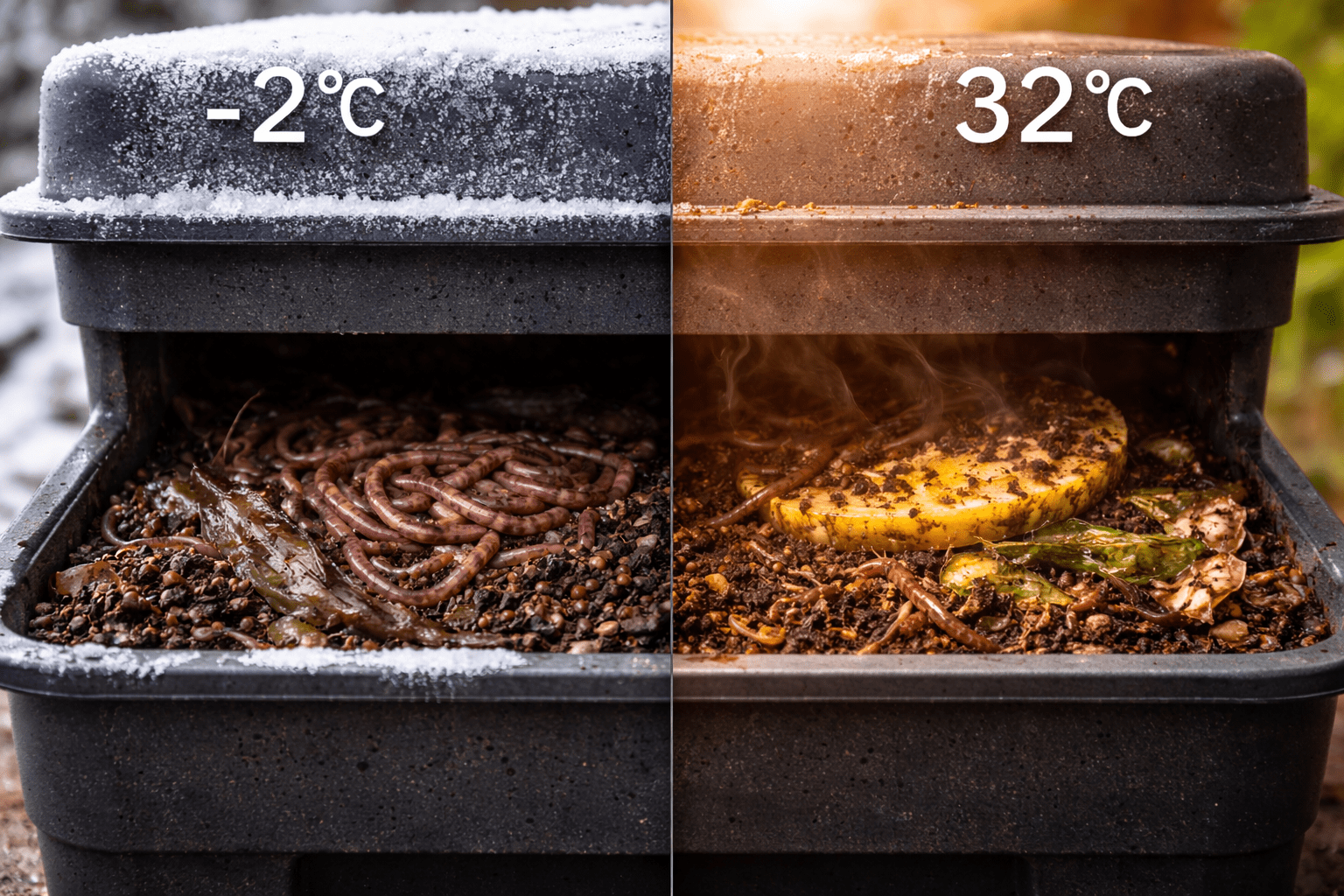
| Temperature Temperature is the factor people think they understand best, and manage worst. It feels straightforward: worms like it mild, not too hot, not too cold. Advice online reduces it to numbers — ranges, thresholds, danger zones — as though a worm farm behaves like a thermostat-controlled room. In practice, temperature is less a setting and more a background condition that quietly and persistently shapes everything else. Worms do not experience temperature as a number. They experience it as pace. Warmth accelerates processes; cold slows them. Feeding, reproduction, movement, and microbial activity—all stretch or compress depending on how heat moves through the bin. This is why temperature problems often show up indirectly. A bin does not announce that it is too cold. It simply becomes inert. It does not shout when it is too warm. It collapses quickly and unevenly. Cold is usually misunderstood as a threat rather than a pause. When temperatures drop, worms retreat, cluster, and reduce activity. Feeding slows dramatically, sometimes to the point where food appears untouched for weeks. This is often interpreted as a failure or starvation, prompting people to intervene when no intervention is required. Worms are not confused by cold. They are conserving energy. The system is still alive; it is simply operating on a different clock. Problems arise when cold is combined with expectation. For example, feeding at summer rates during winter is one of the easiest ways to destabilise a bin. As a result, material accumulates faster than it can be processed, moisture builds, and anaerobic pockets form. The issue, then, is not the temperature itself, but the refusal to adjust behaviour in step with it. Ultimately, worm farms do not operate independently of season, no matter how sheltered they are. Heat, by contrast, creates urgency. Worms have far less tolerance for excess warmth than for cold. High temperatures accelerate microbial activity first. This often happens before the worms themselves can respond. Food heats. Moisture shifts. Oxygen depletes. Worms try to escape by migrating, clustering at the edges, or retreating into narrow zones. Those spots offer marginally better conditions. When that fails, losses happen quickly. Heat rarely offers long warnings. This is where many systems fail abruptly. A bin placed in full sun, a hot spell combined with heavy feeding, a sealed container with poor airflow — all can push temperatures beyond what worms can manage. Unlike cold, which slows processes, heat speeds them up. The bin becomes volatile. Intervention at this stage often comes too late, not because the keeper was careless, but because the system crossed a threshold rapidly and without obvious cues. People often respond to these risks by trying to artificially stabilise the temperature. Insulation, relocation, shade, and ventilation — all sensible responses when used with restraint. However, the mistake lies in treating temperature management obsessively. Worm farms are resilient when allowed to develop gradients. Within a single bin, there are usually cooler and warmer zones, as well as wetter and drier layers. Worms navigate these differences constantly. Yet flattening them in the name of control can remove the very flexibility that allows the system to cope. One of the quieter lessons of temperature management is to think spatially rather than numerically. Instead of just asking if the bin is too hot or too cold, it helps to ask where heat is building up and where it is escaping. Is the bin in contact with the ground? Can air move across its surface? Does bedding let heat escape slowly rather than trap it? These questions focus less on control and more on flow. Seasonal extremes reveal the limits of intervention. Sometimes, protecting a worm farm takes more effort than it’s worth, especially in small systems. Bringing bins indoors, heavy wrapping, or constant adjustments can keep worms alive, but then the practice becomes maintenance rather than coexistence. For some, that trade-off is worth it. For others, it’s a signal to let the system slow down or rest. Rest is rarely discussed in worm farming, perhaps because it goes against the idea of continuous productivity. But many long-running systems go dormant at times. Feeding reduces. Activity dips. Castings appear slowly or not at all. This is not wasted time. It is recovery. Worm populations stabilise, and microbial communities rebalance. When conditions improve, the system resumes without needing a full restart. There is also a tendency to blame temperature for problems that are actually caused by interactions among factors. Heat combined with overfeeding, or cold combined with excess moisture, and sudden temperature shifts after disturbances all create compounded stresses. These matter more than temperature alone. Worm farms rarely fail because one variable shifts slightly. They fail because several shifts are done at once, often due to human impatience. Experienced keepers treat temperature less as something to manage and more as something to accommodate. They adjust feeding before adding insulation. They watch worm behaviour before offering protection. They accept seasonal change, rather than trying to cancel it out. Over time, this creates systems that feel calmer and more predictable. It’s not because conditions are fixed, but because responses are in proportion. Temperature teaches a deeper lesson of worm farming: stability isn’t always about control. Sometimes, it’s about letting systems respond on their own. Worms live longer than we give them credit for. They evolved to endure fluctuating conditions in decomposing environments far harsher than a plastic bin. Their struggle isn’t with change itself, but with sudden, layered pressure. With that understanding, temperature stops feeling like a threat. It becomes context—a background rhythm shaping behaviour but not defining it. Worm farming becomes less about keeping conditions perfectly steady and more about moving with change. It’s about adapting, not resisting. In that sense, temperature does not require mastery. It asks for awareness, adjustment, and the willingness to let systems slow down when that is needed. |
| About our writing & imagery Many of our articles are written by us, drawing on real experience, reflection, and practical work in gardens and places we know. Some pieces are developed with the assistance of AI, used as drafting and research tools rather than as a voice or authority. Featured images may include our own photography, original AI-generated imagery, or—where noted—images kindly shared by other creators and credited accordingly (for example, via Pixabay). All content is shaped, edited, and published by Earthly Comforts, and the views expressed are our own. |

